Polychaeta Facts For Kids
Polychaeta is a class of marine annelid worms, known as bristle worms, that have diverse species and play essential roles in ocean ecosystems.
Select reading age

Polychaeta Facts For Kids
Videos & Quizzesincluded
About this topic
Polychaeta, also known as bristle worms, are fascinating creatures found mainly in oceans! 🌊There are over 10,000 different kinds of polychaetes! They are a type of annelid worm, which means they have a long, segmented body. These worms can be tiny or grow as long as a meter (that's over 3 feet!)! Their name comes from "poly," meaning many, and "chaeta," meaning bristles. 🐍Many polychaetes live in mud or sand at the ocean bottom, while others swim freely in the water. They are important to the ocean ecosystem and help break down organic materials! 🌍
Explore with ChatDinoKey Points
Polychaetes have varied diets depending on their type!
Polychaetes are crucial to ocean ecosystems!
The bodies of polychaetes have unique features!
Polychaeta is a part of the annelid family, which includes other worms like earthworms!
Polychaetes have different ways to reproduce!
Polychaetes can be found in many marine environments!
Polychaetes have a long evolutionary history!
Polychaetes have some similarities and differences when compared to other annelids!
Scientists are excited to study polychaetes!
Photos of Polychaeta

Polychaeta — photo 1

Polychaeta — photo 2

Polychaete cross section

Polychaeta — photo 4

Polychaeta — photo 5
Polychaeta — photo 6

Polychaeta — photo 7
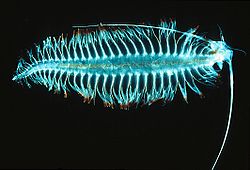
Planctonic polychaete worm from genus Tomopteris .
🦐 Feeding And Diet
Polychaetes have varied diets depending on their type! 🦐Errant polychaetes are usually hunters and eat small crustaceans, fish eggs, and even other worms! Sedentary ones are often filter feeders, using their tentacle-like structures to catch tiny food particles floating in the water. Some polychaetes even feast on decaying plants and animals, helping to recycle nutrients in their environment! 🌱This makes them essential for keeping the ocean clean and healthy! 📦No matter their feeding style, polychaetes play a big role in ocean food webs! 🌌
Go deeper🌍 Ecological Importance
Polychaetes are crucial to ocean ecosystems! 🌍They help break down organic materials and recycle nutrients, which supports many marine creatures. By burrowing into the ocean floor, they help aerate the sediment, allowing oxygen to reach other organisms living below the sand. 🌬️ Additionally, they serve as food for many animals, like fish, sea birds, and even larger mammals. Polychaetes are like the ocean's clean-up crew, making sure everything from dead plants to tiny organisms is recycled! 🔄
Go deeper💪 Anatomy And Morphology
The bodies of polychaetes have unique features! Each segment of their body has special bristle-like structures called chaetae. These bristles help the worms move and hold on to surfaces. 💪The head of a polychaete usually has tentacle-like structures called parapodia that help them swim and dig in the sand! Some polychaetes have vibrant colors, making them look like underwater rainbows! 🌈They can have various sizes and shapes, adapting to different habitats. This diversity makes them very interesting to scientists studying marine life! 🔍
Go deeper🐛 Taxonomy Of Polychaeta
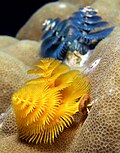
Polychaeta is a part of the annelid family, which includes other worms like earthworms! 🐛They belong to the phylum Annelida, and within this group, there are three main classes: Oligochaeta (like earthworms), Hirudinea (leeches), and Polychaeta. To break it down, Polychaeta can be divided into two big groups: errant (or wandering) polychaetes and sedentary (or sitting) polychaetes. Errant ones tend to be active hunters, while sedentary ones stay in one place and filter food! Some popular polychaetes include the bristle worm and the fan worm! 🐚
Go deeper🌱 Reproductive Strategies
Polychaetes have different ways to reproduce! Some can reproduce through a method called sexual reproduction, where they have special organs to create eggs and sperm. 🌱Others can reproduce asexually by splitting into two or more pieces! Some polychaetes can create specialized segments called epitokes filled with eggs, which are released to float away and grow into new worms. 🌊Each species has its own special way of making babies, usually timed with the changing seasons or when conditions are just right! 🌼
Go deeper🐠 Habitat And Distribution
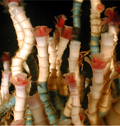
Polychaetes can be found in many marine environments! 🐠They live in oceans around the world, from shallow coastlines to the darkest ocean depths. Some prefer sandy or muddy bottoms in tidal zones, while others can be found in coral reefs. 🌊The deep sea is home to fantastic species like the giant tube worm! 🌌Polychaetes enjoy a wide range of habitats, and this helps them survive in different ocean conditions. The largest concentration of polychaetes is found in places with rich organic matter, which they use as food! 🌿
Go deeper⏳ Fossil Record And Evolution
Polychaetes have a long evolutionary history! They first appeared about 500 million years ago during the Cambrian period! ⏳Fossils of ancient polychaetes can be found in many parts of the world. These fossils show us how worms have changed and adapted to their environments over millions of years. Some ancient examples look very similar to modern polychaetes! 🦠This history helps scientists learn how marine life has evolved and how it will continue to change over time! 🌍The study of polychaete fossils can reveal exciting stories from the deep sea!
Go deeper🐍 Comparison With Other Annelids
Polychaetes have some similarities and differences when compared to other annelids! Like earthworms (Oligochaeta), they have segmented bodies, but polychaetes usually have more pronounced bristles. 🐍While earthworms live in soil and help plants grow, polychaetes thrive in marine habitats. 🌊Leeches (Hirudinea), another type of annelid, are different too; they are often parasites, sucking blood from host animals. 🩸So, while all three belong to the annelid family, polychaetes live in water, have bristles, and play different roles in nature! 🌿
Go deeper🧪 Research And Conservation Efforts
Scientists are excited to study polychaetes! 🧪Research focuses on their role in marine ecosystems, helping us understand how oceans function. Protecting the habitats where polychaetes live is essential because pollution and climate change can harm them! 🌡️ Many scientists work on conservation efforts, aiming to keep ocean environments healthy and thriving. By studying these amazing worms, researchers learn about ocean health, biodiversity, and how we can help protect our planet! 🌎So, when you hear about polychaetes, remember they're important for the sea and our Earth! 🌊
Go deeper