Platonic Solid Facts For Kids
Platonic solids are 3D shapes with identical faces, edges, and angles, consisting of exactly five types: tetrahedron, cube, octahedron, dodecahedron, and icosahedron.
Select reading age

Platonic Solid Facts For Kids
Videos & Quizzesincluded
About this topic
Platonic solids are special shapes in geometry! 🧊They are 3-dimensional figures made up of flat faces that are all the same. There are exactly five types of Platonic solids: the tetrahedron, cube, octahedron, dodecahedron, and icosahedron. Each one is unique and has its own number of faces, vertices (corners), and edges (sides). These solids are named after the ancient Greek philosopher Plato, who believed they were the building blocks of the universe! 🌌Let's dive deeper into these fascinating shapes and discover how they are part of our world!
Explore with ChatDinoKey Points
The concept of Platonic solids dates back to ancient Greece!
Platonic solids have fascinating mathematical properties!
There are five Platonic solids, and each has its own features: 1.
Did you know Platonic solids can be found in nature?
Symmetry is all about balance and harmony!
Visualizing Platonic solids can be super fun!
A Platonic solid is a type of polyhedron that has certain special properties.
Platonic solids often appear in games and toys, especially in dice!
artistas and architects often use Platonic solids in their work!
Platonic solids connect to other geometric shapes in many cool ways!
Photos of Platonic Solid

Platonic Solid — photo 1

Platonic Solid — photo 2

Platonic Solid — photo 3

Platonic Solid — photo 4

Platonic Solid — photo 5

Kepler's Platonic solid model of the Solar System from Mysterium Cosmographicum (1596)


📜 History And Discovery
The concept of Platonic solids dates back to ancient Greece! 📜The famous philosopher Plato (428-348 BCE) studied these shapes and believed they were connected to the elements of the world. He associated the tetrahedron with fire, the cube with earth, the octahedron with air, the dodecahedron with the universe, and the icosahedron with water. 🏺Mathematicians over the centuries, like Euclid, helped us learn more about these solids by recording their properties in a book called "The Elements"!
Go deeper📐 Mathematical Properties
Platonic solids have fascinating mathematical properties! 📐For example, you can find a special formula called Euler's Formula that relates the number of vertices (V), edges (E), and faces (F) of a solid: V - E + F = 2. For the cube, it shows that 8 - 12 + 6 = 2! 🎉Each solid also has equal angles between faces and symmetry. Symmetry means that if you fold or rotate the shape, it looks the same!
Go deeper🌟 Types Of Platonic Solids
There are five Platonic solids, and each has its own features:
1. Tetrahedron: 4 triangular faces, 4 vertices, 6 edges.
2. Cube: 6 square faces, 8 vertices, 12 edges.
3. Octahedron: 8 triangular faces, 6 vertices, 12 edges.
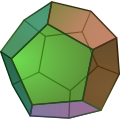
4. Dodecahedron: 12 pentagonal faces, 20 vertices, 30 edges.
5. Icosahedron: 20 triangular faces, 12 vertices, 30 edges.
These shapes are unique because there are no other shapes that fit the same rules! 🌟
Go deeper1. Tetrahedron: 4 triangular faces, 4 vertices, 6 edges.
2. Cube: 6 square faces, 8 vertices, 12 edges.
3. Octahedron: 8 triangular faces, 6 vertices, 12 edges.
4. Dodecahedron: 12 pentagonal faces, 20 vertices, 30 edges.
5. Icosahedron: 20 triangular faces, 12 vertices, 30 edges.
These shapes are unique because there are no other shapes that fit the same rules! 🌟
🌍 Platonic Solids In Nature
Did you know Platonic solids can be found in nature? 🌍For example, the shapes of certain crystals, like pyrite (also called fool's gold), are similar to dodecahedrons. Some viruses, like the common cold, have icosahedron shapes! 🌡️ Nature loves symmetry and geometry, which is why these special solids can be seen in everything from snowflakes to beehives. Isn't that amazing? 🐝
Go deeper✨ Symmetry And Group Theory
Symmetry is all about balance and harmony! ✨Platonic solids are highly symmetric, meaning they can be rotated or flipped and still look the same. Mathematicians study symmetry using something called group theory. 📊This helps them understand how the shapes behave and relate to each other. For example, the cube has 24 different ways to be oriented! This symmetry is not just pretty; it's also useful in math and science!
Go deeper🌈 Visualizing Platonic Solids
Visualizing Platonic solids can be super fun! 🌈You can draw them or even build them using paper or craft materials! 🖍️ Try making a cube with an empty box or a tetrahedron using straws. You can also find apps and online tools to rotate and explore these solids. When you see them in 3D, it helps you better understand their shapes and properties. Get creative and let your imagination soar while learning about these geometric wonders! 🚀
Go deeper📏 Definition Of Platonic Solids
A Platonic solid is a type of polyhedron that has certain special properties. 📏It is convex, which means it pushes outwards and doesn't cave in. Each face is a regular polygon, like a triangle or a square, and all faces are the same shape and size! For example, a cube has 6 square faces, while a tetrahedron has 4 triangular faces. This unique symmetry makes Platonic solids very interesting and important in geometry! 🧩
Go deeper🎲 Platonic Solids In Games And Toys
Platonic solids often appear in games and toys, especially in dice! 🎲Dungeons & Dragons and many board games use different types of dice based on Platonic solids. For instance, the d4 is a tetrahedron, the d6 is a cube, and the d20 is an icosahedron! 🛡️ These shapes add fun, excitement, and chance to games, making them an important part of playtime for kids and adults alike!
Go deeper🏛️ Applications In Art And Architecture
artistas and architects often use Platonic solids in their work! 🏛️ Artists like Leonardo da Vinci admired these shapes and used them to create beautiful paintings. In architecture, buildings often have designs based on Platonic solids for their beauty and strength. For example, the National Gallery of Art in Washington, D.C. features domes inspired by these shapes. 🎨Using Platonic solids enhances creativity and makes structures more appealing!
Go deeper🔗 Connections To Other Geometric Shapes
Platonic solids connect to other geometric shapes in many cool ways! 🔗For example, they belong to a family called convex polyhedra, which are solid shapes without indentations. They are also related to two-dimensional shapes, or polygons, such as triangles, squares, and pentagons. 🌐Learning about Platonic solids can lead to discovering other shapes like prisms and pyramids. Exploring these connections helps us understand the world of geometry better! ✨
Go deeper