Planck Constant Facts For Kids
The Planck constant, denoted by h, is a fundamental number in quantum physics that links the energy of particles to their frequency.
Select reading age

Planck Constant Facts For Kids
Videos & Quizzesincluded
About this topic
The Planck constant (h) is a tiny number used in physics to understand how small particles like atoms and photons behave! 📏It helps us measure energy and frequency in the world of quantum mechanics. This is the study of the smallest things in our universe. The Planck constant is super small: about 0.000000000000000000000006626! By using this special number, scientists can discover amazing things about light and matter. 🌌
Explore with ChatDinoKey Points
The Planck constant was discovered by a German physicist named Max Planck in 1900.
Some kids might think the Planck constant is big because it's used in important studies!
Scientists measure the Planck constant using special devices like laser interferometers and atomic clocks.
The Planck constant is used in many areas of physics!
The Planck constant is a really important number that helps us understand nature at a very tiny level.
In quantum mechanics, the Planck constant is a superstar!
Scientists continue to study the Planck constant to unlock more secrets of the universe.
The Planck constant is super important in modern tech!
There’s a special relationship between the Planck constant, energy, and frequency!
The Planck constant is part of a group of major numbers in physics called fundamental constants.
Photos of Planck Constant

Intensity of light emitted from a black body. Each curve represents behavior at different body temperatures. The Planck constant h is used to explain the shape of these curves.

The observed Planck curves at different temperatures, and the divergence of the theoretical Rayleigh–Jeans (black) curve from the observed Planck curve at 5000 K.
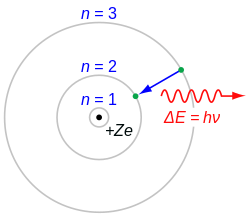 Image by JabberWok at English Wikipedia, licensed under Creative Commons Attribution-Share Alike 3.0
A schematization of the Bohr model of the hydrogen atom. The transition shown from the n = 3 level to the n = 2 level gives rise to visible light of wavelength 656 nm (red), as the model predicts.
🔬 Historical Context
The Planck constant was discovered by a German physicist named Max Planck in 1900. 🇩🇪 Max was trying to understand how hot objects emit light. He ended up creating a revolutionary idea! He realized that energy comes in tiny packets called "quanta." This groundbreaking work laid the foundation for quantum theory, changing how we understand the universe! 🔬
Go deeper📏 Common Misconceptions
Some kids might think the Planck constant is big because it's used in important studies! But it’s actually a very tiny number. 📏Also, people sometimes confuse it with energy itself. Remember, the Planck constant helps us calculate energy but isn’t energy by itself! Understanding this constant gives us a peek into the magical world of particles! 🌟
Go deeper🕰️ Measurement Techniques
Scientists measure the Planck constant using special devices like laser interferometers and atomic clocks. 🕰️ These tools help to check how precisely we can determine this tiny number. For example, they measure the speed of light and the energy of photons! Making sure it’s accurate helps scientists develop new technology and understand our universe better. 🔍
Go deeper👩🔬 Applications In Physics
The Planck constant is used in many areas of physics! It helps with understanding the behavior of electrons, photons, and atoms. 👩🔬 It also plays an essential role in developing new inventions, like lasers and transistors, which are used in things like computers and cell phones! 📱Without it, many of our favorite technologies wouldn’t work!
Go deeper🎈 Definition Of Planck Constant
The Planck constant is a really important number that helps us understand nature at a very tiny level. 🎈It tells us how energy is linked to frequency (how fast something wiggles) and momentum (how much motion it has). This relationship is super special because it connects two important ideas in physics—energy and particles!
Go deeper🌟 Significance In Quantum Mechanics
In quantum mechanics, the Planck constant is a superstar! 🌟It helps explain how light and matter act differently from big objects we see every day. This constant is used in equations that tell us how tiny particles interact and behave. If scientists didn’t have this number, they wouldn't be able to make sense of the strange world of atoms and photons!
Go deeper🛸 Future Research On Planck Constant
Scientists continue to study the Planck constant to unlock more secrets of the universe. 🛸Researchers are working on improving measurements and finding new applications for it in technologies like quantum sensors. This might lead to even greater discoveries and inventions we can't even imagine yet! Who knows what the future holds! 🔭
Go deeper📸 Planck Constant In Modern Technology
The Planck constant is super important in modern tech! For example, it helps in building solar panels, touchscreen devices, and advanced cameras. 📸It ensures gadgets work efficiently by improving measurements in quantum computing. Quantum computers use the strange behaviors of tiny particles, making them potentially much faster than regular computers! 🔍
Go deeper✨ Relationship To Energy And Frequency
There’s a special relationship between the Planck constant, energy, and frequency! ✨A photon’s energy (the energy of light) is calculated by multiplying its frequency by the Planck constant: E = h * f. If you know how quickly it wiggles (frequency), you can find out how much energy it has—pretty cool, right? 🔆
Go deeper🌈 Comparison With Other Fundamental Constants
The Planck constant is part of a group of major numbers in physics called fundamental constants. 🌈Others include the speed of light (c) and the gravitational constant (G). Just like how cookies need flour and sugar, these constants help scientists bake up formulas that explain how the universe works! 🌌
Go deeper