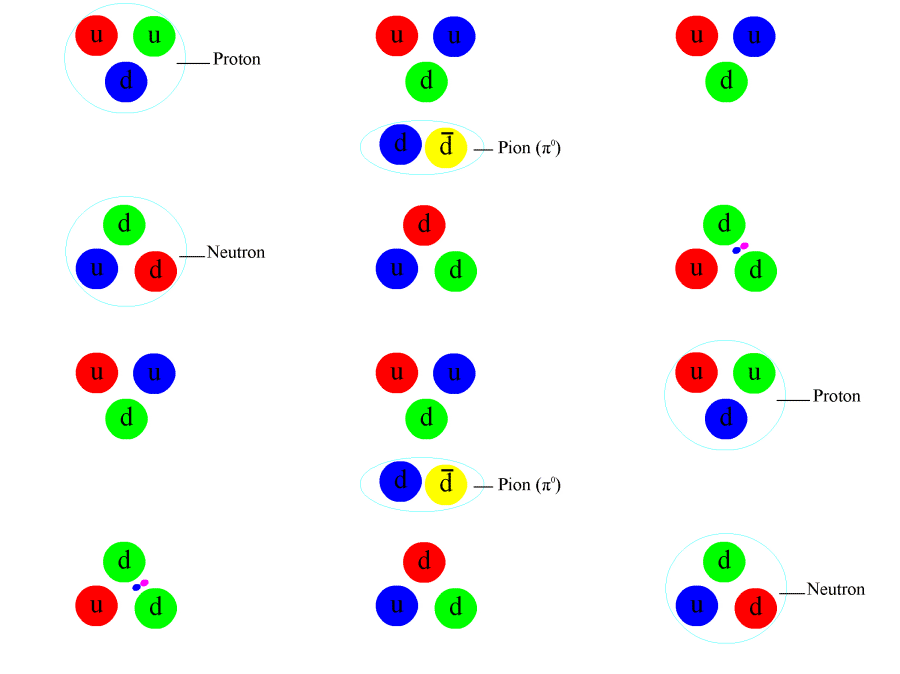
Pions, or pi mesons (π), are subatomic particles made of a quark and an antiquark, coming in three varieties: π0 (neutral), π+ (positive), and π− (negative), essential for the strong nuclear force in atoms.
Set reading age
View for Kids
Easy to read and understand
View for Students
Clear, detailed explanations
View for Scholars
Deep dives and big ideas
Pions are tiny particles that are part of the universe's building blocks! 🛠️ They are known as mesons and come in three types: π0 (neutral), π+ (positive), and π− (negative). Pions are super important because they help to hold together protons and neutrons in atoms. Protons and neutrons are found in the center of atoms called nuclei. Pions are always flying around in a special area called the strong force field, which is a force that holds everything together. They are so small that you can’t see them, but scientists study them using powerful machines! 🌌
Pions come in three exciting types: π0, π+, and π−! 🥳The π0 is neutral, meaning it doesn’t have a charge. The π+ has a positive charge, and the π− has a negative charge. These particles are like a fun family, each with its own special characteristics! Pions can change into other particles through various processes. The different charges of π+ and π− allow them to interact with other particles in unique ways, making them essential for understanding how everything fits together in the exciting world of particle physics! 💥
Pions are very unstable and can change into other particles quickly! ⏳The π0, for instance, decays into two tiny particles called photons. Photons are light particles and are responsible for light itself! The π+ and π− can turn into muons, which are heavier cousins of electrons, and neutrinos, which are mysterious particles that hardly interact with matter! This is called the decay process. The time it takes for pions to decay can be super short—usually just a fraction of a second! Studying these decay processes helps scientists understand the rules of nature! 🌈
A pion, or pi meson, is a special particle in the world of physics. ⚛️ It’s part of the group called mesons, which are made of quarks. Quarks are even smaller particles that gather together to create bigger ones like protons, neutrons, and pions! Pions were first discovered in 1947 by a scientist named Cecil Powell. They can travel very fast and have a really short life – some last only a tiny fraction of a second! The study of pions helps scientists learn how forces work in the universe and can let us peek into the mysterious world of tiny particles. 🌟
Detecting pions is no easy task! Scientists use special machines called particle detectors to find them. 🌠When pions travel through detectors, they can cause other particles to appear, like light flashes in a camera. Some common detectors are bubble chambers and wire chambers! These detectors can capture the trails that pions leave behind, making it possible to study their behavior and properties. Analyzing these trails helps scientists figure out what happens during high-energy collisions and how pions interact with other particles! 🧪
Pions are made from quarks, which are super tiny particles! 🦠A π+ consists of an up quark and a down antiquark, while the π− has a down quark and an up antiquark. The neutral π0 is a little tricky because it's made of up and down quarks as well, but they are mixed up in a special way. Quarks are held together inside pions by a strong force called the strong interaction, which is like a powerful glue! The tiny sizes and the structures of pions are crucial because they help scientists understand how particles in atoms behave.
Pions are created in very high-energy environments! 🌌One common place to find them is in particle accelerators, which are big machines that smash particles together at super high speeds! When colliding particles collide, they can create pions from the energy released. Pions can also come from cosmic rays that enter the Earth's atmosphere. These cosmic rays originate from the sun and other stars. They collide with atoms in the atmosphere, creating pions as a result. Pions are all around us, even if we can’t see them! 🪐
Pions have an exciting history in the world of physics! ✨They were discovered after World War II during a time of exploration and new discoveries. Scientist Cecil Powell found them by using photographic plates to study cosmic rays. His work won him the Nobel Prize in Physics in 1950! 🎖️ The understanding of pions led to the development of quantum chromodynamics, a theory that explains how quarks interact. Research on pions opened many doors to exploring how particles work, resulting in new technologies and insights that continue to illuminate the amazing universe! 🌌
The study of pions isn’t over yet! 🚀Scientists are still excited to learn more about these fascinating particles. Future research may explore how pions behave in extreme environments, such as neutron stars, which are super dense star remnants. Researchers also aim to study how pions interact with other particles in new ways that might unlock secrets of the universe. By experimenting with new technology, scientists hope to uncover even more mysteries! Future discoveries could lead to breakthroughs in our understanding of forces and particles—who knows what we might find! 🌍✨
Pions play a key role in the strong interaction, which is one of the four fundamental forces in our universe! ⚡The strong interaction is what holds protons and neutrons together in atomic nuclei. Pions act as messengers for this force, similar to how birds might carry messages between trees. When protons and neutrons push against each other, they exchange pions, which helps keep them tightly together. Thanks to pions, everything we see around us, like trees 🌳, stars 🌟, and even us, is held together securely by this strong force. Pions are like tiny superheroes of the particle world!
Pions are very useful in the field of particle physics! 🧬Scientists study pions to learn more about fundamental forces and particles in nature. They are also used in medical imaging, like PET scans, where positrons (from π+) are important! Understanding pions helps researchers create better technologies and become more knowledgeable about the universe. They can also play a part in experiments that explore the mysteries of dark matter and energy. By researching pions, scientists continue to expand our understanding of the universe we live in! 🛸


DIY is a creative community where kids draw, build, explore ideas, and share.
No credit card required