Pentagonal Prism Facts For Kids
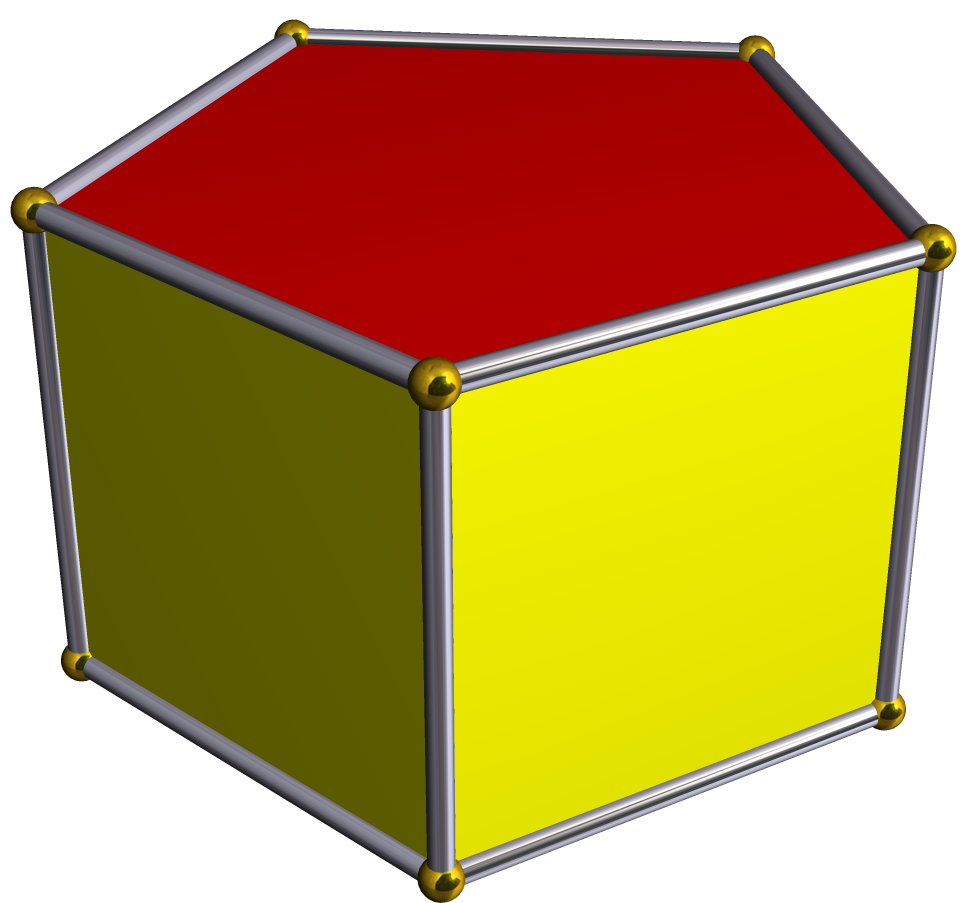
A pentagonal prism is a three-dimensional shape with two pentagonal bases connected by five rectangular lateral faces.
Select reading age
Pentagonal Prism Facts For Kids
Videos & Quizzesincluded
About this topic
A pentagonal prism is a special shape that has two flat faces called bases, and they are shaped like a pentagon! 🤩The prism has five rectangular sides that connect the two bases and make it stand up tall. Imagine stacking candy boxes where the base is a pentagon, and the sides are made of rectangles. You can find pentagonal prisms in real life too, like in some buildings or fun toys! 🌟They are interesting because of their unique shape and stability. Let's explore more about these cool shapes together! 🎉
Explore with ChatDinoKey Points
A pentagonal prism is a three-dimensional shape, which means it has height, width, and depth!
Pentagonal prisms have some exciting properties!
Pentagonal prisms are used in many ways!
The study of shapes like the pentagonal prism has been around for thousands of years!
Math is fun when it comes to shapes!
To find the surface area of a pentagonal prism, we need to calculate the area of the two pentagonal bases and the five rectangular sides.
Nature is full of amazing shapes, including pentagonal prisms!
Pentagonal prisms are just one type of prism!
Photos of Pentagonal Prism

Pentagonal Prism — photo 1

3D model of a (uniform) pentagonal prism

Pentagonal Prism — photo 3

Pentagonal Prism — photo 4

Pentagonal Prism — photo 5

The pentagonal stephanoid has pentagonal dihedral symmetry and has the same vertices as the uniform pentagonal prism.
📏 Definition
A pentagonal prism is a three-dimensional shape, which means it has height, width, and depth! 📏A pentagon is a five-sided polygon, and when you connect two of these pentagons with rectangles, you create a prism. So, the shape has two flat pentagonal bases and five vertical rectangular sides. Each side looks like a tall and thin box! 🗃️ The word "prism" means that light can shine through it, just like a crystal can show beautiful colors in the sunlight! 🌈
Go deeper🛑 Properties
Pentagonal prisms have some exciting properties! They have 7 faces in total: 2 pentagonal bases and 5 rectangular sides. 🛑When you count the edges, there are 15 of them! Edges are where two faces meet. The corners are called vertices, and there are 10 of them in a pentagonal prism. 🤯Isn't that cool? Pentagonal prisms can also be symmetrical, meaning they are the same on both sides if you cut them in half. This amazing shape can also stack nicely, making it very stable! 🏗️
Go deeper🎈 Applications
Pentagonal prisms are used in many ways! 🎈They can be seen in architecture (building design), like some of the rooftops of buildings or towers. 🏢Artists may use them when creating sculptures or installations, making lovely geometric designs. They also appear in children's toys, such as building blocks. 🎲Learning about pentagonal prisms can improve your creative skills when designing new things! And did you know that some containers for snacks and treats can have this shape too? 🍪
Go deeper📜 Historical Aspects
The study of shapes like the pentagonal prism has been around for thousands of years! 📜Ancient Greeks, like mathematician Euclid, explored geometry and described many shapes, including prisms. The use of geometric shapes became important in art, science, and architecture. Over time, mathematicians like Archimedes studied these shapes for their properties and uses. Today, we continue to learn from their discoveries, connecting our lives with history and math! 🌟So, every time you see a prism, remember that it has a story going back in time! ⏳
Go deeper🧮 Mathematical Formulas
Math is fun when it comes to shapes! Here are some important formulas for pentagonal prisms you should know:
1. Surface Area:
\( \text{Surface Area} = 2 \times \text{Area of the base} + \text{Perimeter of the base} \times \text{Height} \)
2. Volume:
\( \text{Volume} = \text{Area of the base} \times \text{Height} \)
These formulas help us figure out how much space our prism takes up and how much area it covers. 🧮Remember, knowing how to use these equations can make you a math whiz! 🏆
Go deeper1. Surface Area:
\( \text{Surface Area} = 2 \times \text{Area of the base} + \text{Perimeter of the base} \times \text{Height} \)
2. Volume:
\( \text{Volume} = \text{Area of the base} \times \text{Height} \)
These formulas help us figure out how much space our prism takes up and how much area it covers. 🧮Remember, knowing how to use these equations can make you a math whiz! 🏆
🖊️ Surface Area And Volume
To find the surface area of a pentagonal prism, we need to calculate the area of the two pentagonal bases and the five rectangular sides. 🖊️ The formula for the surface area is:
Surface Area = 2 × Area of the base + Perimeter of the base × Height.
To calculate the volume, we multiply the area of one base by the height:
Volume = Area of the base × Height. 📐This fun math can help us design things like towers and storage boxes! It teaches us how much space our prism takes up.
Go deeperSurface Area = 2 × Area of the base + Perimeter of the base × Height.
To calculate the volume, we multiply the area of one base by the height:
Volume = Area of the base × Height. 📐This fun math can help us design things like towers and storage boxes! It teaches us how much space our prism takes up.
🌿 Pentagonal Prism In Nature
Nature is full of amazing shapes, including pentagonal prisms! 🌿For example, some crystals, like quartz, can form shapes similar to a pentagonal prism. ✨Bees also create honeycombs, which can have pentagonal shapes, enabling them to store honey efficiently! 🐝The natural world has a beautiful way of using shapes. Nature teaches us that these shapes can be found in plants, animals, and even rocks, showing that geometry isn't just in math books, but around us every day! 🌎
Go deeper🤔 Comparison With Other Prisms
Pentagonal prisms are just one type of prism! 🤔There are also triangular prisms (with triangular bases), rectangular prisms (with rectangular bases), and hexagonal prisms (with hexagonal bases). Each of these shapes has its own unique properties. For example, triangular prisms are great for making roofs, while rectangular prisms help us understand boxes! 📦Pentagonal prisms are more stable compared to triangular ones but less common than rectangular ones. So, exploring these shapes helps us understand the world around us better! 🔍
Go deeper