Optical Dispersion Facts For Kids
Optical dispersion is the phenomenon where light waves separate into different colors when passing through a material, due to the varying speeds of different wavelengths.
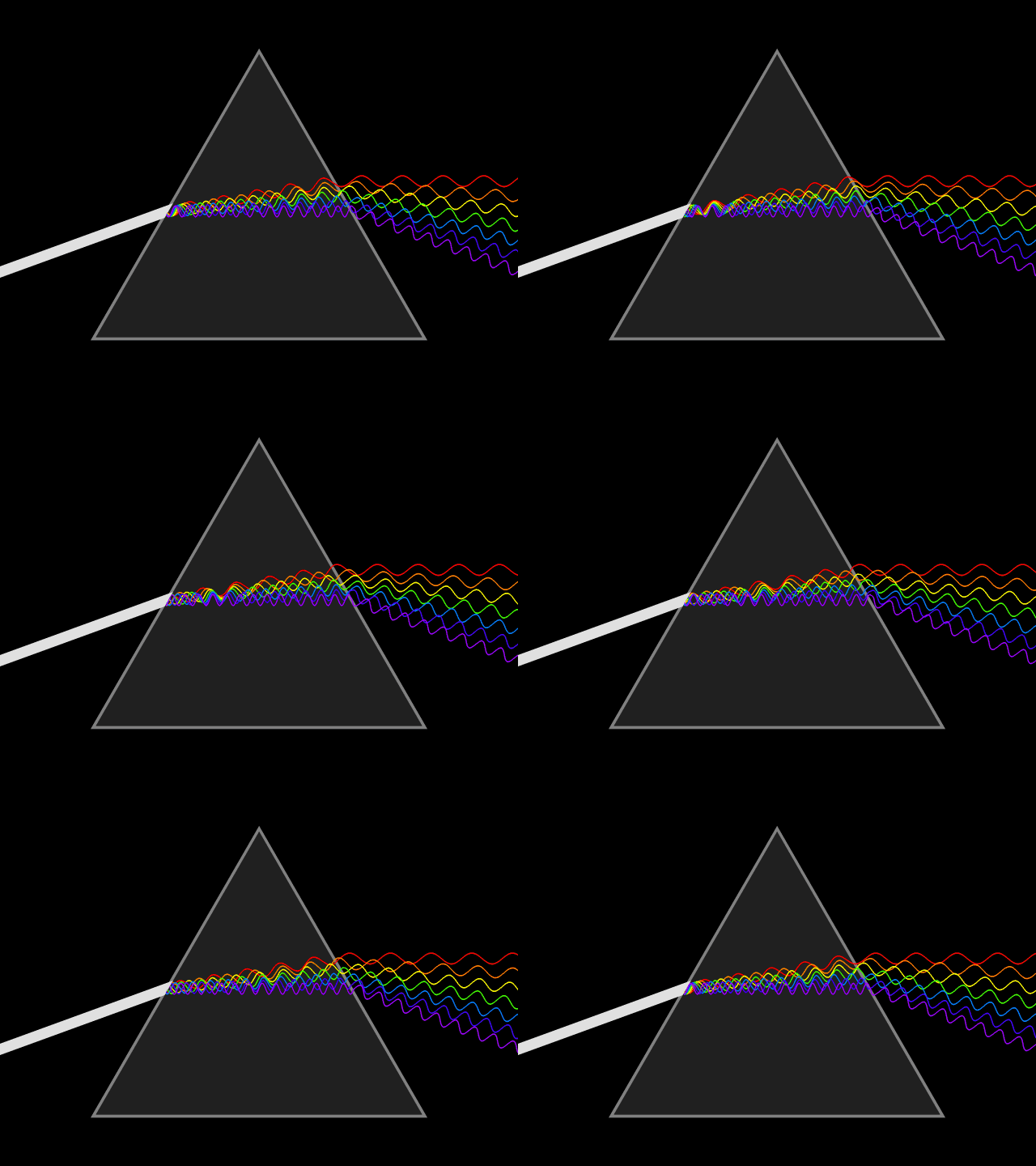
About this topic
Did you know that when light goes through water or glass, it bends? This bending helps create dazzling visuals, like the rainbow after rain! Optical dispersion is an important topic in science and art alike! 🎨✨
Key Points
Photos of Optical Dispersion

A compact fluorescent lamp seen through an Amici prism

The variation of refractive index vs. vacuum wavelength for various glasses. The wavelengths of visible light are shaded in grey.
![Influences of selected glass component additions on the mean dispersion of a specific base glass (nF valid for λ = 486 nm (blue), nC valid for λ = 656 nm (red))[3]](https://upload.wikimedia.org/wikipedia/en/thumb/3/38/Spidergraph_Dispersion.GIF/960px-Spidergraph_Dispersion.GIF)
Influences of selected glass component additions on the mean dispersion of a specific base glass (nF valid for λ = 486 nm (blue), nC valid for λ = 656 nm (red))[3]

Time evolution of a short pulse in a hypothetical dispersive medium (k = ω2) showing that the longer-wavelength components travel faster than the shorter-wavelength components (positive GVD), resulting in chirping and pulse broadening
🌈 Types Of Dispersion
Anomalous dispersion is the opposite! In this case, high-frequency light travels faster than low-frequency light. This unusual behavior can happen in special materials and is important in advanced science projects. 🎓✨
Understanding these kinds of dispersion helps scientists work with lasers and high-tech devices, making our world more colorful and exciting! 🎉🔬
🌟 Historical Experiments
Many other scientists studied dispersion, too! They created different tools to observe light, expanding our knowledge over centuries. Today, we continue building on their discoveries to explore color and light further! 🎓✨
📏 Measurement Techniques
Another method involves using lasers. A laser beam can be directed through different materials, and scientists can observe how the light bends and spreads. ✨By understanding how light disperses, researchers can create better technology and learn more about light itself! 🔬📊
🌊 Theoretical Background
When light enters a new material, like glass, different colors get bent by varying amounts! This bending is caused by how each color interacts with the material. Scientists like Isaac Newton studied this back in 1666 with his famous prism experiment! 🌠Newton helped us understand light and how its colors get separated.
🔍 Current Research Trends
Researchers are also exploring how dispersion affects quantum devices! Quantum technology uses the strange properties of light to create powerful computers and faster communication systems. The future is bright with possibilities thanks to optical dispersion! 🌟💡
🌈 Definition Of Optical Dispersion
It’s similar to how a racecar and a bicycle travel on the same road. They move at different speeds. Just like that, colors in light move at different speeds, creating dispersion! Light enables our vision and helps us celebrate the beauty of colors! 👁️🎈
🌟 Applications Of Optical Dispersion
Another important use of optical dispersion is in fiber-optic cables. These help carry information at lightning speed for phones, computers, and the internet. 🌐It’s amazing how light helps us communicate! Scientists and engineers study dispersion to improve technology for everyone! 🤓📞
💬 Impact On Communication Technologies
Without optical dispersion, our computers and smartphones would not be as quick or efficient! 🚀This technology helps people connect instantly, making the world feel smaller. Scientists keep researching to improve these technologies, ensuring we stay connected, even over long distances! 🌍💻
⚡ Phase Velocity And Frequency Relation
For example, blue light can move faster than red light in glass. The frequency, or how often the light wave peaks occur, affects its speed. Imagine jumping on a trampoline! If you bounce quickly, you reach the top faster, just like high-frequency light moves quicker! 🏃♂️📈
Studying phase velocity helps scientists design better glasses, camera lenses, and even fiber-optic cables for fast internet! 🌐💻
📚 Educational Resources And Further Reading
Books like “Optical Physics for Kids” and “The Magic of Rainbows” are also great reads! 📖Don’t forget to experiment with light at home! Try using a glass prism or a CD to create rainbows! 🌈Exploring the world of light is exciting and can spark your imagination! Keep learning, young scientists! 👩🔬✨