Nix Facts For Kids
Nix is a small, icy moon orbiting Pluto, discovered in 2005, with a diameter of about 49 kilometers.
Select reading age
Nix Facts For Kids
Videos & Quizzesincluded
About this topic
Nix is a fascinating moon that travels around the dwarf planet Pluto! 🌌Discovered in 2006, Nix is a part of Pluto's family of moons. It measures about 49 kilometers (30 miles) across, which is like three times the height of the Statue of Liberty! 🗽Nix is named after the ancient Greek goddess of night. It was found during the Hubble Space Telescope's work to capture pictures of Pluto and its moons. Nix is a unique place and helps scientists learn more about Pluto and our solar system. 🌠
Explore with ChatDinoKey Points
Nix was discovered by a team of astronomers led by Dr.
Nix orbits around Pluto at a distance of about 48,700 kilometers (30,300 miles).
Nix, named after the Greek goddess of night, connects to ancient stories and myths!
The surface of Nix is covered with icy materials!
Nix is part of Pluto's moon system, which includes Charon and three other smaller moons: Kerberos, Hydra, and Styx!
Nix was explored closely by NASA's New Horizons spacecraft in July 2015!
Nix is a small but interesting moon!
Scientists are excited to study Nix in the future!
Nix is one of the smallest moons in our solar system, especially compared to its big sibling, Charon!
Photos of Nix

Discovery images of Nix and Hydra

Hubble image of Pluto's moons (annotated)

Six images of Nix taken by the New Horizons in July 2015 (contrast enhanced)


Nix — photo 6

Nix — photo 7

Nix — photo 8
🌟 Discovery Of Nix
Nix was discovered by a team of astronomers led by Dr. Marc Buie in 2006! 🌟They used the powerful Hubble Space Telescope to spot Nix, making it an exciting moment in space exploration. Hubble is like a really fancy camera in the sky that helps us look at distant objects and learn about them! 🛰️ When Nix was found, scientists already knew about another moon of Pluto called Charon, but Nix and Charon are like siblings, and now there are five known moons! This discovery taught us that even small moons can be important in understanding the universe.
Go deeper🌍 Orbit And Rotation
Nix orbits around Pluto at a distance of about 48,700 kilometers (30,300 miles). 🌍It’s pretty far away compared to Pluto’s size! Nix takes about 24.9 days to complete one orbit around Pluto, which means it travels around the planet slowly. The same side of Nix always faces Pluto, just like how the Moon shows only one side to Earth. 🌙This is called synchronous rotation, and it helps researchers study how moons and planets interact. Nix and Pluto create a unique dance in space as they move together—so cool, right? 💃
Go deeper🌙 Cultural References
Nix, named after the Greek goddess of night, connects to ancient stories and myths! 🌙In mythology, Nix is often portrayed as a powerful and mysterious figure. Many stories are told about gods and goddesses, and Nix is no exception! These cultural stories help people understand how ancient civilizations viewed the sky. When we learn about moons like Nix, we can connect science and stories from the past. 🌌Writers, artists, and dreamers often use characters from mythology to inspire their works, making Nix a part of storytelling too!
Go deeper❄️ Surface Composition
The surface of Nix is covered with icy materials! ❄️ Scientists believe that it might have frozen nitrogen, carbon monoxide, and methane. 🧊These chemicals can make the surface shiny and bright, which is why Nix reflects a lot of sunlight. Just like a snowy day, Nix can look really bright from far away! ☀️ It’s also thought that the surface is covered with craters, like tiny dents made by space rocks hitting it. Nix is like a time capsule, holding clues about how moons and planets develop in space history! 📜
Go deeper🌠 Nix And Pluto's System
Nix is part of Pluto's moon system, which includes Charon and three other smaller moons: Kerberos, Hydra, and Styx! 🌠Nix has a unique relationship with Pluto, where it orbits closely. All these moons help create a complex system around Pluto. When New Horizons flew by, it shared secrets about how these moons interact, which teaches scientists about the history and evolution of the Pluto system. 🌌Just like a family, these moons get to spend time together in space and learn from each other!
Go deeper🚀 Exploration And Research
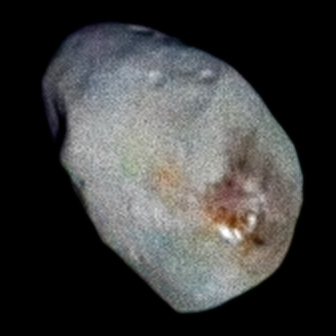
Nix was explored closely by NASA's New Horizons spacecraft in July 2015! 🚀New Horizons flew by Pluto and its moons, taking incredible photographs and collecting valuable data. This mission helped scientists understand Nix's shape, size, and surface features better. 🌈The information it sent back was a big surprise! It revealed the icy surface of Nix and its connection to Pluto. New Horizons is a bit like a space detective, helping scientists solve the mysteries of distant worlds in our solar system! 🕵️♂️
Go deeper🌓 Physical Characteristics
Nix is a small but interesting moon! 🌓With a diameter of 49 kilometers (30 miles), it's not very big compared to Earth’s Moon, which is very large. Its surface appears to be icy and may have some reddish color, which is caused by the chemicals present on its surface. 😊It also has a very irregular shape, kind of like a potato! 🍟This means it doesn't look like a perfect sphere. Scientists think that Nix may be made of a mix of ice and rocks, similar to other moons in the outer parts of the solar system.
Go deeper🚀 Future Studies And Missions
Scientists are excited to study Nix in the future! 🚀With technology improving every year, researchers hope to send more missions to explore Pluto and its moons like Nix! Upcoming telescopes and possible missions could explore it even more and answer questions we still have. 🌟By learning about Nix, we can uncover secrets of our solar system and understand how moons are formed. Future studies might even help us understand what other moons are like throughout the universe. 🌍Keep an eye on the skies—who knows what new discoveries await us!
Go deeper🐒 Comparison With Other Satellites
Nix is one of the smallest moons in our solar system, especially compared to its big sibling, Charon! 🐒Charon is about half the size of Pluto, while Nix is much smaller at only 49 kilometers (30 miles) wide. Some large moons like Ganymede or Titan are much bigger than Nix, but Nix has a special role in helping scientists learn about small moons. 🌙Scientists compare Nix to other moons to understand how they formed and what their surfaces are made of. Each moon has its own story, just like characters in a book! 📚
Go deeper