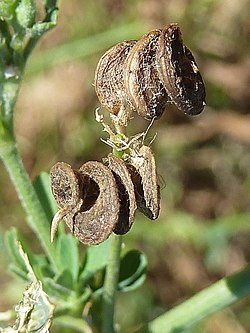
Medicago sativa, known as alfalfa or lucerne, is a vital perennial flowering plant in the legume family Fabaceae, primarily cultivated for animal feed and known for its rich nutrient content.


Set reading age
View for Kids
Easy to read and understand
View for Students
Clear, detailed explanations
View for Scholars
Deep dives and big ideas
Medicago sativa, commonly known as alfalfa or lucerne, is a flowering plant 🌼 that belongs to the legume family, Fabaceae. It’s like a superhero for farmers! Alfalfa is native to regions in Asia and Europe, but now it grows all around the world 🌍, especially in the United States. This plant loves sunny weather and can grow up to 3 feet tall! Alfalfa is grown mainly for animal feed, helping cows, goats, and horses stay healthy and strong 🐄🐐. Additionally, it has beautiful purple flowers that attract bees 🐝, which are important for pollination!
Alfalfa has unique characteristics that make it special. It has bright green leaves 🍃, and its stems are strong and upright. The flowers are purple or blue, and they grow in clusters at the top 🌷. This plant has a deep taproot, which means its roots can reach far down into the soil, helping it get water even in dry times. The root system also helps keep the soil healthy! Alfalfa plants can live for many years, sometimes up to 5-10 years! So, they work hard year after year!
Scientists are studying alfalfa to discover even more incredible ways to use it! 🧬They look into its genes to find out how they can make it stronger against diseases and pests. Genetic research helps in creating new types of alfalfa that can grow in harsh conditions, like dry lands or extreme temperatures! 🌡️ This research is important because it can help farmers grow more food while using fewer resources. With advancements in science, we can help feed animals and people much better!
Alfalfa is a super healthy plant! 🌟It’s loaded with vitamins and minerals. For example, it contains a lot of calcium, which is important for our bones and teeth! 🦴Alfalfa also has protein, which helps our bodies build muscles. In addition, it is rich in fiber, which helps keep our digestive systems running smoothly. If you eat sprouts, you get plenty of antioxidants, which are like tiny protectors for our cells! Eating alfalfa can help you grow big and strong!
Alfalfa has many amazing uses! 🐴It is mainly grown for animal feed, providing essential nutrients for livestock like cattle and livestock 🐄. But that’s not all! Alfalfa is also found in some vitamin supplements for people. It’s packed with vitamins A, C, and K, which help our bodies stay healthy. Additionally, it can be used in salads 🌿 with its tender sprouts that are crunchy and nutritious. Farmers also plant alfalfa to improve soil health, making it easier for other crops to grow strong!
Like many plants, alfalfa can have some pesky problems! 🐛Some insects like aphids and spider mites love to munch on its leaves. Farmers must watch carefully and may use natural sprays to keep them away. Additionally, alfalfa can get diseases like downy mildew, which makes the leaves look fuzzy. 🌫️ Preventative care, like rotating crops and using healthy seeds, can help keep alfalfa plants safe. By taking care of alfalfa plants, farmers can continue to grow them strong for many years!
Alfalfa is great for the environment! 🌿It helps improve soil quality and prevents erosion, allowing other plants to thrive. Its deep roots help hold onto water, reducing run-off during rains. Alfalfa also fixes nitrogen in the soil, making it richer for future crops. 🥕When farmers grow alfalfa in rotation with other crops, it keeps the earth healthy and nourished. By protecting our ecosystems, alfalfa plays a chunky role in sustainable farming and food production!
There are many types of alfalfa! 🌼Some are better for making hay, while others are great for grazing livestock. The varieties can be grouped based on their growing habits and flowering times. For example, some types grow quickly and others flourish for a long time. There’s also “dormant” alfalfa, which can survive in colder areas, and “non-dormant” varieties for warmer regions 🌡️. With so many alfalfa choices, farmers can select the best type for their needs and surroundings!
Alfalfa has a long history! 🌟It was first cultivated over 6,000 years ago in Central Asia! Ancient peoples used it to feed their horses 🐴, and it became popular in Europe and the Americas as farming spread. In the 1800s, alfalfa was brought to the United States, where it thrived in the sunny climates 🌞. People recognized its importance for agriculture and livestock. Today, alfalfa is still one of the most important crops for farmers around the world!
Farmers love growing alfalfa! 🌾It's usually planted in the spring when the soil is warm and ready. Alfalfa needs well-drained soil and plenty of sunshine ☀️ to thrive. Farmers often harvest it 3 to 5 times a year! Alfalfa is cut when it blooms, allowing it to regrow stronger. It is often dried to make hay 🍂 for feeding animals. Growing alfalfa also helps prevent soil erosion, keeping the ground safe and healthy for other plants to grow. It’s like a gardening superhero!
Alfalfa belongs to a larger group of plants called legumes, which includes peanuts and beans! 🌱The scientific name, Medicago sativa, helps scientists communicate and understand more about the plant. It's part of the Fabaceae family, where the members have pods and seeds. Alfalfa is classified as a dicot, which means it has two seed leaves. Isn’t that cool? 🌼When you look closely, you can see how its leaves are shaped like little clovers! Alfalfa helps the soil by fixing nitrogen, adding nutrients that other plants love.