Mass Defect Facts For Kids
Mass defect is the tiny amount of mass that disappears when parts come together and release energy, showing how matter and energy are linked.
About this topic
Scientists explain this with Einstein’s idea of mass–energy equivalence written as \(E=mc^2\). Here \(E\) means energy (like heat or light), \(m\) means mass (how much stuff there is), and \(c\) is the speed of light (a very big number). When parts join and energy is given off, a tiny amount of mass is missing — the mass defect.
Quick Facts
Key Points
📘 Nuclear Binding Energy Basics
Scientists connect binding energy to mass defect with the same idea: \(\Delta E = \Delta m c^2\). Here \(\Delta E\) is the energy needed to pull the nucleus apart, \(\Delta m\) is the missing mass (the mass defect), and \(c\) is the speed of light. If \(\Delta E\) is large, the nucleus is held together tightly; we often say how much energy there is for each particle inside.
🔎 A Simple Mass Defect Example
That missing 0.8% turned into binding energy when the nucleus formed. In other words, some mass became energy (light or heat) while the pieces stuck together. The equation \(\Delta E = \Delta m c^2\) tells us how much energy came from the missing mass.
🧭 Fusion, Fission, And Mass-energy
In every case, the energy released comes from a change in mass. We write that as \(\Delta E = \Delta m c^2\), where \(\Delta E\) is the energy out, \(\Delta m\) is the lost mass, and \(c\) is the speed of light. Radioactive decay is another slow way energy comes out from nuclei.
💡 Binding Energy And Special Isotopes
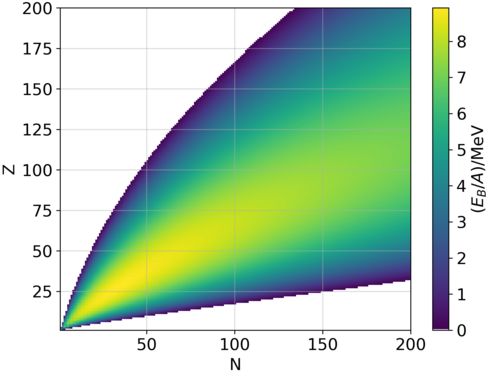
The energy that keeps the nucleus together is the binding energy — it is how much energy you must add to pull the nucleus apart. Scientists often look at binding energy per nucleon (that means per proton or neutron) to see how tightly held each piece is. For example, nickel‑62 is one of the most tightly bound isotopes, so its pieces fit very snugly. When light nuclei, like hydrogen, fuse into heavier ones with higher binding energy per nucleon, they give off energy — this is how stars shine.
🌟 The Nuclear Force: What Holds The Nucleus Together
The nuclear force is short‑range: it is very strong when particles are almost touching, but it fades quickly as they move apart. Protons also push away from each other because they are positively charged, so the nuclear force must be stronger than that push at close range to hold the nucleus together. Electrons are held to the atom by the electric force, not by the nuclear force, so the nucleus and the electron cloud use different kinds of attraction.
🧠 Take the Quiz about Mass Defect
Frequently asked questions
What is mass defect?
Mass defect is the tiny amount by which the whole weighs less than the sum of its parts. When the parts join, some mass becomes energy, so the missing mass is called the mass defect.
What is binding energy?
Binding energy is the energy that holds the tiny pieces inside an atomic nucleus together, like glue. Scientists connect it to mass defect with the idea that energy equals mass times the speed of light squared. If the binding energy is large, the nucleus is held tightly.
What happened in the helium example?
When four tiny parts (two protons and two neutrons) join to form a helium nucleus, the total mass becomes a little less than adding the four parts separately. That missing mass is about 0.8 percent of their mass, and it turned into binding energy.
What are fusion and fission?
Fusion is when small nuclei join to form a heavier one; fission is when a large nucleus splits into smaller pieces. Both can release energy if the final pieces are held together more tightly, and the energy comes from a change in mass.
What does nickel-62 tell us about binding energy?
Binding energy per nucleon shows how tightly each piece of the nucleus is held. Nickel-62 is one of the most tightly bound isotopes, so its pieces fit very snugly.
What is the nuclear force and what does it do?
The nuclear force is a very strong pull that keeps protons and neutrons close in the nucleus. It is short-range and must beat the repulsion between protons; electrons are held by the electric force, not by the nuclear force.