The Maclaurin series is a type of Taylor series expansion of a function about zero, allowing for polynomial approximation of functions near that point.
Set reading age
View for Kids
Easy to read and understand
View for Students
Clear, detailed explanations
View for Scholars
Deep dives and big ideas
Imagine you want to make a perfect curve using straight lines! 🎉The Maclaurin Series helps us do this by using simple math. It's a way to express complicated functions like sin(x) or e^x as an infinite sum of terms. This means we can write them down using basic building blocks: powers of x! For example, when we find the Maclaurin Series for a function, we get a series of additions that can help us understand the curve better at that point. The cool part? You can use it to estimate the function's behavior near zero!
The Maclaurin Series is named after Scottish mathematician Colin Maclaurin, who lived from 1698 to 1746. 🏴☠️ He worked on calculus while helping others understand curved lines! But, did you know that this idea was also discovered by Isaac Newton? He used series to describe curves over 100 years earlier! 🎩Maclaurin's work became important in math, making it easier to grasp complex functions. Today, students around the world learn about him and his amazing series!
“Convergence” and “divergence” are two important terms to understand how series work. 🌊Convergence means the series gets closer and closer to the function’s value as we add more terms. 🌈For instance, the Maclaurin Series for e^x converges for all x values! However, some series diverge, which means they don't get close to the actual value, like the series for f(x) = 1/(1-x) when x ≥ 1. It’s like a race: some runners get closer to the finish line, while others just keep running in circles!
Let’s look at some examples! 🎈
1. For the function f(x) = e^x, the Maclaurin Series is:
1 + x + x²/2! + x³/3! + ...
2. For sin(x), it becomes:
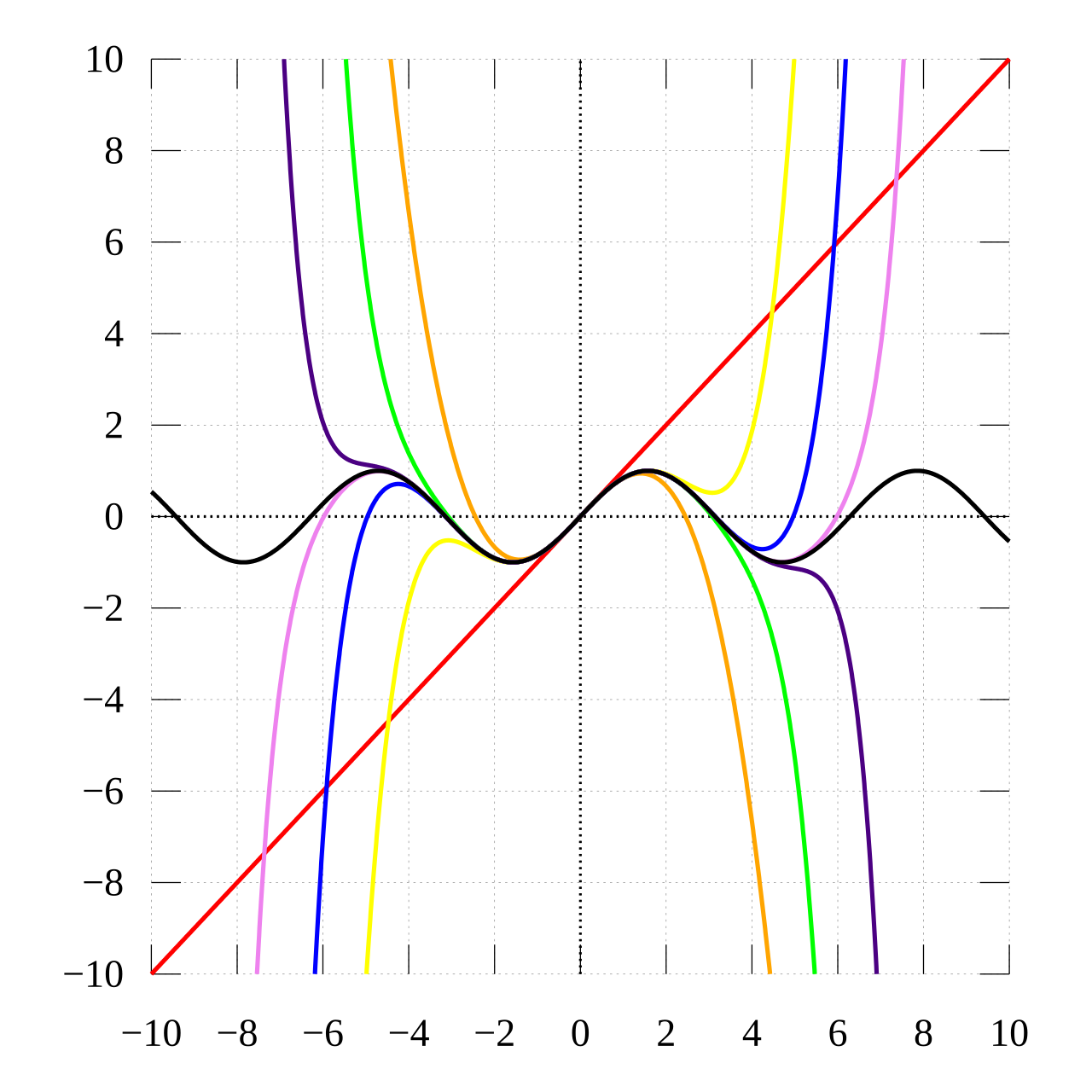
x - x³/3! + x⁵/5! - ...
3. And for cos(x), we use:
1 - x²/2! + x⁴/4! - ...
These series help us estimate the values of e^x, sin(x), and cos(x) near zero, making calculations easier and quicker! 🎉
Visualizing the Maclaurin Series is like seeing a magical drawing coming to life! 🎨When you plot a function on a graph and add the Maclaurin Series terms, you can see how well they match the curve near zero. As you include more terms, the series becomes closer and closer to the original function! 📈You can use graphing tools or apps to see this fun transformation. It’s a colorful way to learn how math can create shapes, just like artists use crayons to fill their pictures! 🎨
The Maclaurin Series is a special case of the Taylor Series, just like a sunflower is a type of flower. 🌻The key difference is the center point: the Maclaurin Series is centered at 0, while the Taylor Series can be centered anywhere! For example, if we center the Taylor Series for f(x) at a point a, the formula looks similar but starts with f(a) instead of f(0). So, if you know the Maclaurin Series, learning about Taylor Series is like taking a short detour in a garden of math! 🌼
The Maclaurin Series is a special type of Taylor Series. ✨What’s a Taylor Series, you ask? Well, it helps us write functions as an infinite sum of terms. In the Maclaurin Series, we specifically look at a function around the point 0. The formula is:
f(x) = f(0) + f'(0)x + f''(0)x²/2! + f'''(0)x³/3! + ...
Here, f(0) is the function value at 0, and f’(0), f’’(0), and so on are the function’s derivatives (the slopes) at that point. It’s like a treasure map leading us to the shape of a function! 🌟
Let’s see how we build the Maclaurin Series step-by-step! 🛠️ We start with a function, let’s say f(x). First, we find its value at 0, f(0). Then we calculate the first derivative, f'(x), and evaluate it at 0. The key idea is to keep finding derivatives! The second derivative gives us f''(0), and we use these to build our series:
f(x) = f(0) + f'(0)x + f''(0)x²/2! + ...
The “2!” means we divide by 2 times 1! (1 x 2), which helps us keep things neat. It’s like baking a yummy cake with several layers! 🎂
The Maclaurin Series is super useful in math, science, and engineering! ✅For example, engineers use it to design cars, planes, and bridges, making sure they are safe. Scientists use this series in physics to understand how things move. It also helps in computer graphics to create smooth curves in video games. 🎮Some apps even use it for calculations in smartphones! So, this series is not just about numbers; it helps create the fun we enjoy in life!
📈 The Maclaurin series is a special case of the Taylor series centered at 0.
🧮 The formula for the Maclaurin series of a function ( f(x) ) is given by ( f(x) = f(0) + f'(0)x + rac{f''(0)}{2!} x^2 + rac{f'''(0)}{3!} x^3 + ldots )
🔍 The Maclaurin series can be used to approximate functions near the point x = 0.
🌊 The convergence of the Maclaurin series depends on the properties of the function.
✨ Common functions with known Maclaurin series include ( e^x ), ( sin(x) ), and ( cos(x) ).
📉 The Maclaurin series can provide polynomial approximations of functions, making complex calculations simpler.
🔄 The remainder term in the Maclaurin series gives an indication of the approximation error for a finite number of terms.
⚗️ The degree of the polynomial in the Maclaurin series affects the accuracy of the approximation.
🔢 The coefficients of the Maclaurin series can be derived from the derivatives of the function at x = 0.
❓ The Maclaurin series is particularly useful in calculus for evaluating limits and integrals involving complicated functions.