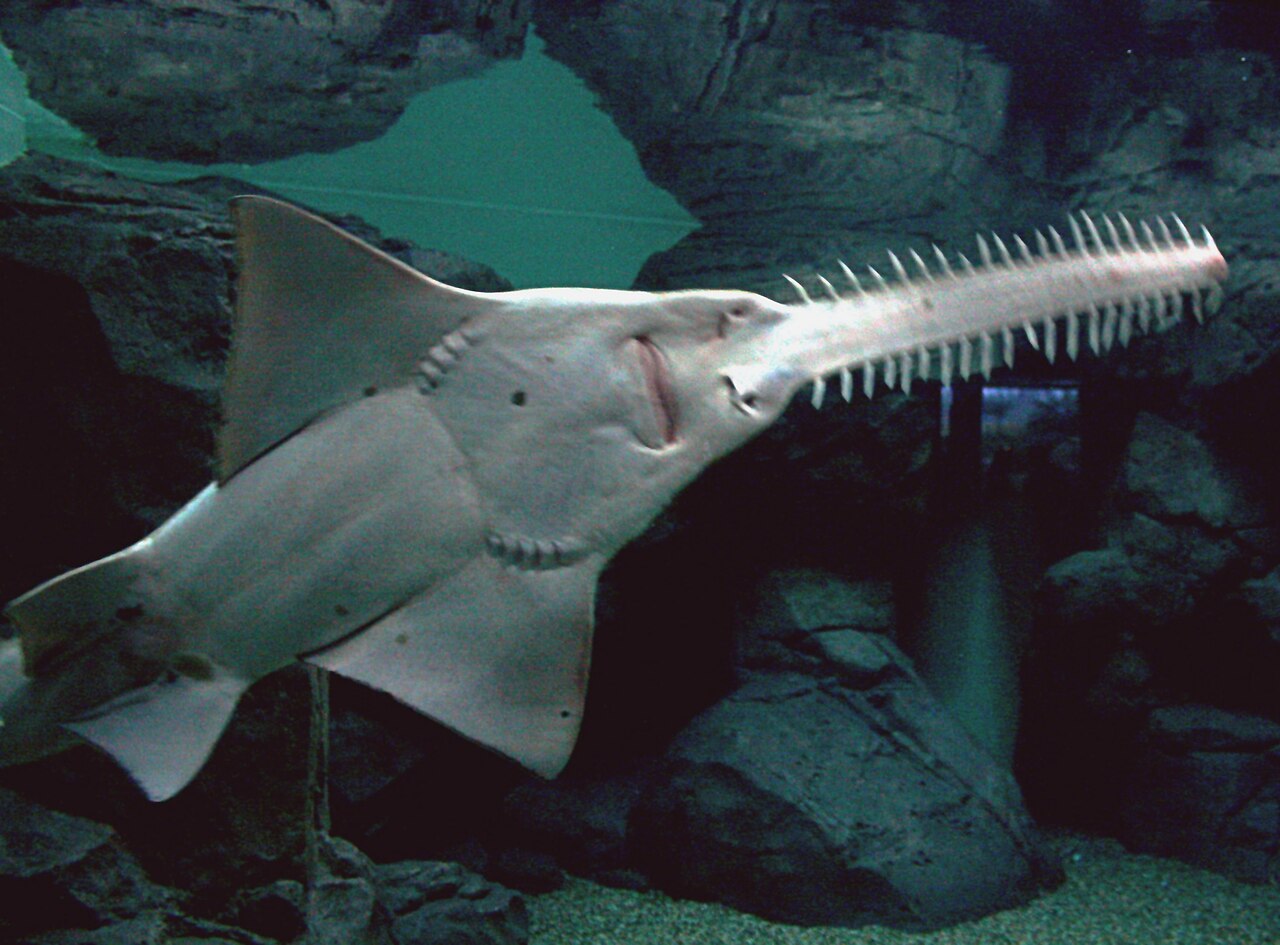
The largetooth sawfish is a critically endangered species characterized by its elongated snout with large, serrated teeth, commonly found in warm coastal waters and estuaries.
Set reading age
View for Kids
Easy to read and understand
View for Students
Clear, detailed explanations
View for Scholars
Deep dives and big ideas
The largetooth sawfish 🐟 is a unique type of fish known for its long, flat snout that looks like a saw! This special snout has sharp teeth, which helps it catch prey. The largetooth sawfish can grow up to 23 feet long! 🌊They live in warm coastal waters and rivers, mostly found in parts of Africa, Asia, and Australia. In the water, they are brown or gray to blend in with their surroundings, making them great hunters. Because they are so special, largetooth sawfish are classified as a vulnerable species, meaning they need our help to survive!
Did you know that the largetooth sawfish can be spotted in both saltwater and freshwater? 🌊Not many fish can do this! Another fun fact is that their teeth are made of the same stuff as our bones, called dentin. The rostrum of a sawfish helps it navigate, hunt, and protect itself. They are related to sharks and rays 🦈! Additionally, in parts of Africa, the largetooth sawfish is called "zambezi shark," even though it is not a true shark. Isn't that cool?
The largetooth sawfish is considered a vulnerable species by the International Union for Conservation of Nature (IUCN) 🌍. This means there are not many of them left in the wild, and they need help to survive. Their numbers are decreasing mainly due to fishing practices, habitat destruction, and pollution. 🌿Conservation efforts are essential to protect these fascinating fish, and people are working to create safer environments for them. Many marine biologists are studying the largetooth sawfish to learn more about how to keep them safe!
Largetooth sawfish hold cultural significance in various regions, especially in some indigenous communities in Australia and Africa 🌏. They are often depicted in traditional stories, symbolizing strength and adaptability. These communities have a deep respect for the largetooth sawfish, viewing it as a vital part of their marine culture. 🐚In some cultures, the sawfish represents the connection between land and sea. By learning about the largetooth sawfish, we can appreciate its place in our world and the importance of protecting our oceans!
Largetooth sawfish are carnivorous fish 🐠, meaning they eat meat! They mainly feed on smaller fish and invertebrates. Their saw-like snout helps them hunt by swinging it side to side to stun their prey, making it easier to swallow. 👅They have a great sense of smell and can detect their food from a distance! Once they've stunned their meal, they gulp it down using their wide mouths. Using their saws is a smart way to hunt, showcasing their incredible feeding techniques.
Largetooth sawfish are found in warm coastal regions and rivers 🌐. They enjoy shallow areas like estuaries, bays, and swamps. These fish can be seen in places like the Gulf of Mexico, parts of East Africa (like Mozambique), and northern Australia. They're often found in brackish water, which is a mix of fresh and saltwater. This fish also travels between rivers and coastal areas throughout its life, making it a versatile swimmer! 🌊Unfortunately, loss of habitat is one of the reasons why largetooth sawfish numbers are declining.
The most striking feature of the largetooth sawfish is its saw-like snout, which can be as long as 3 feet! 🔪This snout, called a "rostrum," has around 20-30 large teeth on each side. Their bodies are long and flattened, resembling a shark, helping them swim quickly. They also have a unique pair of small dorsal fins located towards the back of their bodies. Their coloration is usually light brown or gray, which helps them camouflage in the water. 🦈Adults can weigh up to 1,000 pounds, making them quite heavy!
Largetooth sawfish are ovoviviparous fish, which means they give birth to live young instead of laying eggs. 🥚A female can have up to 20 baby sawfish at once! The babies are born fully developed and about 2 feet long. The young fish grow quickly and can swim alongside their mothers. Largetooth sawfish have a lifespan of about 30 to 50 years in the wild! 🕒Their slow growth rate and late maturity contribute to their vulnerability, making it crucial to protect them.
Several threats impact the largetooth sawfish, including overfishing, habitat loss, and pollution 🚫. They often get accidentally caught in nets and fishing gear, leading to injury or death. Efforts to conserve them include establishing marine protected areas 🛡️ and educating fishermen about safe fishing practices. Organizations work on research to better understand the largetooth sawfish while helping preserve their habitat. By protecting the oceans and rivers where they live, we can contribute to the survival of these magnificent creatures!