Kuiper Belt Facts For Kids
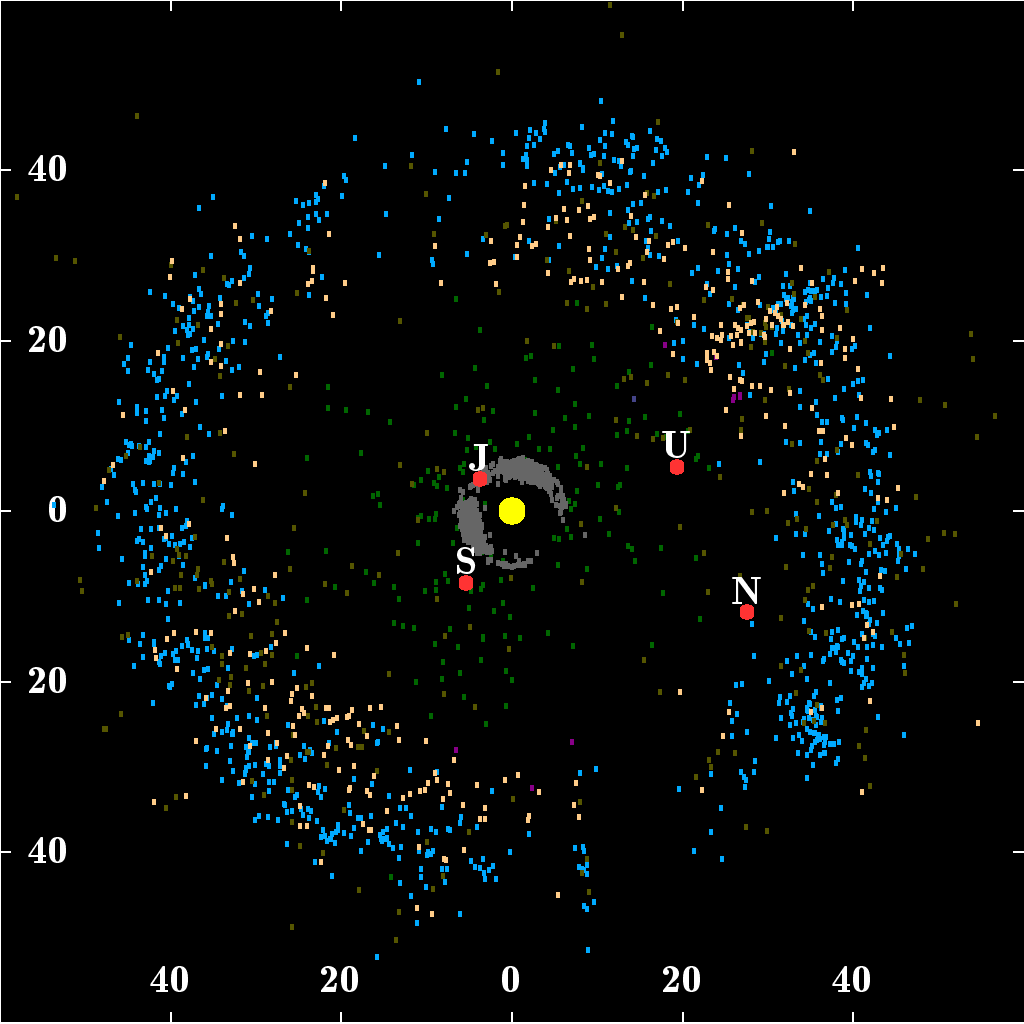
The Kuiper Belt is a circumstellar disc in the outer Solar System filled with icy bodies and dwarf planets, located from about 30 to 50 astronomical units from the Sun.

Do more with AI
Introduction
The Kuiper Belt is a special area in space, past the planet Neptune! 🌌It's like a cosmic treasure chest filled with icy objects and small planets. The Kuiper Belt starts around 30 astronomical units (AU) from the Sun and stretches to about 50 AU. One astronomical unit is the distance from the Earth to the Sun, which is about 93 million miles (150 million kilometers). So, the Kuiper Belt is REALLY far away! 😊It’s not just empty space – it’s home to many interesting things, including dwarf planets like Pluto. Let’s explore this exciting place!
Images of Kuiper Belt

Pluto and Charon

Astronomer Gerard Kuiper, after whom the Kuiper belt is named
![In 1980, astronomer Julio Fernandez predicted the existence of a belt. It has been said that because the words "Kuiper" and "comet belt" appeared in the opening sentence of Fernandez's paper, this hypothetical region was referred to as the "Kuiper belt".[36]](https://upload.wikimedia.org/wikipedia/commons/thumb/1/1a/Julio_A._Fernandez_%28recortado%29.jpg/960px-Julio_A._Fernandez_%28recortado%29.jpg)
In 1980, astronomer Julio Fernandez predicted the existence of a belt. It has been said that because the words "Kuiper" and "comet belt" appeared in the opening sentence of Fernandez's paper, this hypothetical region was referred to as the "Kuiper belt".[36]

Telescopes atop Mauna Kea. The Kuiper belt was discovered with UH88, which is the fourth from the left.

Semi-major axis and eccentricity structure of the Kuiper belt. Plutinos are in orange, while other resonant objects are in red. Non-resonant hot cubewanos are in sky blue, while cold cubewanos are dark blue. The Haumea collisional family is slate blue. Notable objects are labeled.

Plot of trans-Neptunian objects highlighting orbital resonances. Plutinos are in orange, while other resonant objects are in red. Non-resonant cubewanos and scattered disk objects are in blue and grey.

Orbit classification (schematic of semi-major axes)

Histogram of the semi-major axes of Kuiper belt objects with inclinations above and below 5 degrees. Spikes from the plutinos and the 'kernel' are visible at 39–40 AU and 44 AU.

Simulation showing outer planets and Kuiper belt: (a) before Jupiter/Saturn 1:2 resonance, (b) scattering of Kuiper belt objects into the Solar System after the orbital shift of Neptune, (c) after ejection of Kuiper belt bodies by Jupiter
Composition And Structure
The Kuiper Belt is made up of tiny icy bodies and rocks. 🌍Most of these objects are mostly frozen water, ammonia, or methane, which makes them look shiny and new! The icy objects can be small, like a car, or large, like Pluto, which is about 1,200 kilometers (around 750 miles) wide! The Kuiper Belt is also shaped like a disc, similar to a giant frisbee, with objects spread out in different orbits. 🌠These orbits are often tilted or elliptical, meaning they can be stretched out rather than perfectly round. It's a frozen wonderland up there!
Future Research Directions
The Kuiper Belt is still a mystery waiting to be solved! 🌌Scientists have exciting plans for future research, like sending new missions to study its fascinating objects. 🚀Spacecraft with advanced technology will help us explore deeper into the Kuiper Belt, collecting more data on its icy inhabitants. Scientists are also developing telescopes to find smaller objects, which may lead to new discoveries! 🔭Understanding the Kuiper Belt will help us learn more about the origins of our Solar System. The future is bright for Kuiper Belt exploration, and who knows what surprises await!
Discovery Of The Kuiper Belt
The Kuiper Belt was discovered in the 1990s, thanks to scientist David Jewitt and astronomer Jane Luu. Their discovery was exciting because they found many icy objects beyond Neptune! ❄️ The first object they found was called 1992 QL1. This discovery helped scientists learn more about our Solar System. The Kuiper Belt is named after astronomer Gerard Kuiper, who first suggested its existence in the 1950s! 📅Since then, many more objects have been found, and scientists continue to study them to understand what lies beyond our planets. How cool is that?
Kuiper Belt Vs. Asteroid Belt
You might wonder how the Kuiper Belt is different from the Asteroid Belt! 🤔The Asteroid Belt is located between Mars and Jupiter and is mostly made up of rocky asteroids, while the Kuiper Belt is farther out and is made up of icy objects and dwarf planets. 🌌The Asteroid Belt has many small rocks, while the Kuiper Belt is like a big collection of frozen treasures! The Kuiper Belt is also larger, stretching from 30 to 50 AU from the Sun, compared to the Asteroid Belt that ranges from 2.1 to 3.3 AU! The two belts are key parts of our Solar System!
Exploration Of The Kuiper Belt
Exploring the Kuiper Belt is a thrilling adventure for scientists! 🚀In 2015, NASA's New Horizons spacecraft gave us amazing pictures of Pluto and other Kuiper Belt objects. New Horizons traveled over 3 billion miles to reach Pluto, and it was the first spacecraft to visit this mysterious region! ⚡Since its encounter, New Horizons has continued to travel deeper into the Kuiper Belt, sending back fascinating data about our cosmic neighbors. More missions are planned, like sending advanced telescopes and spacecraft to study these icy worlds up close. Who knows what they might discover next?
Major Objects In The Kuiper Belt
The Kuiper Belt has lots of cool objects! ⛵One of the most famous is Pluto, which used to be classified as a planet but is now a dwarf planet. Dwarf planets like Haumea and Makemake also reside in the Kuiper Belt. Haumea is special because it spins really fast, making it oblong-shaped! 💫Another notable object is Eris, which is even larger than Pluto. Besides these big names, there are thousands of smaller objects waiting to be discovered. Each object helps scientists learn more about how our Solar System formed!
Cultural Impact And Representation
The Kuiper Belt has inspired stories, movies, and art! 🎨Because the Kuiper Belt contains mysterious and distant objects, artists and writers use it as a backdrop for imaginative tales. Some science fiction stories feature adventures to dwarf planets like Pluto or discuss the wonders of the Kuiper Belt. 📚Learning about this faraway region of space helps fuel curiosity about our universe, inspiring kids (and adults!) to dream big about space exploration. Sharing ideas about the Kuiper Belt encourages creativity while allowing us to admire the beauty of the cosmos. 🌌The universe is full of possibilities!
Kuiper Belt Objects And Planetary Science
Studying Kuiper Belt objects helps scientists learn more about our planets and the Solar System! 🧑🔬 The materials found in the Kuiper Belt can help explain how the planets formed and changed over time. 🌏For example, by examining the icy surfaces of dwarf planets like Pluto, scientists can uncover secrets about the building blocks of planets! Additionally, understanding the Kuiper Belt can reveal how our Solar System's structure has evolved. By investigating these icy bodies, scientists are piecing together a cosmic puzzle that tells the story of our home in the universe!
The Relationship Between The Kuiper Belt And Comets
Did you know that the Kuiper Belt is closely connected to comets? ☄️ Comets are icy bodies that travel through the Solar System, and many of them come from the Kuiper Belt! When these icy objects get close to the Sun, they heat up, causing gas and dust to create beautiful glowing tails. 🌠For example, Halley's Comet visits our inner Solar System every 76 years, and it may originate from the Kuiper Belt! The Kuiper Belt acts like a delivery system for comets, bringing them closer to us for a spectacular sky show. Isn’t that amazing?
The Role Of The Kuiper Belt In Solar System Formation
The Kuiper Belt is essential because it helps scientists learn about how our Solar System formed! 🛠Scientists believe that the Kuiper Belt and its objects are leftover materials from when our Solar System was created roughly 4.6 billion years ago! 🌌By studying these icy bodies, researchers can better understand the history of the planets and how they grew. The Kuiper Belt acts like a time capsule, holding clues to the past. These objects share stories about the origins of our Solar System, making the Kuiper Belt a fascinating topic for space explorers of all ages!
Kuiper Belt Quiz
Learn more about Kuiper Belt
