Kovar Facts For Kids
Kovar is a specialized alloy composed mainly of nickel and cobalt, renowned for its low thermal expansion and high dimensional stability, making it ideal for demanding industrial and electronic applications.
Select reading age
Kovar Facts For Kids
Videos & Quizzesincluded
About this topic
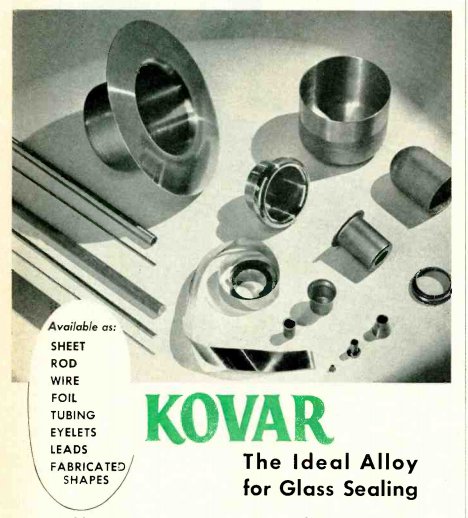
Kovar is a special metal alloy made mainly of iron (54%), nickel (29%), and cobalt (17%). 🧪It's a popular material because it has a unique ability to match the expansion and contraction rates of glass. This means it can fit well with glass without breaking when heated or cooled. Kovar is often used in electronics, making it very important for technology! 🔌It was developed by a company called Westinghouse in the 1930s and is named after a trademark of that company.
Explore with ChatDinoKey Points
Kovar was invented in the United States by the Westinghouse Electric Corporation in 1934.
Kovar is used in many cool devices!
Kovar is different from other alloys, like steel or aluminum, because of its low thermal expansion.
Kovar is made using a process called metal alloying.
While Kovar is great, there are challenges!
Kovar is made up of iron, nickel, and cobalt, which gives it its special properties.
The future looks bright for Kovar!
Making Kovar has an environmental impact, just like any metal production.
🌟 History Of Kovar
Kovar was invented in the United States by the Westinghouse Electric Corporation in 1934. 🌟The engineers wanted to create a metal that could work together with glass in light bulbs. Over time, Kovar became widely used in many modern devices, including TVs and radios. Before Kovar, other metals would break or cause problems with glass. 🌈In 1969, Kovar was recognized as a very important material for technology, making life easier for people all over the world!
Go deeper🖥️ Applications Of Kovar
Kovar is used in many cool devices! 🖥️ It's found in things like light bulbs, lasers, and computer parts. Kovar is also used in making connectors and lids for electronic devices. 🎧Because of its special properties, Kovar is important in aerospace technology, helping rockets and satellites! 🚀Engineers love using Kovar because it helps keep devices safe and working well, even in tough situations.
Go deeper⚖️ Kovar Vs. Other Alloys
Kovar is different from other alloys, like steel or aluminum, because of its low thermal expansion. ⚖️ Steel expands more with heat, which is not always good for tightly sealed devices! Aluminum is too lightweight and can’t handle heat as well. 🏁Kovar is more durable and can take the heat, making it ideal for sensitive gadgets. 📱Companies often choose Kovar over other metals when working with glass and electronics because it performs better together!
Go deeper🔨 Manufacturing Processes
Kovar is made using a process called metal alloying. 🔨First, the raw materials—iron, nickel, and cobalt—are heated until they melt. Then they are mixed together and cooled to form Kovar. 🥵This process uses machines and tools to ensure the mixture is just right! After that, different shapes can be made through processes like casting, forging, and machining. 🌪️ Finally, Kovar parts are polished and treated to ensure quality before being used in products!
Go deeper💡 Challenges In Using Kovar
While Kovar is great, there are challenges! 💡It can be hard to find because of the specific ingredients needed. Cobalt can be expensive and rare! 💵In addition, working with Kovar requires special equipment. Sometimes, people find it tricky to weld Kovar to other metals. ⚙️ Finally, as technology changes, engineers are exploring new materials that might also work well, which means Kovar faces competition.
Go deeper🌐 Composition And Properties
Kovar is made up of iron, nickel, and cobalt, which gives it its special properties. 🌐It has a total of 100% composition as follows: 54% iron, 29% nickel, and 17% cobalt. Kovar expands and contracts with heating and cooling but stays stable. This property is called a "low thermal expansion coefficient." 📏 This means it doesn't change size much when temperatures change, making it perfect for precision devices like semiconductors and thermometers!
Go deeper🌞 Future Of Kovar In Technology
The future looks bright for Kovar! 🌞As technology grows, the need for Kovar may increase, especially in electronics and space travel. 🚀Scientists are researching ways to use Kovar in even more devices. With the rise of renewable energy, Kovar may help build better solar panels! 🌻Engineers are excited about finding new, smart applications for this amazing alloy, helping make our world more connected and efficient!
Go deeper🏞️ Environmental Impact Of Kovar Production
Making Kovar has an environmental impact, just like any metal production. 🏞️ Mining cobalt, nickel, and iron can damage ecosystems. It takes a lot of energy to refine these metals, leading to greenhouse gas emissions. 🌍Companies are working hard to find cleaner production methods and recycle Kovar to lessen the environmental footprint. ♻️ By being responsible, they can continue using Kovar but protect the Earth at the same time! 🌳
Go deeper