Jean Piaget Facts For Kids
Jean Piaget was a Swiss psychologist renowned for his pioneering work in understanding children's cognitive development and the processes by which they learn.
Select reading age

Jean Piaget Facts For Kids
Videos & Quizzesincluded
About this topic
Jean Piaget was a famous Swiss psychologist born on August 9, 1896, in Neuchâtel, Switzerland. 🎂He became well-known for studying how children think and learn. Piaget realized that children don’t think like adults, so he spent many years observing kids at different ages. He discovered that kids go through stages in their thinking as they grow up. Piaget's work helped us understand how to teach children better and how they develop their ideas about the world. 🌍He died on September 16, 1980, but his ideas still help teachers and parents today!
Explore with ChatDinoKey Points
Growing up, Piaget showed a huge interest in nature and science.
Piaget identified four important stages of cognitive development.
While many people love Piaget's work, some have critiqued it, too!
Piaget's theories greatly influenced modern psychology and how we study kids!
One key concept in Piaget's theory is "schemas."
Piaget used a unique way to study children, mainly involving observations and interviews.
Piaget's discoveries changed the way teachers help kids learn.
Jean Piaget's legacy lives on in education and psychology!
Photos of Jean Piaget

Piaget at Award ceremony of the Erasmus Prize, 1972, Amsterdam
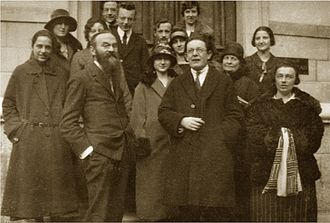
Photo of the Jean Piaget Foundation with Pierre Bovet (1878–1965) first row (with large beard) and Jean Piaget (1896–1980) first row (on the right, with glasses) in front of the Rousseau Institute (Geneva), 1925
🦋 Biographical Background
Growing up, Piaget showed a huge interest in nature and science. 🦋He even published a paper about a rare bird when he was just ten years old! In his twenties, he started studying psychology and became fascinated by how children think. Piaget's work began in the 1920s, and he focused on how children develop their thinking skills. He traveled around Europe and worked with kids, observing how they solved problems. He even had three children of his own, which helped him learn more about how kids think! 👶👧👦
Go deeper🤱 Cognitive Development Stages
Piaget identified four important stages of cognitive development. The first stage is the Sensorimotor Stage (0-2 years). 🤱Babies learn through their senses and actions! The second stage is the Preoperational Stage (2-7 years). Here, children think a lot about symbols and images but may struggle with logic. 🏰The third stage is the Concrete Operational Stage (7-11 years). Kids start using logical thinking about concrete objects. Finally, the Formal Operational Stage (12 years and up) is where abstract thinking develops! 🧠Understanding these stages helps us know how kids learn and grow at different ages.
Go deeper📉 Critiques Of Piaget's Theory
While many people love Piaget's work, some have critiqued it, too! 📉One argument is that he underestimated how much young kids can understand. For instance, some research shows that babies might understand object permanence, where they know something still exists even when they can't see it, much earlier than Piaget thought! Others believe that cultural differences might affect how children learn, which Piaget’s theory didn’t fully consider. 🌍These critiques help scientists continue to study and improve understanding of child development.
Go deeper📖 Piaget And Modern Psychology
Piaget's theories greatly influenced modern psychology and how we study kids! 📖His ideas helped researchers think about cognitive development in new ways. Today, psychologists build on his work by looking at different methods of how children process information and develop their thinking. Many psychologists also study how emotions and social experiences play into learning, building upon what Piaget discovered. 📊His influence makes child development an exciting field for researchers and educators alike!
Go deeper📚 Key Concepts In Piaget's Theory
One key concept in Piaget's theory is "schemas." 📚 A schema is like a mental framework that helps kids understand the world. For example, a "dog" schema might include all the things one knows about dogs—like that they bark! Another important idea is "assimilation" and "accommodation." Assimilation involves adding new experiences to existing schemas, while accommodation means changing schemas when faced with new info. 🤔These concepts are crucial in showing how children's minds adapt and grow over time!
Go deeper👀 Research Methods Used By Piaget
Piaget used a unique way to study children, mainly involving observations and interviews. 👀He liked to create special tasks for kids that were both fun and challenging! For example, he would ask them to solve puzzles or say why they thought something was true. Instead of giving kids tests, he watched how they approached different problems, which helped him understand their thinking processes. 🌈His methods allowed him to get deep insights into how kids think and learn across different ages and stages.
Go deeper🏫 Influence On Educational Practices
Piaget's discoveries changed the way teachers help kids learn. 🏫Educators now understand that children should be actively involved in their learning. Instead of just memorizing facts, students get to explore, ask questions, and discover for themselves. Hands-on activities and games are encouraged, so kids can use their senses and experiences! 🌈Mountains of research support his ideas, and many classrooms today include more creativity and problem-solving based on Piaget's stage theories. Learning is now fun and engaging!
Go deeper😊 Legacy And Contributions To Child Development
Jean Piaget's legacy lives on in education and psychology! 😊His ideas are still used in classrooms today, guiding how we teach and understand children. Many educational tools and programs are designed based on his theories, highlighting the importance of active learning. Piaget's work has inspired countless researchers, helping parents and teachers connect with kids’ learning processes. Every time a child discovers something new, they are part of Piaget's legacy—all thanks to his groundbreaking work! 🌟
Go deeper