Jagadish Chandra Bose Facts For Kids
Sir Jagadish Chandra Bose was a multifaceted Indian scientist known for his groundbreaking contributions in biology, physics, and his philosophical views, paving the way for future research and innovations.

Do more with AI
Introduction
Jagadish Chandra Bose 🌱 was a fantastic scientist born on November 30, 1858, in Munsiganj, Bangladesh. He loved exploring nature and made amazing discoveries in biology and physics. People remember him for his wonderful experiments with plants and inventing cool gadgets. As a great thinker, he even wrote stories that combined science with imagination. Bose was a pioneer who showed everyone the magic of science! He was versatile, shining in many subjects, much like a superhero of knowledge. Kids like you can be inspired by his curiosity and love for learning! 🦸♂️✨
Images of Jagadish Chandra Bose
![Acharya Bhavan, the residence of J C Bose built in 1902, was turned into a museum.[69]](https://upload.wikimedia.org/wikipedia/commons/thumb/0/0d/Acharya_Bhavan_-_Kolkata_2009-11-07_2938.JPG/960px-Acharya_Bhavan_-_Kolkata_2009-11-07_2938.JPG)
Acharya Bhavan, the residence of J C Bose built in 1902, was turned into a museum.[69]

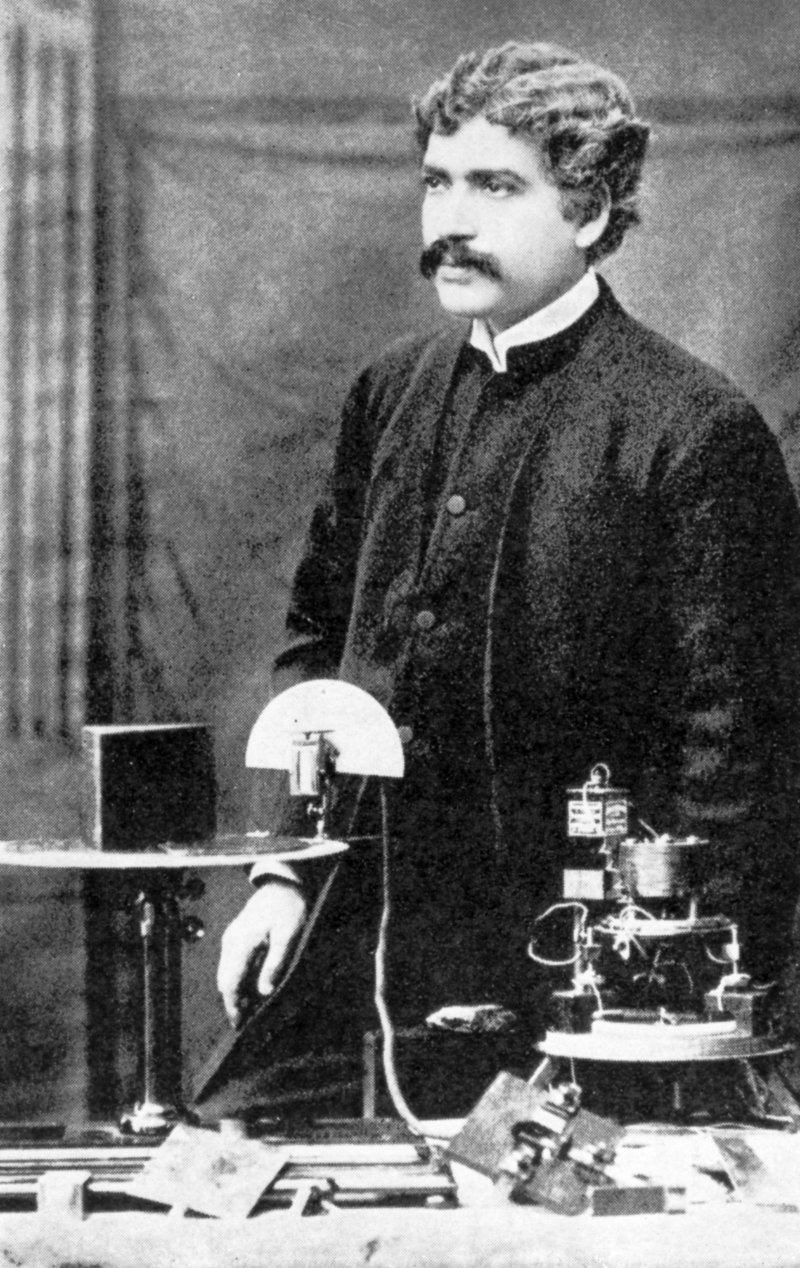
Bose's 60 GHz microwave apparatus at the Bose Institute, Kolkata, India. His receiver (left) used a galena crystal detector inside a horn antenna and galvanometer to detect microwaves. Bose invented the crystal radio detector, waveguide, horn antenna, and other apparatus used at microwave frequencies.

Diagram of microwave receiver and transmitter apparatus, from Bose's 1897 paper.

Jagadish Chandra Bose with other prominent scientists from Calcutta University.


Bose lecturing on the "nervous system" of plants at the Sorbonne in Paris in 1926

Bust of Acharya Jagadish Chandra Bose which is placed in the garden of Birla Industrial & Technological Museum

Jagadish Chandra Bose 1958 stamp of India
Inventive Innovations
Bose loved inventing new devices! One of his famous creations was a "crescent-moon" shaped radio receiver 🎶. It was one of the first devices that could detect electromagnetic waves, which helped in wireless communication! 🌌He also invented a device called a "broadband receiver" that could pick up signals from different sources. Bose's inventions were groundbreaking! They paved the way for the development of modern technologies like Wi-Fi and mobile phones. 📱💡 His love for invention shows how creativity can lead to amazing discoveries in the world of science! ✨
Awards And Recognitions
Bose received many awards throughout his life! 🏆In 1917, he became the first Indian to be elected as a Fellow of the Royal Society in London, which is a big honor for scientists. He also received honorary degrees from different universities for his incredible contributions. 🎓In India, he was recognized with awards like the Rai Bahadur title, celebrating his achievements in science! People around the world admire him for his work, inspiring countless young scientists to follow his footsteps. His dedication to science will always be remembered! 🌎✨
Early Life And Education
As a child, Bose was very curious and loved to ask questions. His family moved to Calcutta (now Kolkata), India, where he went to school. He was a bright student and later attended the University of Calcutta. After that, he traveled to England to study at Cambridge University. There, he learned about physics and biology! 🌍📚 Although Bose faced challenges as a student, he never gave up. He was determined to learn and explore. His love for education inspired many, showing us how important it is to follow our passions and dreams! 🌟
Scientific Contributions
Jagadish Chandra Bose contributed to two main fields: biology and physics! In the 1900s, he was one of the first scientists to study how plants respond to stimuli, like light and sound. 🌱🔊 He invented devices to measure plant growth and even discovered that plants can feel pain! In physics, he worked on microwave technology, helping us understand how waves travel. 📡By combining both fields, he showed the world that plants and living things are much more sensitive than we thought! His research opens new doors for future scientists. 🚪✨
Research In Plant Physiology
Jagadish Chandra Bose loved studying plants! 🌿He spent a lot of time observing how they grow and interact with their environment. His research in plant physiology showed that plants are not just what they seem; they have feelings too! 🌼Bose discovered that when plants are touched, they can respond by moving or changing. He believed that plants communicate through electrical signals, just like we do with our friends! ⚡His experiments helped scientists understand that plants are living beings with emotions, making us respect and appreciate nature even more! 🦋
Cultural Impact And Commemoration
Jagadish Chandra Bose's impact goes beyond science! 🌍He is celebrated in India for his groundbreaking discoveries. Schools, streets, and parks are named after him, showing how much people appreciate his work. In 2017, India celebrated the 159th anniversary of his birth as "National Science Day!" 🎉 Many people participate in science fairs and activities, honoring his contributions. Bose's life story teaches everyone, especially kids, the value of curiosity and hard work. He left behind a legacy that inspires us to explore science and nature every day! 🌱💖
Legacy And Influence On Future Scientists
Jagadish Chandra Bose's legacy is truly inspiring! 💪He opened doors for future scientists and showed them the importance of curiosity and experimentation. Scientists from different parts of the world look up to him for his innovative ideas and groundbreaking research. Today, many schools and universities honor his work by teaching about him and his inventions. 🏫Bose's ability to connect biology and physics helped shape fields like biophysics! His legacy encourages all of us to explore, ask questions, and never stop learning! 🌟🌈
Philosophical Views And Literary Contributions
Besides being a brilliant scientist, Jagadish Chandra Bose was also an imaginative writer! 📖He believed that science and philosophy could coexist harmoniously. He wrote science fiction stories that combined his scientific knowledge with creativity, encouraging young minds to dream big. 🌠Bose also published books discussing the wonders of nature and the universe. He wanted everyone to appreciate how amazing science can be! His love for literature and learning showed that creativity and curiosity are essential to any great scientist! ✨🤓
Pioneering Work In Radio And Wireless Communication
Bose made incredible contributions to radio and wireless communication! 📶In the early 1900s, he conducted experiments that were ahead of his time. His work on microwaves helped lay the groundwork for modern communication technologies. One remarkable event was in 1895 when he made a successful demonstration of using radio waves! 🌊He was one of the first to send wireless signals and sparked interest in the field. He demonstrated his work in London, and people were amazed! His pioneering efforts truly changed how we connect with each other today! 🌍📞
Jagadish Chandra Bose Quiz
Learn more about Jagadish Chandra Bose
