Hertz Facts For Kids
Hertz is the SI unit of frequency, indicating the number of cycles per second of a periodic event.
Select reading age

Hertz Facts For Kids
Videos & Quizzesincluded
About this topic
Hertz (Hz) is a special unit that tells us how many times something happens in one second. 🤔For example, if a light blinks on and off 10 times in one second, we say it has a frequency of 10 Hertz! The name Hertz comes from a smart man named Heinrich Hertz, who lived in Germany in the 1800s. 📅Knowing about Hertz helps us understand many things, like sound, music, and technology. So, let’s dive into this exciting world and learn all about Hertz together! 🌟
Explore with ChatDinoKey Points
Hertz is used to measure how often something occurs, specifically in one second!
In physics, Hertz is super important!
Here are some fun facts about Hertz!
To measure Hertz, we look at how many times something happens in one second.
When you listen to music, you are experiencing Hertz in action!
The term "Hertz" was named after Heinrich Hertz, a scientist who proved that electromagnetic waves exist!
Hertz and frequency are like best friends!
Hertz is super important in technology!
When you listen to the radio, Hertz plays a big role!
Photos of Hertz
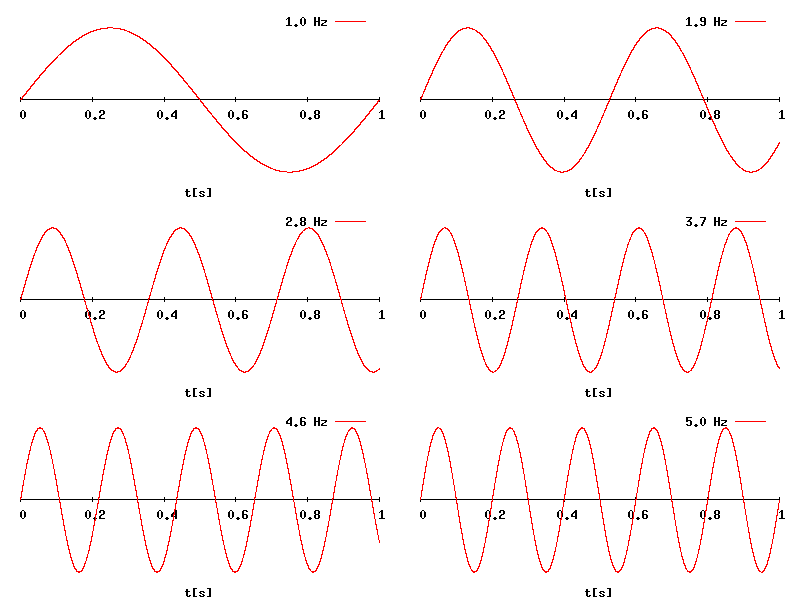
A sine wave with varying frequency

A heartbeat is an example of a non-sinusoidal periodic phenomenon that may be analyzed in terms of frequency. Two cycles are illustrated.
🎉 What Is Hertz?
Hertz is used to measure how often something occurs, specifically in one second! 🎉One Hertz means something happens one time in one second. For example, if a fan spins around twice in one second, we can say it’s spinning at 2 Hertz! 🌀The higher the number of Hertz, the faster or more frequently something occurs. This helps us understand waves, like sound waves and light waves, which are super important in our everyday lives! 🌈So whenever you hear the word "Hertz," you’ll know it’s all about how often something happens!
Go deeper🧲 Hertz And Physics
In physics, Hertz is super important! 🧲It helps scientists understand waves, energy, and motions. For example, light waves travel at incredibly high frequencies, from about 400 trillion Hertz (red light) to 800 trillion Hertz (violet light). 🌈The speed of these waves can be very fast! Hertz also helps measure vibrations in different materials. So, when you learn about the universe, remember Hertz is like a secret code that scientists use to understand waves and how things move! 🌌
Go deeper🎉 Fun Facts About Hertz
Here are some fun facts about Hertz! 🎉Did you know that the highest note humans can hear is around 20,000 Hz? 🐦Or that a blinking LED light can operate at thousands of Hz?! 💡Also, radio waves travel at the speed of light, which is about 300,000 kilometers per second! 🚀Isn’t that amazing? Hertz helps us discover more about the world around us, making science fun! So, whether you’re listening to music or talking on the phone, remember that Hertz is an essential part of your life! 🌠
Go deeper⏱ How Hertz Is Measured
To measure Hertz, we look at how many times something happens in one second. ⏱If a machine clicks 30 times in one second, we say it’s working at 30 Hertz! You can use tools like oscilloscopes or frequency counters to help count these events accurately. 📏When scientists want to measure frequencies in Hz, they often look at waves, like sound or light waves. For sound, we can hear from 20 Hz to 20,000 Hz! 🎶When you listen to music, you’re actually experiencing different frequencies measured in Hertz!
Go deeper🎶 Hertz In Sound And Music
When you listen to music, you are experiencing Hertz in action! 🎶Musical notes have different frequencies measured in Hertz. For instance, the note A above middle C is 440 Hz! 🎼This is known as the standard pitch for tuning musical instruments. Different instruments produce different Hertz: a drum might go as low as 50 Hz while a flute might go up to 2000 Hz or more! 🎤So, every time you enjoy a song, think about how all those cool frequencies are combined to make beautiful music!
Go deeper🧑🔬 History Of The Hertz Unit
The term "Hertz" was named after Heinrich Hertz, a scientist who proved that electromagnetic waves exist! 🧑🔬 He was born in Hamburg, Germany, in 1857 and did amazing experiments in the late 1880s. 📚Heinrich Hertz didn't create the unit, but his work helped scientists understand waves better. In 1930, the International Electrotechnical Commission decided to name the unit of frequency after him. 🎊Since then, hertz has been used globally to talk about sound, radio, and other cool things in science! So remember, every time we use Hertz, we celebrate Heinrich Hertz!
Go deeper🤝 Relation Of Hertz To Frequency
Hertz and frequency are like best friends! 🤝Frequency refers to how often something happens, while Hertz is the unit we use to measure that. The more frequently an event occurs, the higher the Hertz! 🔼For example, if a wave happens 5 times a second, it has a frequency of 5 Hertz. Waves can be found in sound, light, and even ocean waves! 🌊Understanding Hertz helps scientists, like physicists, study and explain different kinds of waves in nature!
Go deeper🌐 Applications Of Hertz In Technology
Hertz is super important in technology! 🌐For example, in computers, the speed of the processor is measured in gigahertz (GHz), where 1 GHz equals 1 billion Hz! 🖥This tells us how fast the computer can work. Similarly, TV signals and Wi-Fi also operate in certain frequencies measured in Hertz. 🌊Scientists use these frequencies to send information through the air! 📡So next time you use your phone or watch TV, remember that Hertz is working in the background, helping everything function smoothly!
Go deeper📻 Hertz In Radio And Telecommunications
When you listen to the radio, Hertz plays a big role! 📻Radio stations broadcast signals that travel through the air in waves measured in megahertz (MHz). One megahertz equals one million hertz! 🌌Most FM radio stations work anywhere between 88 MHz to 108 MHz. 📡When you tune your radio, you're selecting a specific frequency, allowing you to listen to your favorite songs or news. So, next time you turn on the radio, think of all the Hertz buzzing around to bring you sounds!
Go deeper