Henry Moseley Facts For Kids
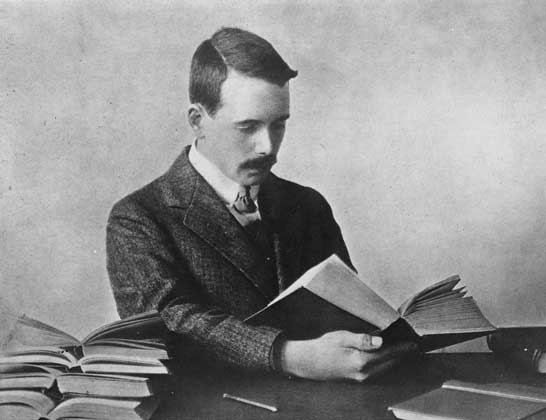
Henry Moseley was a pioneering English physicist whose groundbreaking work on atomic number redefined the periodic table and advanced the field of atomic physics.
Select reading age
Henry Moseley Facts For Kids
Videos & Quizzesincluded
About this topic
Henry Moseley was a clever English scientist born on November 23, 1887, in Weymouth, England 🇬🇧. He loved learning about atoms and elements, which are tiny particles that make up everything around us! At the young age of 27, he made amazing discoveries about how elements are organized in the periodic table. Moseley’s work changed science forever, helping us understand what makes up matter. Tragically, he died in World War I at just 27 years old, but his discoveries continue to influence scientists today! 🧪✨
Explore with ChatDinoKey Points
The Moseley Medal is a special award given to honor scientists who make important discoveries in the field of physics.
Moseley’s Law is an important scientific principle he discovered!
Henry Moseley’s legacy lives on in science, inspiring future generations!
Henry Moseley grew up in a family that loved education.
Thanks to Henry Moseley's discoveries, the periodic table is now organized by atomic number!
Henry Moseley is most famous for his research on atomic numbers 🔢.
Henry Moseley’s discoveries transformed modern chemistry and physics!
Sadly, Henry Moseley's life was cut short when he decided to serve in World War I ⚔️🌍.
Photos of Henry Moseley

A plaque commemorating Moseley's work in the Department of Physics and Astronomy, University of Manchester

Moseley in the Balliol-Trinity Laboratories in 1910

Blue plaque erected by the Royal Society of Chemistry on the Townsend Building of Oxford's Clarendon Laboratory, commemorating Moseley's work on X-rays emitted by elements
🥇 Moseley Medal
The Moseley Medal is a special award given to honor scientists who make important discoveries in the field of physics. 🥇🌌 It is named after Henry Moseley to remember his amazing contributions. The medal is awarded by the Institute of Physics, which is an organization in the UK that encourages people to study and enjoy physics. This exciting award helps scientists get recognized for their hard work and achievements, just like how Moseley was celebrated for changing our understanding of elements! 🌟By giving this medal, scientists are encouraged to be curious and explore the mysteries of our world! 🌍🔍
Go deeper📏 Moseley's Law
Moseley’s Law is an important scientific principle he discovered! 📏⚛️ It states that the frequency of X-rays emitted from an element is related to its atomic number. This means that as the atomic number increases, the energy and frequency of the X-rays also increase. Moseley proved that the atomic number, not atomic mass, should be used to organize elements in the periodic table. This finding helped chemists and physicists understand the relationship between elements better and enhanced experiments using X-rays. Moseley's Law is still used in laboratories around the world today! 🔬🔭
Go deeper💫 Legacy And Honors
Henry Moseley’s legacy lives on in science, inspiring future generations! 💫After his death, many scientists recognized his genius and contributions to chemistry and physics. The Moseley Medal was established in his honor, awarded to scientists who made significant contributions to experimental physics. His work on the periodic table remains crucial in our understanding of the elements, and students today still learn about him. Schools and institutions may also name awards and programs after him to commemorate his amazing achievements and encourage young scientists to follow in his footsteps 🥇🌟.
Go deeper📚 Early Life And Education
Henry Moseley grew up in a family that loved education. His father, who was a teacher, encouraged him to learn a lot 📚. He attended the prestigious University of Oxford, where he studied physics. Moseley was a curious student and worked hard to learn about atoms. During his studies, he became fascinated by X-rays, powerful rays that can see inside things. In 1912, he earned his degree and joined a research group to find out more about the world of atoms. This path would lead him to make great discoveries! 🎓🔍
Go deeper🗂️ Impact On Periodic Table
Thanks to Henry Moseley's discoveries, the periodic table is now organized by atomic number! 🗂️🔬 Before Moseley, scientists were confused because some elements didn’t fit neatly when arranged by atomic mass. By showing that the atomic number is the key to organizing elements, he laid the groundwork for future scientists to work more efficiently. This change allowed us to understand elements like gold (atomic number 79) and oxygen (atomic number 8) better, making chemistry more exciting and easier to study. Today, the periodic table is a vital tool in science classrooms around the world! 🌍🍎
Go deeper🔢 Scientific Contributions
Henry Moseley is most famous for his research on atomic numbers 🔢. He used X-ray technology to measure the positive charge of an atom’s nucleus. This was groundbreaking because it helped scientists see that the number of protons in the nucleus determines the identity of an element. Before Moseley's work, the periodic table was organized by atomic mass, which sometimes caused confusion. His findings made the periodic table clearer and more accurate, allowing scientists to build upon his work and explore the world of chemistry even more. 💡👨🔬
Go deeper⚛️ Influence On Modern Chemistry
Henry Moseley’s discoveries transformed modern chemistry and physics! ⚛️💡 By figuring out how to arrange the periodic table by atomic number, he helped scientists better understand how different elements interact. For example, now we know much more about the properties of elements like hydrogen (atomic number 1) and helium (atomic number 2). Moseley’s ideas led to advances in research, like how to create new materials and medicines. His focus on accuracy encourages scientists to keep exploring, making the world of science an adventurous journey! Today, scientists build on his work, searching for new elements and their uses! 🌌🔬
Go deeper⚔️ World War I And Military Service
Sadly, Henry Moseley's life was cut short when he decided to serve in World War I ⚔️🌍. He joined the British Army and fought bravely for his country, showing great honor and courage. Moseley believed it was important to help others and protect those in need. He served as a second lieutenant in the Royal Engineers and was sent to the battlefield in Gallipoli, Turkey, in 1915. Tragically, he died on August 10, 1915, while fighting for his country. Even though his life was brief, his contributions to science were remarkable! 🎖️❤️
Go deeper