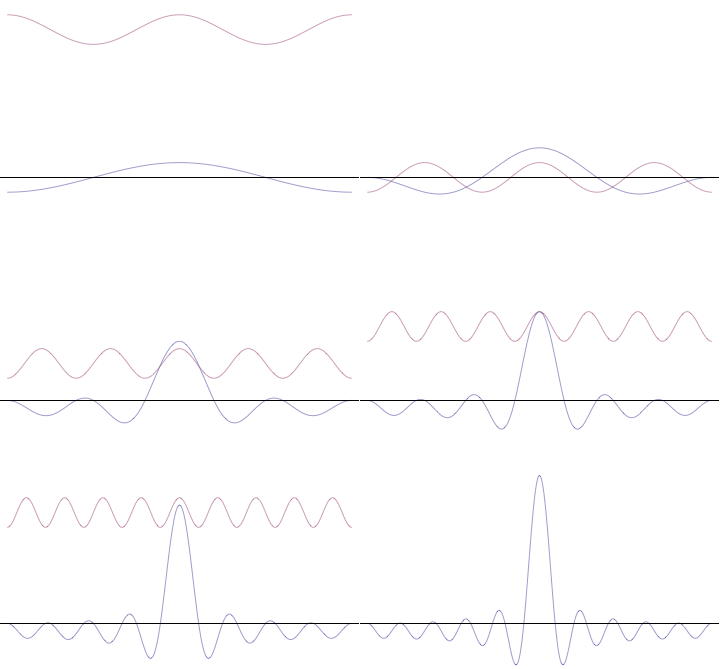
The Heisenberg Uncertainty Principle is a fundamental concept in quantum mechanics that asserts limitations on the precision of simultaneously measuring certain pairs of complementary variables, such as position and momentum.


Set reading age
View for Kids
Easy to read and understand
View for Students
Clear, detailed explanations
View for Scholars
Deep dives and big ideas
The Heisenberg Uncertainty Principle is a cool idea in physics proposed by a scientist named Werner Heisenberg in 1927. 🤔This principle tells us that we can’t know everything about tiny particles like electrons at the same time. For example, if we know where an electron is, we can’t tell how fast it’s moving, and if we know its speed, we don’t know exactly where it is! This is super important because it helps scientists understand the behavior of tiny things in the universe. 🌌
Werner Heisenberg was born in Germany in 1901. 🎉He studied physics and became one of the key figures in quantum mechanics, which studies very small particles. His big idea, the Uncertainty Principle, was a major discovery that changed how scientists think about the tiniest parts of our world. He won the Nobel Prize in Physics in 1932 for his work! Heisenberg's ideas helped shape modern physics and are still discussed today. 🏆
The Heisenberg Uncertainty Principle is often written as Δx × Δp ≥ h/4π. But what does it mean? 🤓Here, Δx is the uncertainty in position (where something is), and Δp is the uncertainty in momentum (how fast something is moving). The h stands for Planck’s constant, which is a very small number that helps us understand the tiny world of quantum particles. This equation tells us that the more precisely we try to know one of these things, the less we can know about the other! 📏
The Heisenberg Uncertainty Principle isn’t just an idea for scientists; it helps improve technology too! 📱For instance, it plays a role in developing technologies like quantum computers, which use tiny particles to perform amazing calculations. This principle also helps with making super-precise measurements and tools used in many devices, like GPS! Without understanding this principle, many modern technologies would not be possible. 🚀
The Heisenberg Uncertainty Principle raises interesting questions! 🤔If we can never know everything about a particle, what does that say about knowledge in general? Some philosophers argue it shows that the universe is unpredictable. This idea reminds us that even in science, some things are beyond our grasp. 🌌Others believe this principle encourages curiosity and exploration, pushing scientists to keep searching for answers about the mysteries of the universe! 🌟
Some people think the Uncertainty Principle means we just need better tools to measure particles more accurately. 🔧But that’s not true! The principle is a limit built into the nature of particles. Just because we want to measure something doesn’t mean we can know it perfectly. 🎯It’s not a result of mistakes; it’s a fundamental rule of how things work at a tiny level! Understanding this helps us appreciate the mystery of the quantum world. 🌌
Scientists are still researching the Heisenberg Uncertainty Principle today! 📚They want to understand more about how particles behave in different situations. There are exciting developments in quantum technology, such as quantum computing and quantum cryptography, that rely on this principle. Researchers are also experimenting with new theories that could change what we know about particles and the universe. Who knows what they will discover next? The journey of exploration continues! 🚀🎉
In quantum mechanics, the Heisenberg Uncertainty Principle has big implications! 🌌It means that particles don't have definite positions or speeds until we try to measure them. This makes the world of tiny particles very different from what we see in our everyday lives. Because of this principle, scientists believe particles exist in a sort of “fuzzy” state, where they can be in many places at once! This idea challenges how people think about reality. 🌈
In experiments, scientists have shown the Uncertainty Principle is real! ⚗️ One famous experiment involves shooting light at electrons. When scientists measure where the electron is, the light can change its momentum (speed and direction), making it impossible to know both things at the same time! This confirms Heisenberg's idea and shows that uncertainty is a fundamental part of nature. More experiments using lasers and tiny particles also support this principle! 🔬


DIY is a creative community where kids draw, build, explore ideas, and share.
No credit card required