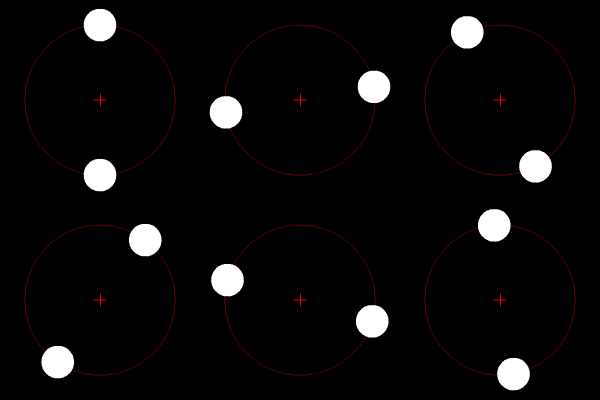
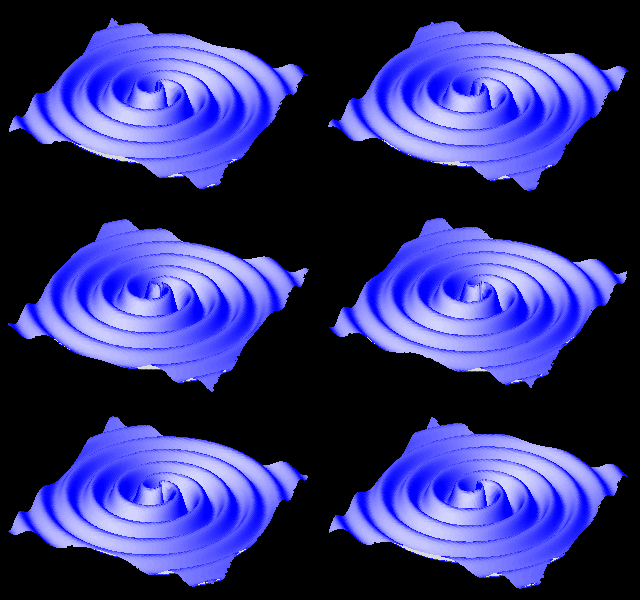
Gravitational waves are tiny disturbances in the gravitational field caused by the motion of massive objects, radiating outward at the speed of light.
Set reading age
View for Kids
Easy to read and understand
View for Students
Clear, detailed explanations
View for Scholars
Deep dives and big ideas
Gravitational waves are like ripples in a pond, but instead of water, they are found in space! 🌌These waves happen when massive objects, like stars and black holes, move around. Imagine two ballet dancers twirling together—when they move, they create waves that spread out around them. Gravitational waves travel at the speed of light, which is super fast—about 186,000 miles per second! 🏃♂️💨 Scientists first discovered these waves just a few years ago, in 2015. Learning about them helps us understand more about the universe and our place in it! 🌟🪐
Gravitational waves are changes in gravity caused by moving objects in space. ⚛️ When two massive things collide or orbit each other, they shake space like a drum. This shaking creates tiny waves that can reach Earth from billions of miles away! 🛰️ Think about a big rock being thrown into a lake, creating ripples; that’s similar to what happens in space! These waves are very weak and difficult to detect, but they tell us amazing stories about super cool things like black holes and neutron stars! 🌌💖
Cosmology is the study of the universe! 🪐Gravitational waves help us learn about the universe's history and how it has changed over time. They can tell stories about early galaxies, how stars form, and when events like supernovae occur! 🌟💥 By mapping out these waves, scientists can create a picture of what the universe looked like billions of years ago! 🌌✨ Researchers believe gravitational waves will lead to even more discoveries about dark matter and dark energy, the mysterious forces that make up much of our universe. 🌌🔍
Black holes are super mysterious and powerful! 🌌A black hole forms when a massive star runs out of fuel and collapses. When two black holes spiral together, they create gravitational waves! 🌑💥 Since they don’t let light escape, we can’t see them directly, so detecting the waves gives us clues about them instead. In fact, the first gravitational wave detected came from two merging black holes! 🎉Learning about these waves helps uncover more secrets about black holes and their amazing influence on the universe! 🌠🔭
To find these tiny waves, scientists built special detectors, like LIGO (Laser Interferometer Gravitational-Wave Observatory) in the United States. 🇺🇸🔭 LIGO uses lasers that bounce around and can detect even the tiniest changes caused by gravitational waves. Imagine a super advanced set of ears listening for the faintest sound! When a wave passes, it slightly stretches and squeezes the detector, allowing scientists to “hear” these waves. 📡LIGO has detected several waves since its launch, opening a new way to explore space! 🌌✨
Some incredible events have been observed through gravitational waves! The first detection, GW150914, was from two black holes merging into a single, even bigger black hole. 🌌🌑 Another event, GW170817, was special because it came from a collision between two neutron stars, which is a superdense type of star! 🌟💥 This event also created visible light but was much harder to detect. Scientists could view both gravitational waves and light from it, giving them more information about space than ever before! 📡🔍
The future of studying gravitational waves is bright! ☀️ Scientists are developing even more advanced detectors, like the one being built in Europe called the Einstein Telescope. 🧑🔬 This new instrument will be more sensitive, allowing us to “hear” even fainter waves from distant space events. With more detectors around the world, scientists hope to unlock more secrets about black holes, neutron stars, and the Big Bang! 🌌💖 Exciting discoveries are still waiting to be made, so the adventure of understanding the universe will continue! 🌠✨
Detecting gravitational waves is tricky! 🎢The waves are super tiny compared to the distance they travel. 🌌LIGO and other detectors are very sensitive, but things like earthquakes or even cars driving nearby can create noise that makes it hard to spot the waves. 🌍🔊 Scientists constantly work to improve their techniques and make their detectors quieter! They have to use clever methods to separate the actual waves from all the “background noise.” Each new wave detected is a victory against these challenges! 🎉🔭
Gravitational wave astronomy began with scientist Albert Einstein in 1916. 🧑🏫 He predicted that waves could exist, but no one could find them for a long time. In 2015, after nearly 100 years of searching, LIGO made the first successful detection from a collision of two black holes! 🌑💥 This event was called GW150914. Scientists around the world celebrated this achievement as a huge leap for astronomy! Since then, gravitational waves have given us insights into mysterious events in space, making 2015 a historic year! 📅🌠
Gravitational waves are a big deal because they help scientists understand gravity and the universe better! 🌌✨ They allow researchers to study objects that can’t be seen with regular telescopes, like black holes merging or neutron stars colliding. 🧑🔬 Learning about these waves helps fill in gaps about how our universe works, much like solving a puzzle. Each discovery helps refine scientists’ theories about stars, galaxies, and the nature of space itself! Gravitational waves truly take physics to an exciting new level! 🎉⚛️
Gravitational waves are revolutionizing our understanding of the universe! 🌌They offer a new way to observe cosmic events that are invisible to other telescopes. 📡Each detected wave gives us information about the forces at work in the universe. This helps us learn about how galaxies form, how elements like gold are created, and even the life cycles of stars! 🌟By studying gravitational waves, scientists are answering questions that have puzzled humanity for centuries. 🌠✨ They are opening our eyes to a whole new universe of possibilities! 🌌💖


DIY is a creative community where kids draw, build, explore ideas, and share.
No credit card required