Gravitational Lens Facts For Kids
Gravitational lensing is a phenomenon where massive objects bend light from distant sources, allowing us to see faint stars and galaxies.

About this topic
Quick Facts
Key Points
Photos of Gravitational Lens
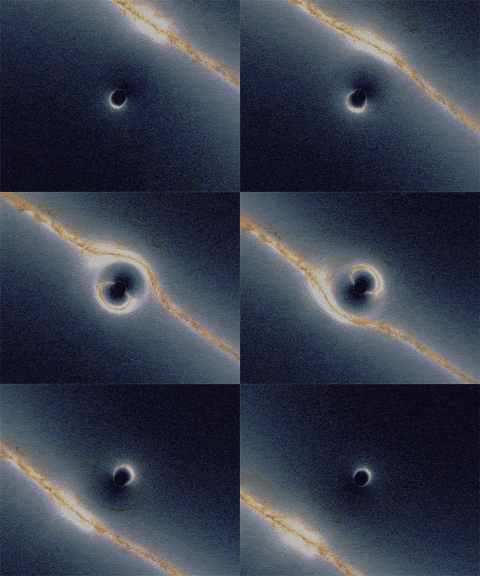
Simulated gravitational lensing (black hole passing in front of a background galaxy)

A light source passes behind a gravitational lens (invisible point mass placed in the center of the image). The aqua circle is the light source as it would be seen if there were no lens, while white spots are the multiple images of the source (see Einstein ring).

One of Eddington's photographs of the 1919 solar eclipse experiment, presented in his 1920 paper announcing its success

Bending light around a massive object from a distant source. The orange arrows show the apparent position of the background source. The white arrows show the path of the light from the true position of the source.

In the formation known as Einstein's Cross, four images of the same distant quasar appear around a foreground galaxy due to strong gravitational lensing.

This image from the NASA/ESA Hubble Space Telescope shows the galaxy cluster MACS J1206.
![Galaxy cluster SDSS J0915+3826 helps astronomers to study star formation in galaxies.[27]](https://upload.wikimedia.org/wikipedia/commons/thumb/6/6d/Helping_Hubble_SDSS_J0915%2B3826.tif/lossy-page1-640px-Helping_Hubble_SDSS_J0915%2B3826.tif.jpg)
Galaxy cluster SDSS J0915+3826 helps astronomers to study star formation in galaxies.[27]

October 16, 2014 RELEASE 14-283 NASA’s Hubble Finds Extremely Distant Galaxy through Cosmic Magnifying Glass http://www.nasa.gov/press/2014/october/nasa-s-hubble-finds-extremely-distant-galaxy-through-cosmic-magnifying-glass IMAGE: The mammoth galaxy cluster Abell 2744 is so massive that its powerful gravity bends the light from galaxies far behind it, making these otherwise unseen background objects appear larger and brighter than they would normally. Image Credit: NASA, J. Lotz, (STScI) DESCRIPTION: Peering through a giant cosmic magnifying glass, NASA’s Hubble Space Telescope has spotted a tiny, faint galaxy -- one of the farthest galaxies ever seen. The diminutive object is estimated to be more than 13 billion light-years away. This galaxy offers a peek back to the very early formative years of the universe and may just be the tip of the iceberg. “This galaxy is an example of what is suspected to be an abundant, underlying population of extremely small, faint objects that existed about 500 million years after the big bang, the beginning of the universe,” explained study leader Adi Zitrin of the California Institute of Technology in Pasadena, California. “The discovery is telling us galaxies as faint as this one exist, and we should continue looking for them and even fainter objects, so that we can understand how galaxies and the universe have evolved over time.” The galaxy was detected by the Frontier Fields program, an ambitious three-year effort that teams Hubble with NASA’s other great observatories -- the Spitzer Space Telescope and Chandra X-ray Observatory -- to probe the early universe by studying large galaxy clusters. These clusters are so massive their gravity deflects light passing through them, magnifying, brightening, and distorting background objects in a phenomenon called gravitational lensing. These powerful lenses allow astronomers to find many dim, distant structures that otherwise might be too faint to see. The discovery was made using the lensing power of the mammoth galaxy cluster Abell 2744, nicknamed Pandora’s Cluster, which produced three magnified images of the same, faint galaxy. Each magnified image makes the galaxy appear 10 times larger and brighter than it would look without the zooming qualities of the cluster. The galaxy measures merely 850 light-years across -- 500 times smaller than our Milky Way galaxy-- and is estimated to have a mass of only 40 million suns. The Milky Way, in comparison, has a stellar mass of a few hundred billion suns. And the galaxy forms about one star every three years, whereas the Milky Way galaxy forms roughly one star per year. However, given its small size and low mass, Zitrin said the tiny galaxy actually is rapidly evolving and efficiently forming stars. The astronomers believe galaxies such as this one are probably small clumps of matter that started to form stars and shine, but do not yet have a defined structure. It is possible Hubble is only detecting one bright clump magnified due to the lensing. This would explain why the object is smaller than typical field galaxies of that time. Zitrin’s team spotted the galaxy’s gravitationally multiplied images using near-infrared and visible-light photos of the galaxy cluster taken by Hubble’s Wide Field Camera 3 and Advanced Camera for Surveys. But they needed to measure how far away it was from Earth. Usually, astronomers can determine an object’s distance based on how far its light has been stretched as the universe slowly expands. Astronomers can precisely measure this effect through spectroscopy, which characterizes an object’s light. But the gravitationally-lensed galaxy and other objects found at this early time period are too far away and too dim for spectroscopy, so astronomers use an object’s color to estimate its distance. The universe’s expansion reddens an object’s color in predictable ways, which scientists can measure. Zitrin’s team performed the color-analysis technique and took advantage of the multiple images produced by the gravitational lens to independently confirm the group’s distance estimate. The astronomers measured the angular separation between the three magnified images of the galaxy in the Hubble photos. The greater the angular separation due to lensing, the farther away the object is from Earth. To test this concept, the astronomers compared the three magnified images with the locations of several other closer, multiply-imaged background objects captured in Hubble images of Pandora’s cluster. The angular distance between the magnified images of the closer galaxies was smaller. “These measurements imply that, given the large angular separation between the three images of our background galaxy, the object must lie very far away,” Zitrin explained. “It also matches the distance estimate we calculated, based on the color-analysis technique. So we are about 95 percent confident this object is at a remote distance, at redshift 10, a measure of the stretching of space since the big bang. The lensing takes away any doubt that this might be a heavily reddened, nearby object masquerading as a far more distant object.” Astronomers have long debated whether such early galaxies could have provided enough radiation to warm the hydrogen that cooled soon after the big bang. This process, called reionization, is thought to have occurred 200 million to 1 billion years after the birth of the universe. Reionization made the universe transparent to light, allowing astronomers to look far back into time without running into a “fog” of cold hydrogen. The team’s results appeared in the September online edition of The Astrophysical Journal Letters. The Hubble Space Telescope is a project of international cooperation between NASA and the European Space Agency. NASA's Goddard Space Flight Center in Greenbelt, Maryland, manages the telescope. The Space Telescope Science Institute (STScI) in Baltimore conducts Hubble science operations. STScI is operated for NASA by the Association of Universities for Research in Astronomy, Inc., in Washington. For images and more information about Hubble, visit: http://www.nasa.gov/hubble
![Galaxy cluster MACS J2129-0741 and lensed galaxy MACS2129-1.[43]](https://upload.wikimedia.org/wikipedia/commons/thumb/7/76/Galaxy_cluster_MACS_J2129-0741_and_lensed_galaxy_MACS2129-1.jpg/960px-Galaxy_cluster_MACS_J2129-0741_and_lensed_galaxy_MACS2129-1.jpg)
Galaxy cluster MACS J2129-0741 and lensed galaxy MACS2129-1.[43]