Francis Galton Facts For Kids
Francis Galton was a British polymath best known for his contributions to psychology, statistics, and eugenics, and was a pioneer in the study of human intelligence and heredity.
Select reading age

Francis Galton Facts For Kids
Videos & Quizzesincluded
About this topic
Francis Galton was a famous scientist born on February 16, 1822, in Birmingham, England 🇬🇧. He was a smart man who loved exploring and studying human behavior. Galton is best known for his work in statistics and was a cousin of Charles Darwin, the man who created the idea of evolution 🌱. He wanted to understand how people differ from one another and invented many cool methods to study this. Galton passed away on January 17, 1911, but his ideas still help people today. Let’s dive into the fascinating life and discoveries of this extraordinary scientist! 🧪
Explore with ChatDinoKey Points
Galton is often associated with the eugenics movement, which started in the late 1800s 🤔.
Francis Galton was born into a wealthy family, which helped him get a great education 📚.
Galton made big contributions to statistics!
While Francis Galton made important discoveries, some of his ideas have faced criticism 🔍.
Francis Galton's ideas continue to influence science today 🌟.
Galton was curious about how people differ, so he created a field called anthropometry, which studies human measurements (like height and weight)📐.
Today, scientists continue to explore ideas started by Francis Galton!
Francis Galton was a pioneer in psychometrics, the science of measuring human intelligence and abilities 🧠.
Photos of Francis Galton
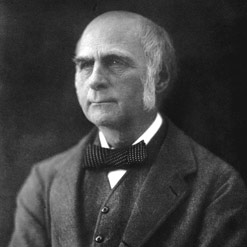
Galton in his later years

Portrait of Galton by Octavius Oakley, 1840

Portrait by Charles Wellington Furse, 1903
Full text of Inquiries into human faculty and its development

Sir Francis Galton, 1890s

Galton's 1889 illustration of the quincunx or Galton board
![Galton's correlation diagram 1886[57]](https://upload.wikimedia.org/wikipedia/commons/thumb/b/b2/Galton%27s_correlation_diagram_1875.jpg/960px-Galton%27s_correlation_diagram_1875.jpg)
Galton's correlation diagram 1886[57]

Francis Galton (right), aged 87, on the verandah at Fox Holm, Cobham, with the statistician Karl Pearson

Louisa Jane Butler
🤔 Eugenics Movement
Galton is often associated with the eugenics movement, which started in the late 1800s 🤔. Eugenics is the idea of improving human populations by controlling who can have babies. Galton believed that good traits could be passed down through generations, just like eye color or height. He wanted to identify people with 'desirable' traits to encourage them to have more children. However, many people today view eugenics as a harmful idea that can lead to discrimination and unfair treatment. It’s important to remember that everyone is unique and valuable, no matter their traits! 🌈
Go deeper📚 Early Life And Education
Francis Galton was born into a wealthy family, which helped him get a great education 📚. He attended King Edward's School in Birmingham and later went to the University of Birmingham. After that, he traveled to Germany to study at the University of Göttingen. Galton loved mathematics, geography, and natural science! He spent lots of time reading and exploring. Did you know? Galton became a traveler and adventurer, visiting many places in Africa and the Middle East! 🌍He loved collecting data and learning about the world, setting the stage for his future discoveries.
Go deeper📊 Contributions To Statistics
Galton made big contributions to statistics! 📊He invented the term "correlation," which helps scientists understand how things relate to each other. For example, if you want to know how height and shoe size relate, you can use correlation! Galton also developed new ways to collect and analyze data, including the use of scatter plots and regression lines. These help us see patterns in numbers. Because of his work, statistics became super important in science, and we still use his ideas today! 📈His approach changed how people study and measure the world around them.
Go deeper🔍 Controversies And Criticisms
While Francis Galton made important discoveries, some of his ideas have faced criticism 🔍. His work in eugenics was controversial because it promoted the idea that some people are "better" than others, which can lead to inequality and discrimination. Modern scientists recognize that all human beings have value, regardless of their traits or backgrounds. Some of Galton's methods, like using head sizes to determine intelligence, are now seen as outdated and wrong. It’s crucial to learn from the past and understand how to treat everyone with respect and fairness, regardless of differences. 🌍❤️
Go deeper🌟 Galton's Legacy And Influence
Francis Galton's ideas continue to influence science today 🌟. He started the field of behavioral genetics, which studies how genes affect behavior. Some scientists even consider him the grandfather of modern psychology! Galton inspired other famous scientists, like his cousin Charles Darwin, and many researchers in modern fields of biology and social sciences. His work with statistics has shaped how we analyze and interpret data, making it easier for scientists to learn more about the world. Galton's passion for human differences helped spark interest across many scientific fields that are important today! 🎓
Go deeper📐 Anthropometry And Human Variation
Galton was curious about how people differ, so he created a field called anthropometry, which studies human measurements (like height and weight)📐. He and his friends measured thousands of people to find patterns in human traits. For example, he noticed that taller parents often had taller children! 🧬Galton used these ideas to create a "family resemblance" tool. His work helped scientists learn more about genetics and how traits are passed down. Today, anthropometry is still important in health and fitness studies! Galton's fascination with human differences laid the foundation for understanding diversity among people.
Go deeper🎉 Modern Relevance And Applications
Today, scientists continue to explore ideas started by Francis Galton! 🎉His work in statistics is used in many areas, such as psychology, medicine, and sociology. Researchers still study human variation and behavior. For example, understanding genetics has helped scientists discover how diseases can be linked to our DNA. Galton's ideas about measuring traits have shaped how we collect and analyze information in all fields of science. Even though some of his ideas were controversial, his desire to learn about the human experience inspires scientists to keep exploring and asking questions about ourselves! 🤓✨
Go deeper🧠 Psychometrics And Intelligence Testing
Francis Galton was a pioneer in psychometrics, the science of measuring human intelligence and abilities 🧠. He created one of the first intelligence tests in the late 1800s. Galton believed intelligence was based on measurements like reaction time and sensory abilities. He even measured people's head sizes to see if it related to intelligence! 📏Although many of his ideas are not used today, they helped inspire modern IQ tests and assessments to understand how people think and learn. Galton's work showed that finding ways to measure and understand intelligence can be a fun and important challenge!
Go deeper