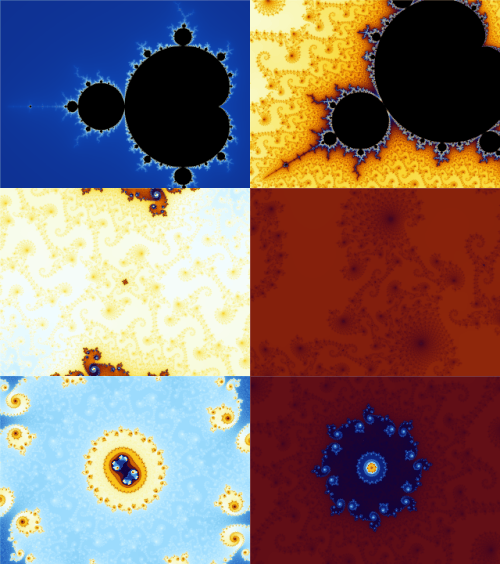
Fractals are complex geometric shapes exhibiting detailed structure at smaller scales, often characterized by self-similarity and non-integer dimensions.


Set reading age
View for Kids
Easy to read and understand
View for Students
Clear, detailed explanations
View for Scholars
Deep dives and big ideas
Fractals are fascinating shapes that look the same no matter how much you zoom in or out! 🤩Imagine a snowflake or a tree branch; if you examine them closely, they still show similar patterns. Fractals are found in math and nature, making them super cool! 🌳✨ They were popularized by mathematician Benoit Mandelbrot in the 1970s. He said, "Fractals are everywhere!" You can see fractals in coastlines, clouds, and even in broccoli! 🌊☁️🥦 Learning about fractals helps us understand patterns in nature, art, and science. Let's explore this magical world of repeating shapes together!
Some of the most famous fractals include the Mandelbrot set and the Julia set! The Mandelbrot set, discovered by Benoit Mandelbrot, is a colorful shape that looks like a heart or a swirling ocean! 🖤💙 It’s defined by a simple equation, but it creates stunning patterns when graphed. The Julia set, named after Gaston Julia, has many beautiful variations based on different equations. These fractals can be made into colorful designs! 🎨Other famous examples include the Koch snowflake, which looks like a snowy mountain, and the Fern fractal, resembling a tiger fern plant! 🌿❄️
Fractals have inspired many artists! 🎨Some create stunning artworks using fractal patterns, making paintings that look like swirling galaxies or elaborate flowers! 🌌🌼 An artist named Jackson Pollock used repetition in his paintings, which reminds us of fractals. 🖌️ Computer art programs can help create fractal artwork by generating patterns and colorful designs. Fractals are also used in architecture, where buildings have repeating shapes that create unique designs! 🏛️ Next time you look at art, try to spot the fractal patterns hidden within! Art and math can mix in beautiful ways! 🎉❤️
Fractal dimension is a fun and weird part of fractals! 🎢While regular shapes have dimensions like 1, 2, or 3 (like lines, squares, and cubes), fractals can have fractions! 🤯For example, the coastline of a country has a dimension between 1 and 2 because of its jagged edges. This means it's not fully a line or a flat area! 📏The fractal dimension gives us a way to understand how complex a shape is; the more detail it has, the higher the dimension. Fractal dimension helps scientists study everything from landscapes to galaxies! 🌌🪐
Fractals are everywhere in nature! 🌍For instance, coastlines are often jagged and irregular, just like a fractal. If you zoom in on a rocky coastline, it still looks similarly rough and uneven! 🏝️ Trees are another great example; the branches split off in a repeating pattern. 🌳Even clouds form shapes that look like fractals when you observe them from above! ☁️ Random things like lightning bolts and river networks also exhibit fractal properties! By studying these natural patterns, scientists can better understand our world. Nature really loves fractals! 🍃✨
Generating fractals can be a fun activity! 🎨One way to create your own fractals is through a simple rule. For example, you might take a line and split it into three equal parts, remove the middle part, and make a triangle stick out. Keep repeating this, and you will create a Koch snowflake! ❄️ Another method is using computers. By inputting equations, programs can generate stunning fractal images! 💻Programs like Fractal Explorer let you zoom in and out, discovering never-ending patterns. So, grab some paper or a computer, and start creating your own fractal masterpiece! 🎉✏️
Fractals started becoming popular in the 20th century thanks to Benoit Mandelbrot, who was born in Poland in 1924. He saw that shapes in nature didn’t fit traditional geometric ideas. In 1975, he published “The Fractal Geometry of Nature,” which taught people about these unique shapes. 📚✨ Before Mandelbrot, other mathematicians like Georg Cantor and Julia sets studied similar patterns. They laid the groundwork, but it was Mandelbrot's work that helped everyone see how amazing fractals truly are! Since then, fractals have influenced art, science, and even computer graphics! Talk about a big impact! 🎨💻
Seeing fractals can be an exciting experience! 💫For example, look at the Mandelbrot set; if you zoom into its edges, you discover mesmerizing patterns that seem to go on forever! 🖥️ Fractals can also be visualized through art. Many artists use fractal patterns to showcase beauty in their work! 🎨You can even take pictures of nature and notice fractal patterns in trees, rivers, and mountains. 📷Museums have exhibits where you can see both computer-generated and natural fractals. Exploring these shapes visually makes learning about them even more fun! 🌟👀
Fractal geometry is a special branch of mathematics that studies these patterns. 📐A key idea is that fractals can be created by repeating simple shapes over and over again! For example, take a triangle and keep dividing it into smaller triangles. You’ll end up with a more complex shape, just like the Sierpinski triangle! 🔺Fractals often have what’s called a "fractal dimension." This means they can be more than just two-dimensional shapes. 🌌Unlike normal shapes, fractals can have dimensions that are not whole numbers! Isn’t that fun and surprising? 🎉
Fractals aren't just cool to look at; they have many real-life uses! 🛠️ Engineers use fractals to design antennas that can receive signals better. 🛰️ Doctors study fractals in blood vessels to better understand how they function. When designing computer graphics, fractals help create realistic landscapes and animations! 🎮Additionally, fractals are used in weather forecasting to model storms and clouds, making predictions more accurate! ☀️ Fractals even appear in art and music, where artists use repeating patterns for beautiful creations! 🎶✨ So, fractals play a big part in science, technology, and art!
Fractals have special math rules that make them interesting! 📏One important property is "self-similarity", which means part of the fractal looks like the whole! 🌟This is why you can see the same repeated pattern even when you zoom in! Another property is "infinite detail," meaning no matter how much you look closer, you’ll find new shapes! 🔍Also, fractals can have areas but still have zero width, like the famous Cantor set! 🌀These properties help mathematicians understand how complex systems work. By exploring these rules, we learn more about the world around us! 🌍✨
🌟 Fractals look the same no matter how much you zoom in or out!
🖤 The Mandelbrot set, discovered by Benoit Mandelbrot, resembles beautiful swirling shapes.
🌿 Nature is full of fractals, like trees, coastlines, and even clouds!
🤗 The Sierpinski triangle is made by dividing a triangle into smaller triangles over and over.
🎨 Artists often use fractal patterns to create stunning artworks and designs.
📚 Benoit Mandelbrot published 'The Fractal Geometry of Nature' in 1975 to teach about fractals.
⏳ Fractal dimension can be more than whole numbers, like 1 or 2, which makes them unique!
❄️ The Koch snowflake is a famous fractal that looks like a snowy mountain.
🖥️ Computer programs can generate beautiful fractal images by using special equations.
🌌 Fractal dimension helps scientists study everything from landscapes to galaxies!


DIY is a creative community where kids draw, build, explore ideas, and share.
No credit card required