Fourier series are mathematical tools used to express periodic functions as sums of sines and cosines, playing a crucial role in various fields of physics and engineering.

Set reading age
View for Kids
Easy to read and understand
View for Students
Clear, detailed explanations
View for Scholars
Deep dives and big ideas
Have you ever heard music made by different instruments? 🎶That's kind of like what a Fourier series does! A Fourier series helps us understand complex sounds and waves by breaking them down into simpler parts, like notes! It was named after a smart French mathematician named Joseph Fourier, who lived from 1768 to 1830. He discovered that any repeating pattern can be made using basic waves called sine and cosine waves. 🌊This series helps scientists and engineers with things like music, sound, heat, and even light! Isn’t that cool? 😄
Let’s get a little mathy! 📐A Fourier series represents a function (like a wave) as an infinite sum of sine and cosine waves! 🤹♂️ The basic formula looks like this:
\( f(x) = a_0 + \sum_{n=1}^{\infty} (a_n \cos(nx) + b_n \sin(nx)) \)
Here, \( a_0 \), \( a_n \), and \( b_n \) are special numbers called coefficients. They tell us how strong each wave is in the mix! The symbol \( \sum \) means we are adding up many parts. This helps us find out what the original wave looks like! So when you hear your favorite song, it may be composed of many simple waves just like this! 🎸
The story of Fourier series begins with Joseph Fourier in France. 🇫🇷 In the early 1800s, he studied heat transfer and noticed that he could describe heat patterns using waves! 🔥His ideas changed how scientists thought about sounds, heat, and light. In 1822, he published a book called "The Analytical Theory of Heat." 📚 This book introduced Fourier series to the world! Over time, more scientists and mathematicians built on his ideas, leading to amazing discoveries in sound, music, and communication. Today, Fourier series are used in many fields, like engineering and music production. 🎤
Like everything, Fourier series have their challenges! 🥳Sometimes, they can struggle with functions that are not smooth, or that have sudden changes, like clapping your hands! 👏This can create complications with how accurately they represent the sound or wave. Also, if we add too many waves, it can make calculations really complex and slow. 🐢However, many smart scientists and engineers find clever ways to overcome these challenges! They continue to improve Fourier series and make them even better for all the exciting things we want to do! 🚀
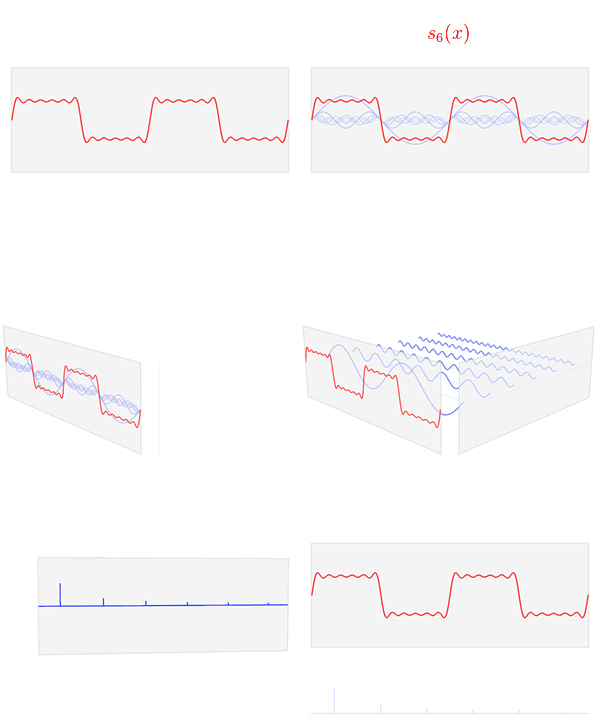
Now, let’s talk about how a Fourier series works! When we add many sine and cosine waves together, the result gets closer and closer to the original sound or wave. This is called "convergence." 🌈 If you have a paper with dots and you connect them with lines, the more lines you draw, the closer you get to seeing the real picture! 🖼️ Sometimes, it may not be perfect right away, but with enough parts, it gets really close! For most functions, the Fourier series does a great job of making everything clear. 🎯
Fourier series are super useful! 🎉They help in many areas like music, science, and even Medicine! 🎹In audio engineering, they make our songs and sounds clearer. 🎧For example, when recording, sound engineers use Fourier series to mix and master tracks! In the field of science, we use these series to analyze data from satellites and even in computers! 💻In Medicine, doctors analyze heartbeats using Fourier series to check our heart health! ❤️ All these applications make our lives better, thanks to Joseph Fourier's amazing discovery! 📊
You might wonder, what’s the difference between Fourier series and something called Fourier Transform? 🤔While Fourier series works with repeating or periodic waves, the Fourier Transform is for non-repeating ones. For example, think about ocean waves. 🌊They can go on forever, so we use transforms to analyze them! The Fourier Transform tells us how much of each frequency (or wave) is present in a sound or signal. They’re like two superheroes fighting together to help us understand waves better! 🦸♂️🦸♀️
Fourier series show up in many fun places! 🎠For instance, in music! 🎷When you listen to your favorite song, Fourier series help mix the sounds from different instruments so they blend perfectly! Also, in Google Maps and GPS systems, they are used to analyze signals for tracking your location. 🗺️ Scientists use them to study waves in the ocean, too! 🌊Car engines, weather predictions, and even your voice when talking on the phone use Fourier series. It’s amazing how math helps our everyday lives! 🌟
Let’s talk about computers! 🖥️ They use Fourier series to solve problems and analyze sound. Software programs, like MATLAB and Python, help scientists and engineers quickly perform these calculations! 🧑💻 With just a few lines of code, they can find the Fourier series for many different waves! This makes complex calculations much faster. Imagine building sound effects in video games—all thanks to Fourier series! 🎮So, computers and Fourier series work together like best friends!
🔄 Fourier series decompose periodic functions into sums of sine and cosine functions.
📏 The coefficients of the Fourier series represent the amplitude of each harmonic component.
🔍 Fourier series can represent any periodic function as long as it satisfies Dirichlet conditions.
🎶 They are widely used in signal processing to analyze and synthesize signals.
💻 Fourier series provide mathematical foundations for algorithms like the Fast Fourier Transform (FFT).
📊 They can approximate complex shapes and waveform signals in electrical engineering.
🌀 The series converges to the function at points where the function is continuous.
✏️ Fourier series are named after Jean-Baptiste Joseph Fourier, a French mathematician and physicist.
🌊 They demonstrate how waveforms can be created by superimposing multiple sine waves.
🔗 Applications of Fourier series extend to fields such as acoustics, optics, and heat transfer.


DIY is a creative community where kids draw, build, explore ideas, and share.
No credit card required