Firefly Facts For Kids
Fireflies are bioluminescent beetles known for their twinkling lights, primarily used for attracting mates and communication.
Select reading age

Firefly Facts For Kids
Videos & Quizzesincluded
About this topic
Fireflies, also known as lightning bugs, are fascinating insects from the beetle family 🌟. They belong to the family Lampyridae and are known for their unique ability to produce light. This light is a chemical reaction that occurs in their lower abdomen, giving them that beautiful glow. Fireflies can be found in more than 2,000 species worldwide! Most of them are found in warm, humid areas like forests, meadows, and gardens between late spring and early summer 🌼. The glow of a firefly can be yellow, green, or orange and is used mainly for attracting mates.
Explore with ChatDinoKey Points
Fireflies play an important role in their ecosystems 🌿.
Fireflies have soft bodies covered in a hard shell called an exoskeleton 🦋.
Many species of fireflies are declining due to habitat loss and pollution 🚫.
Fireflies have a special way of talking to each other — they use their light!
Fireflies have inspired human culture for centuries.
Fireflies have four stages in their life cycle: egg, larva, pupa, and adult 🐞.
Fireflies thrive in various environments!
Scientists are currently researching fireflies to better understand their behaviors and habitats 🔬.
Photos of Firefly

Firefly — photo 1

A larviform female with light-emitting organs on her abdomen. Unlike actual larvae, she has compound eyes.

Photuris female by flash photography (above); by her own light (below)

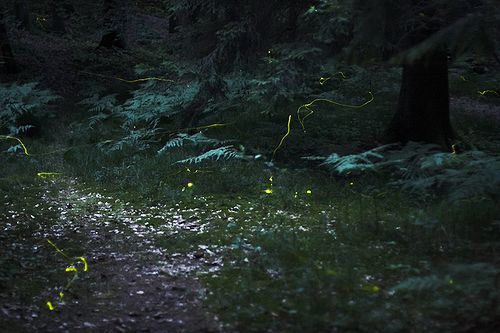
Fireflies in the forest near Nuremberg, exposure time 30s.

Firefly — photo 6

Firefly — photo 7

Firefly — photo 8

🌿 Role In Ecosystems
Fireflies play an important role in their ecosystems 🌿. As larvae, they eat soft-bodied pests like snails and slugs, helping to control pest populations in gardens and nature. Adult fireflies are also eaten by birds, frogs, and other predators, making them a part of the food chain. 🌊Their bioluminescence also contributes to the health of ecosystems by attracting pollinators to flowers. Overall, fireflies help maintain the balance in their habitats!
Go deeper🦋 Biology And Anatomy
Fireflies have soft bodies covered in a hard shell called an exoskeleton 🦋. They measure about 0.25 to 1 inch long, with long, slender legs that help them move quickly. Male fireflies often have two pairs of wings, while females have smaller bodies and may not fly. The enchanting glow comes from special cells that contain a chemical called luciferin, which reacts with oxygen to produce light in a process called bioluminescence 💡. Their large eyes help them see at night, and their antennae are extremely sensitive for detecting mates.
Go deeper🚫 Conservation Status
Many species of fireflies are declining due to habitat loss and pollution 🚫. Light pollution from cities can interfere with their communication and reproduction. Some conservation groups are working hard to study and protect firefly habitats. You can help by creating a firefly-friendly environment in your backyard! 🌺Plant native flowers, limit outdoor lighting, and avoid using chemicals in your garden to support these amazing insects!
Go deeper🌌 Communication Methods
Fireflies have a special way of talking to each other — they use their light! 🌌Males flash their lights in patterns while flying to catch a female's attention. Each firefly species has its unique flashing pattern. For example, the Photinus pyralis species has a simple, consistent flash that attracts females. Interestingly, females sometimes respond with their own light pattern to let the males know they're interested! 💞This light communication helps them find a mate in the dark.
Go deeper🌏 Cultural Significance
Fireflies have inspired human culture for centuries. 🌏In many cultures, they represent hope, love, and magic. For example, in Japan, there are festivals called “Firefly Festivals” that celebrate these glowing insects as symbols of summer! 🎆Also, fireflies are often featured in children's stories and songs, captivating imaginations with their magical lights. They teach us the beauty of nature and inspire young explorers to learn more about the world around them.
Go deeper🐞 Life Cycle And Behavior
Fireflies have four stages in their life cycle: egg, larva, pupa, and adult 🐞. Female fireflies lay eggs in moist soil or under leaves. After about two to four weeks, tiny larvae hatch! These larvae glow as well, helping to warn predators that they are potentially toxic. 🦠As they grow, they shed their skin several times before pupating. After about one month in their pupa stage, they emerge as adult fireflies! Adult fireflies typically live for around 2 months and spend their nights flashing their lights to find partners.
Go deeper🌳 Habitat And Distribution
Fireflies thrive in various environments! 🌳You can find them in wetlands, forests, meadows, and even backyards. They love warm, damp places, which is why they're often seen around ponds or near tall grass. Fireflies live on every continent except Antarctica. 🌍In the United States, they are most commonly found in the northeastern and southeastern regions. Some popular spots where you can catch a glimpse of fireflies include Great Smoky Mountains National Park and Congaree National Park.
Go deeper🔬 Research And Future Studies
Scientists are currently researching fireflies to better understand their behaviors and habitats 🔬. They study how light pollution affects firefly communication and populations. Additionally, researchers are exploring the chemical processes that create bioluminescence, hoping to discover new applications for this natural wonder. Fireflies can teach us important lessons about protecting our environment and appreciating nature's beauty 🌻. Join the effort to protect these incredible insects for future generations to enjoy!
Go deeper