Fibula Facts For Kids
The fibula is a slender bone located alongside the tibia in the lower leg, playing a key role in muscle attachment and ankle stability.
Select reading age

Fibula Facts For Kids
Videos & Quizzesincluded
About this topic
The fibula is a long, thin bone in your leg! 🦵It is located next to a bigger bone called the tibia. The fibula starts just below your knee and ends near your ankle. Although it’s smaller, the fibula helps support your leg and keep it nice and strong. Like the tibia, it's found in our body but is not the main bone for bearing weight. Don’t worry if you broke it—your body is good at healing!
Explore with ChatDinoKey Points
The fibula is around 15 inches long in adults.
The fibula plays many important roles!
The fibula is different from the tibia.
Did you know that different animals have fibulas too?
Like any bone, the fibula can get hurt!
Did you know the word "fibula" means "clasp" in Latin?
If you hurt your fibula, it's important to rest and ice the area to reduce swelling!
The study of the fibula goes back thousands of years!
Photos of Fibula

Fibula — photo 1

3D medical animation still shot of fibula structure

Fibula — photo 3

Fibula — photo 4

Fibula — photo 5

Plan of the development of the en:fibula by three centres.

Lower extremity of right fibula. Medial aspect.
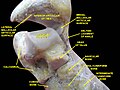
Anatomical dissections
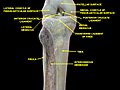
Anatomical dissection
💡 Anatomy Of The Fibula
The fibula is around 15 inches long in adults. It has two ends: the head, which connects to the tibia near the knee, and the lateral malleolus, which is the bony part you can feel on the outside of your ankle. 💡The fibula is made of strong tissue, called cortical bone, that helps protect it and keep it sturdy. It is quite thin compared to the tibia, like a pencil next to a textbook!
Go deeper🏃♂️ Functions Of The Fibula
The fibula plays many important roles! First, it helps stabilize your ankle, which is super important for walking and running. 🏃♂️ It also serves as a place for muscles to attach, helping you move your foot in different ways, like tiptoeing or kicking a soccer ball! ⚽Another fun fact: while it holds some weight, most of the heavy lifting is done by the tibia.
Go deeper💪 Comparison With Other Bones
The fibula is different from the tibia. While the fibula is thin and supports the leg, the tibia is thicker and bears most of the weight when standing or walking. 💪Other leg bones include the femur, which is the longest bone in your body and located in your thigh! Each bone has its own job, making your leg strong and capable!
Go deeper🦓 Fibula In Different Species
Did you know that different animals have fibulas too? 🦓In humans and other mammals, it helps support walking, running, and jumping. However, in birds like ostriches, the fibula is much thinner and plays a lesser role, while reptiles like snakes have no fibula at all! Each species adapts its leg bones to suit its environment and lifestyle!
Go deeper🚑 Common Injuries And Conditions
Like any bone, the fibula can get hurt! 🚑Common injuries include fractures, where it breaks due to falls or accidents, and stress fractures from overuse like running too much. Sometimes, people get a condition called "syndesmosis," which is when the ligaments connecting the fibula and tibia are damaged. This can happen during sports like football or basketball.
Go deeper🤔 Interesting Facts About The Fibula
Did you know the word "fibula" means "clasp" in Latin? 🤔Ancient Romans named it because it looked like a fastening pin! The fibula is often ignored compared to the tibia, but it’s just as important! Also, the average person takes about 7,500 steps a day, and every one of those steps involves your fibula! 🥳
Go deeper❄️ Treatment Options For Fibula Injuries
If you hurt your fibula, it's important to rest and ice the area to reduce swelling! ❄️ Doctors often put on a cast or brace to protect the bone while it heals. Sometimes, they may also suggest physical therapy to help you regain strength in your leg. If the break is severe, surgery might be needed to fix it. Always follow a doctor’s advice!
Go deeper📜 Historical Perspectives On Fibula Research
The study of the fibula goes back thousands of years! In ancient Greece, doctors called Hippocrates learned about bones and how they heal. 📜They didn’t have modern technology but used their observations to help patients. Today, we know even more about fibula injuries and how to treat them, thanks to researchers who study bones in medical schools worldwide!
Go deeper