Eurasian Oystercatcher Facts For Kids
The Eurasian oystercatcher is a striking coastal bird known for its black and white plumage and long, colorful bill, adept at foraging for shellfish in intertidal zones.
Select reading age

Eurasian Oystercatcher Facts For Kids
Videos & Quizzesincluded
About this topic
The Eurasian Oystercatcher is an exciting bird 🐦 found near coastlines in Europe, Asia, and parts of Africa. These birds are known for their striking black and white feathers, along with a bright orange beak! They belong to a family called Haematopodidae, which means "blood-footed." Did you know that their scientific name is Haematopus ostralegus? These birds can be spotted wading in shallow waters, investigating rocky shores, and even foraging in sandy beaches! They're around 42-46 cm (16.5-18 inches) long and weigh about 600 grams (1.3 pounds). Watch out for their loud, distinctive calls! 🎶
Explore with ChatDinoQuick Facts
Key Points
Here are some fun facts about the Eurasian Oystercatcher!
Eurasian Oystercatchers are currently listed as a species of "Least Concern" by the IUCN, which means their population is stable 📊.
When it's time to breed, Eurasian Oystercatchers nest between April and June.
In several cultures, the Eurasian Oystercatcher is a symbol of resilience and adaptability.
Eurasian Oystercatchers live in coastal regions of Europe and Asia, from Norway down to Spain, and across to the Arctic shores.
The Eurasian Oystercatcher has a unique appearance that helps it stand out!
Eurasian Oystercatchers are very clever when it comes to finding food!
The Eurasian Oystercatcher is one of many fascinating shorebirds!
Photos of Eurasian Oystercatcher

Eurasian Oystercatcher — photo 1

Eurasian Oystercatcher — photo 2

Eurasian Oystercatcher — photo 3

Eurasian Oystercatcher — photo 4

Eurasian Oystercatcher — photo 5

Eurasian oystercatcher flying on Loch Sligachan on the Isle of Skye, Scotland

Egg, Jacques Perrin de Brichambaut collection, Muséum de Toulouse
Eurasian Oystercatcher — photo 8

Eurasian Oystercatcher — photo 9
🤩 Fun Facts
Here are some fun facts about the Eurasian Oystercatcher! 🤩Did you know that these birds can fly at speeds of up to 40 km/h (25 mph)? That’s pretty fast for a bird! They also have fantastic eyesight, spotting food from a distance. Interestingly, oystercatchers can live for over 10 years in the wild! They often "dance" at their nesting sites, performing a little show to attract a mate. Lastly, different populations of Eurasian Oystercatchers have different calls, like dialects! How cool is that? Get outside and see if you can spot one on the beach! 🏖️
Go deeper📊 Conservation Status
Eurasian Oystercatchers are currently listed as a species of "Least Concern" by the IUCN, which means their population is stable 📊. Despite this, they face threats from habitat loss due to human activities, like beach development and pollution. Additionally, predators like foxes can be a danger to their nests. Conservation efforts are essential to ensure these lovely birds continue to thrive in their natural habitats. It's crucial for everyone to help protect coastlines and our environment, so we can keep watching these beautiful birds for many years to come! 🌏
Go deeper🥚 Breeding And Nesting
When it's time to breed, Eurasian Oystercatchers nest between April and June. They usually make their nests on flat ground near the beach, sometimes using pebbles or grass to create a cozy spot. A female typically lays 2-4 eggs, which are camouflaged to blend in with the sandy surroundings 🥚. Both parents take turns incubating the eggs for about 3 weeks. Once the chicks hatch, they can walk and forage for food right away! The parents keep a watchful eye on their babies, teaching them how to find food as they grow up. Isn’t that special? ❤️
Go deeper🎣 Cultural Significance
In several cultures, the Eurasian Oystercatcher is a symbol of resilience and adaptability. They are often featured in local folklore and stories. In some regions, these birds are seen as a sign of good luck when spotted while fishing 🎣. Birdwatchers enjoy spotting them along shorelines during birding festivals. Artists find inspiration in their unique appearance, painting pictures that celebrate their beauty. Many coastal communities also work to protect the habitats where these birds live, highlighting the importance of taking care of nature. 🌈
Go deeper🏴☠️ Habitat And Distribution
Eurasian Oystercatchers live in coastal regions of Europe and Asia, from Norway down to Spain, and across to the Arctic shores. They can also be found in countries like Finland, Poland, and the United Kingdom 🏴☠️! During winter, some oystercatchers migrate to warmer places, like North Africa. These birds love to stay near estuaries, sandy beaches, and mud flats where they can find food easily. They often build their nests in grassy areas close to the shore, making their homes in places where they can see and hear the ocean's waves. 🌊
Go deeper😋 Physical Characteristics
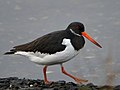
The Eurasian Oystercatcher has a unique appearance that helps it stand out! It has a white body with shiny black wings and a striking black head. Its long, orange bill is perfect for digging up tasty food! 😋Their eyes are bright yellow, helping them see well as they search for shellfish. The birds also have pinkish-red legs, which help them move quickly across sand and rocks. Male and female oystercatchers look very similar, making it tricky to tell them apart. They have slightly different sizes, but both are very beautiful birds! 🌅
Go deeper🐚 Behavior And Feeding Habits
Eurasian Oystercatchers are very clever when it comes to finding food! They usually eat marine creatures, especially bivalves like mussels and clams 🐚. Their strong bills help them crack open shells and get to the tasty meat inside! Oystercatchers are also known to hunt for worms and small insects on the beach. They are quite social, often found in groups called flocks, and they make loud, cheerful calls that sound like “Kleep! Kleep!” while communicating with each other. You can often see them walking gracefully along the shore, moving in unison with their friends! 🚶♀️🚶♂️
Go deeper🐦 Comparison With Other Shorebirds
The Eurasian Oystercatcher is one of many fascinating shorebirds! Unlike plovers, which are smaller and have rounder bodies, oystercatchers are larger with long, slender beaks 🐦. They are also distinct from sandpipers, which are usually seen running along the shoreline and have thinner bills. Other shorebirds, like godwits and avocets, have different feeding strategies and body shapes. Oystercatchers are unique because of their remarkable ability to find and eat shellfish, which many other shorebirds don’t do. Each bird plays an important part in its ecosystem, making shorebird watching even more exciting! 🦩
Go deeper