Eukaryote Facts For Kids
Eukaryotes are organisms that have cells with a membrane-bound nucleus, making them more complex than prokaryotes.
Select reading age

Eukaryote Facts For Kids
Videos & Quizzesincluded
About this topic
Eukaryotes are special living things that have cells with a nucleus! 🧬A nucleus is like a tiny control center where all the important information is kept. Eukaryotes can be found almost everywhere on our planet, from oceans to rainforests. Some examples of eukaryotes are plants, animals, fungi, and even tiny creatures called protists! 🌳🐾 Fungi like mushrooms 🍄 and animals like elephants 🐘 are all eukaryotes. They are very different from bacteria, which are simpler and do not have a nucleus. Can you imagine how many different eukaryotes there are?
Explore with ChatDinoKey Points
The genome is like a recipe book for living things!
There are four main types of eukaryotes!
Metabolism is how living things use energy to grow and function!
Eukaryotes have been around for a long time!
Eukaryotic cells have many parts that work together!
Eukaryotes can reproduce in two main ways: asexually and sexually!
Eukaryotes greatly impact human health!
Eukaryotes are incredibly diverse!
Eukaryotic cells are unique!
Eukaryotes play a crucial role in ecosystems!
Photos of Eukaryote

Eukaryote — photo 1

Eukaryote — photo 2

Eukaryote — photo 3
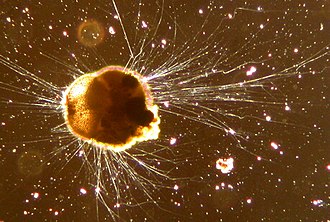
Eukaryote — photo 4

Eukaryote — photo 5

Eukaryote — photo 6

Eukaryote — photo 7

Eukaryote — photo 8

Eukaryote — photo 9
📖 Eukaryotic Genomes
The genome is like a recipe book for living things! 📖Eukaryotes have much larger genomes than bacteria. For example, humans have about 20,000 to 25,000 genes in their DNA, while fruit flies have around 15,000! 🍏All these genes tell the body how to grow, develop, and function. Scientists study genomes to learn more about diseases and how to treat them. 🧪By understanding eukaryotic genomes, we can help keep all living things healthy! Isn’t it amazing to think about all that information wrapped up in tiny cells?
Go deeper🥳 Types Of Eukaryotes
There are four main types of eukaryotes! 🥳First, we have *animals* like dogs, cats, and humans. Then there are *plants* such as flowers 🌼 and trees 🌳 that make their food using sunlight! Next, we have *fungi*, including mushrooms 🍄 and molds, that help decompose dead things. Finally, there are tiny *protists*, like paramecia, which live in water. 🌊All four types are super different, but they all belong to the eukaryote family! Isn’t it amazing how diverse life can be?
Go deeper☀️ Eukaryotic Metabolism
Metabolism is how living things use energy to grow and function! ☀️ Eukaryotes have complex metabolic systems. Plants use sunlight and carbon dioxide to make their food through photosynthesis. 🌿This process releases oxygen, which animals need to breathe! 🐦Animals, on the other hand, eat plants or other animals to get their energy. All eukaryotes break down food through a process called cellular respiration, which uses oxygen to release energy. 💥This energy helps them move, grow, and stay alive. A balanced relationship helps everyone survive!
Go deeper🌍 Evolution Of Eukaryotes
Eukaryotes have been around for a long time! 🌍Scientists believe they first appeared about 1.5 billion years ago. That's older than dinosaurs! 🦖Eukaryotes evolved from simpler cells called prokaryotes. Over millions of years, they learned how to combine parts from other cells. This partnership helped them grow bigger and more complicated! 🌱Some eukaryotes, like plants, even learned to use sunlight to make food. This process is called photosynthesis! ☀️ Their evolution has shaped life on Earth into the variety we see today!
Go deeper🧬 Eukaryotic Cell Structure
Eukaryotic cells have many parts that work together! The most important part is the nucleus, where the DNA is stored. 🧬Cells also have organelles like mitochondria, which give the cell energy, and ribosomes, which help make proteins. 💪Plants have a cell wall for support, as well as chloroplasts for photosynthesis! ☀️ Animal cells, on the other hand, do not have a cell wall. Instead, they have flexible membranes. All these parts work together to keep the cell healthy and functioning. Isn’t teamwork wonderful? 🤝
Go deeper🌱 Reproduction In Eukaryotes
Eukaryotes can reproduce in two main ways: asexually and sexually! 🌱Asexual reproduction means one parent can create a new organism, like yeast making more yeast! 🌿Sexual reproduction involves two parents, like a mother and father, creating offspring with unique traits. 👫This variety is super important for evolution! Some eukaryotes can even switch between these methods depending on the situation. For example, certain protists can reproduce asexually when conditions are good, but will switch to sexual reproduction when times are tough! It’s all about survival! 🐢
Go deeper🏥 Eukaryotes And Human Health
Eukaryotes greatly impact human health! 🏥Some eukaryotes, like beneficial bacteria in our gut, help us digest food. 🥗Other eukaryotes, like yeast, are used to make bread and beer! 🍞However, some eukaryotes can cause diseases. For example, certain fungi can make us sick or spoil food. 😷Scientists study eukaryotic pathogens to find treatments and vaccines. Thanks to research, we can learn more about how eukaryotes affect our health. Understanding these relationships can help keep us and the planet healthy! 💖
Go deeper🌈 Eukaryotic Diversity And Ecology
Eukaryotes are incredibly diverse! 🌈They can live in different environments, like oceans, deserts, and forests. Some can even survive in extreme conditions, such as boiling hot springs or freezing polar regions! 🌊❄️ This diversity allows them to fill many ecological roles. For example, plants provide food and shelter, while fungi decompose waste. 🐢Eukaryotes also interact with each other in ecosystems, forming symbiotic relationships where both benefit! 🥰This helps maintain balance in nature, showing how important eukaryotes are for our planet's health!
Go deeper🌈 Characteristics Of Eukaryotic Cells
Eukaryotic cells are unique! They come in all shapes and sizes, but they share some cool features. First, they have a membrane that surrounds the cell, keeping everything safe inside. 🌈The nucleus holds DNA, which tells the cell what to do. Eukaryotic cells also have other parts called organelles, like mitochondria, which provide energy! 💡They can be single-celled like amoebas or multicellular like humans. 👫One more fun fact: eukaryotic cells usually have more complex structures than bacteria. That makes them very special!
Go deeper🌍 Importance Of Eukaryotes In Ecosystems
Eukaryotes play a crucial role in ecosystems! 🌍Plants produce oxygen and food through photosynthesis. This helps support life for many creatures, like animals and humans. 🐦Fungi break down dead matter, recycling nutrients back into the soil. This keeps ecosystems healthy! 🌱Animals help pollinate plants and spread seeds, showing how everything is connected. 🌺Eukaryotes also provide habitats and food for other organisms. Without them, ecosystems would struggle to survive. They keep everything in balance, making sure life continues on Earth. 🌏Isn’t that amazing?
Go deeper