En Passant Facts For Kids
En Passant is a special chess move that allows a pawn to capture an opponent's pawn that has just advanced two squares beside it, but it must be done on the very next turn.
Select reading age
En Passant Facts For Kids
Videos & Quizzesincluded
About this topic
En Passant is a special move in chess that only pawns can make! ♟️ When a pawn moves two squares forward from its starting position, it can be "captured" by an enemy pawn in a special way. This rule adds excitement to the game! Chess is played on an 8x8 board with 64 squares, and each player has 16 pieces, including 8 pawns. En Passant gives players a clever tactic to catch their opponent off guard! This rule makes chess more strategic and fun, reminding us that there's always more to learn about this ancient game. Let's dive in! 🏰
Explore with ChatDinoKey Points
En Passant is a French term that means "in passing."
Executing En Passant is easy if you know how!
The En Passant rule has been in chess for over 100 years!
En Passant has appeared in several famous chess games!
Ready to practice En Passant?
Using the En Passant rule wisely can change the game!
Playing chess online is super fun!
Many players have myths about En Passant!
Most chess games around the world follow the same rules for En Passant.
Photos of En Passant

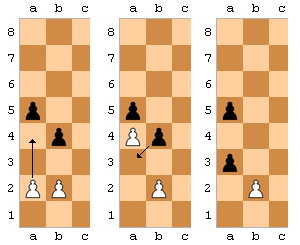
Animation of an en passant capture
🏇 What Is En Passant?
En Passant is a French term that means "in passing." It’s a unique rule for pawns 🏇 in chess. If a player moves their pawn forward two squares from its starting position, and it lands next to an opponent's pawn, that opponent can capture it "in passing." This means the enemy pawn moves diagonally to the square behind the pawn that just moved! But remember, the capturing pawn must act immediately on the next turn—if it waits, the chance is lost! This rule helps keep the game dynamic and allows for interesting strategies!
Go deeper✅ How To Execute En Passant
Executing En Passant is easy if you know how! ✅First, make sure your opponent's pawn has just moved forward two squares. Next, check if it lands next to your pawn. If yes, you can capture it on your next move! Move your pawn diagonally to the square behind the opponent’s pawn. Remember, this move can only happen immediately after your opponent moves. If you forget or wait, you lose the chance! 🌟Practicing this move will help you become a strategic chess player and catch your friends by surprise!
Go deeper📅 History Of The En Passant Rule
The En Passant rule has been in chess for over 100 years! 📅It was created in Europe around the 15th century when pawns gained the ability to move two squares forward. The rule was officially added in the 19th century to stop players from using the two-square move to escape being captured easily. Its odd name, "En Passant," is French, and means "in passing," which fits perfectly for how it works! As chess evolved, so did the rules. En Passant remains a unique and important part of modern chess games today! 🌍
Go deeper🏅 En Passant In Famous Chess Games
En Passant has appeared in several famous chess games! One great example is the match between world champions Bobby Fischer and Boris Spassky in 1972. 🏅During this legendary game, Fischer didn't use En Passant but lost several pawns due to clever tactics! Another example is Garry Kasparov vs. Anatoly Karpov in their 1985 championship match. Kasparov executed En Passant at a crucial moment, surprising Karpov! 🎭These games show that En Passant can create exciting twists and turns in chess history. Who knows? You could create the next memorable moment!
Go deeper🌟 Practice Exercises For En Passant
Ready to practice En Passant? Let’s do it! 🌟First, set up a simple chessboard with both sides ready. Move your pawns forward so you can practice! One way to practice is to create pawn battles. Set your pawns in a line and see how many En Passant captures you can make! 🏇Draw out different scenarios on paper, like capture situations, then visualize them on your board. Challenge a friend or family member to a match and see if you can use your new skills! Regular practice makes you better and more confident in your game!
Go deeper🎉 Strategic Importance Of En Passant
Using the En Passant rule wisely can change the game! 🎉It helps you control the board and puts pressure on your opponent. If you can capture an opponent's pawn that just moved, you might open up new tactics for future moves! Also, blocking the path of enemy pawns can create opportunities for your other pieces to move freely. Smart players can even force their opponents into making mistakes! Remember, En Passant isn’t just a rule—it’s a powerful tool for victory in chess! 🏆
Go deeper🖥️ En Passant In Online Chess Platforms
Playing chess online is super fun! 🖥️ Many platforms, like Chess.com or Lichess, have En Passant built into their games. When you play online, you’ll see messages or hints about the move, making it easier to remember. 💬It’s also great practice because you can play anywhere! Just keep in mind that online platforms follow the same official rules as face-to-face chess games. So, you can earn your skills and victory points using En Passant wherever you are! 🎮Happy playing!
Go deeper❌ Common Misconceptions About En Passant
Many players have myths about En Passant! One common misconception is that you can use it any time. ❌En Passant only works right after your opponent moves their pawn two squares forward, not later. Another mistake is thinking you can use it with pieces other than pawns. Not true! Only pawns can use this unique capture method. 🚫Finally, some think the opponent's pawn must be right in front to capture it. Remember, it must be adjacent! Knowing these details will help you play better and avoid mistakes! 🤓
Go deeper🌏 Variations In Chess Rules Regarding En Passant
Most chess games around the world follow the same rules for En Passant. 🌏However, some chess tournaments may have specific rules, especially for kids. In some cases, they may adjust the rules to make it easier for younger players to learn the game. It’s important to ask your chess coach or tournament organizer about the rules being used. 🔍This way, whether you're at home or a chess competition, you will play by the correct rules and have even more fun! Understanding these variations helps everyone enjoy the game!
Go deeper