Ellipsoid Facts For Kids
An ellipsoid is a smooth, three-dimensional geometric shape that generalizes a sphere to allow for different lengths along each axis.
Select reading age

Ellipsoid Facts For Kids
Videos & Quizzesincluded
About this topic
An ellipsoid is a special 3D shape that looks like a squished or stretched-out ball! 🌍It has three main parts called axes that determine how long it is. The longest axis is called the "major axis," while the shorter ones are called "minor axes." You can find ellipsoids in many places, like fruits! 🍐For example, an egg is shaped like an ellipsoid. Scientists study ellipsoids because they help understand the shape of the Earth and even planets! 🪐Isn’t that cool?
Explore with ChatDinoKey Points
Geodesy is the science that studies Earth's shape and size.
In astronomy, ellipsoids help us understand planets and stars!
An ellipsoid is defined as a shape where all points on its surface are the same distance from its center, but it's not a perfect ball.
Ellipsoids aren't just math problems; they're super useful too!
1.
Mathematicians describe an ellipsoid using a formula!
Today, scientists continue to explore ellipsoids to solve problems!
Ellipsoids can be a fun topic in school!
Photos of Ellipsoid
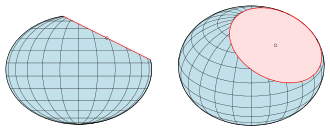
Plane section of an ellipsoid

Plane section of an ellipsoid (see example)

Plane section of the unit sphere (see example)

Pins-and-string construction of an ellipse: |S1 S2|, length of the string (red)

Pins-and-string construction of an ellipsoid, blue: focal conics

Determination of the semi axis of the ellipsoid

Top: 3-axial Ellipsoid with its focal hyperbola. Bottom: parallel and central projection of the ellipsoid such that it looks like a sphere, i.e. its apparent shape is a circle
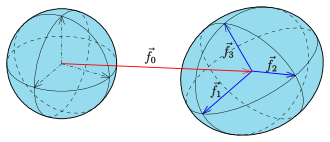
ellipsoid as an affine image of the unit sphere

Artist's conception of Haumea, a Jacobi-ellipsoid dwarf planet, with its two moons
🌐 Ellipsoids In Geodesy
Geodesy is the science that studies Earth's shape and size. 🌐Scientists created the "WGS 84" ellipsoid to help with GPS! This means when you’re out playing and your device shows you on the map, it’s using an ellipsoid to figure that out! 📱The WGS 84 helps measure distances accurately around the world. Knowing the shape of the Earth helps in navigation and helps boats and planes find their way. So, the next time you're exploring, remember, scientists used ellipsoids to help you get there! 🗺️
Go deeper🌟 Ellipsoids In Astronomy
In astronomy, ellipsoids help us understand planets and stars! 🌟For example, the planet Jupiter is not a perfect sphere; it's an oblate ellipsoid because it spins quickly, making the middle bulge out. It’s made of gas and spins so fast that its shape is stretched! 📏Scientists study these shapes to learn how planets form and behave. By understanding ellipsoids, astronomers can discover new planets and learn more about space. 🚀Isn’t space fascinating?
Go deeper🌏 Definition And Properties
An ellipsoid is defined as a shape where all points on its surface are the same distance from its center, but it's not a perfect ball. It has two important properties: the "equatorial radius," which is the distance from the center to the widest part, and the "polar radius," which goes from the center to the top or bottom. 🌏In simple terms, you can imagine it as a stretchy balloon! There are three axes: the major, minor, and vertical axes. These help mathematicians understand different types and sizes of ellipsoids.
Go deeper🍏 Applications Of Ellipsoids
Ellipsoids aren't just math problems; they're super useful too! For example, gardeners use the shape of an ellipsoid to design better fruit trees, making them taller and healthier! 🍏Engineers use ellipsoids in aircraft designs to improve flight. 🛩️ In sports like baseball or basketball, knowing the shape of the ball helps players perfect their game! ⚾Learning about ellipsoids can even help in architecture for building better structures!
Go deeper🌍 Fun Facts About Ellipsoids
1. Did you know that Earth is not a perfect sphere? It's an oblate ellipsoid! 🌍
2. The famous fruit, the watermelon, is shaped like a big ellipsoid! 🍉
3. Some planets in our solar system, like Saturn and Mars, also have ellipsoidal shapes! 🪐
4. The longest axis of an ellipsoid can be hundreds of kilometers! 🚀
5. You can find ellipsoids in many objects, like eggs, balloons, and even some candies! 🍬
Learning about these shapes is a tasty adventure!
Go deeper2. The famous fruit, the watermelon, is shaped like a big ellipsoid! 🍉
3. Some planets in our solar system, like Saturn and Mars, also have ellipsoidal shapes! 🪐
4. The longest axis of an ellipsoid can be hundreds of kilometers! 🚀
5. You can find ellipsoids in many objects, like eggs, balloons, and even some candies! 🍬
Learning about these shapes is a tasty adventure!
📐 Mathematical Representation
Mathematicians describe an ellipsoid using a formula! 📐The equation is:
\[(x/a)² + (y/b)² + (z/c)² = 1\]
Here, \(a\), \(b\), and \(c\) are the lengths of the axes. If \(a = b = c\), then it’s a perfect sphere! 🎱If \(a\) is longer, it’s called a prolate ellipsoid, and if \(b\) is longer than \(a\), it’s an oblate ellipsoid. This math helps scientists and engineers design things like satellites! 🚀
Go deeper\[(x/a)² + (y/b)² + (z/c)² = 1\]
Here, \(a\), \(b\), and \(c\) are the lengths of the axes. If \(a = b = c\), then it’s a perfect sphere! 🎱If \(a\) is longer, it’s called a prolate ellipsoid, and if \(b\) is longer than \(a\), it’s an oblate ellipsoid. This math helps scientists and engineers design things like satellites! 🚀
🌿 Current Research And Innovations
Today, scientists continue to explore ellipsoids to solve problems! Researchers are developing ellipsoidal models to predict climate change effects on Earth’s shape. 🌿They’re also creating better satellites that use ellipsoid shapes to look at the Earth from space more accurately. Scientists are working hard to understand how space and Earth interact, using ellipsoids to guide their research! This helps us learn more about weather patterns and how to protect our planet. 🌍Every small discovery brings us closer to helping our Earth!
Go deeper📚 Teaching Ellipsoids In Education
Ellipsoids can be a fun topic in school! 📚Teachers can help students make models using clay 🎨 or play with toys to visualize this shape better. Students can learn through activities like measuring and comparing Ellipsoids in fruits or sports balls! 🏀Understanding ellipsoids allows kids to see math and science in real life, making learning super enjoyable and interactive. Lessons about ellipsoids can inspire the next generation of scientists and engineers! 🎓
Go deeper