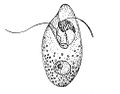
Dinoflagellates are fascinating single-celled eukaryotes that swim in aquatic habitats and can exhibit unique traits such as bioluminescence and diverse dietary habits.

Set reading age
View for Kids
Easy to read and understand
View for Students
Clear, detailed explanations
View for Scholars
Deep dives and big ideas
Dinoflagellates are tiny, single-celled creatures found in oceans around the world! 🌊They belong to a group called protists. The name "dinoflagellate" comes from the Greek word "dino," which means whirling, and the Latin word "flagellum," meaning whip. This is because they can move in a spinning motion using their whip-like tails called flagella. Dinoflagellates are special because they can do photosynthesis like plants, but they also eat other tiny organisms! 🌱They can be found in many colors—from yellow to green to red!
Dinoflagellates are super unique because they have two flagella that help them swim! 🏊♀️ One flagellum wraps around their middle, while the other trails behind, making them spin as they move. They have a tough outer covering called a theca, which protects them. Many dinoflagellates also have unique shapes, like round, oval, or even tall forms! Some can even change form at different times, like jelly! 😮They also contain chloroplasts, where they keep the green pigment used for photosynthesis. This gives them bright colors when seen under a microscope! 🔬
Dinoflagellates live mainly in oceans, where they float in the water as plankton! 🌊You can find them almost everywhere in the world's oceans, from the icy waters of the Arctic 🥶 to the warm, tropical seas 🌴. Some dinoflagellates even thrive in freshwater environments like lakes and rivers! They prefer warm waters rich in nutrients, and can often be found in shallow coastal regions. Sometimes, they form large groups, called blooms, which can make the water look colorful! 🎨These blooms are important as they provide food for many sea animals.
Dinoflagellates can reproduce in two main ways: asexually and sexually. 🌱During asexual reproduction, one dinoflagellate splits into two exactly the same! This can happen very quickly under the right conditions. For sexual reproduction, two dinoflagellates combine their genetic material to create new offspring! ✨Dinoflagellates can also form cysts, which are like sleeping bags. These cysts protect them during harsh conditions, allowing them to wake up and grow when the conditions are better! Their life cycle is full of transformations that help them survive!
Dinoflagellates play an essential role in the ocean's ecosystem! 🌍They are an important source of food for many small animals, like fish and zooplankton. By producing oxygen through photosynthesis, they help keep the water healthy for all ocean life! 🐠Without dinoflagellates, marine food webs would be disrupted, meaning fewer fish and other animals could thrive! Additionally, they contribute to the carbon cycle, helping to keep our planet's climate balanced. This makes dinoflagellates important not just for the ocean, but for the entire planet!
Dinoflagellates are classified into two main groups: autotrophic and heterotrophic. Autotrophic dinoflagellates can make their own food using sunlight, much like plants do! 🌞One common type is Symbiodinium, which helps corals by providing them with energy. Heterotrophic dinoflagellates cannot make their own food and must eat other organisms. An example is Gymnodinium, which eats other plankton! 🦠They are further divided into many species. Overall, scientists estimate there are over 2,000 different types of dinoflagellates!
Did you know some dinoflagellates can glow in the dark? 🌟This process is called bioluminescence. When disturbed, these tiny creatures release a beautiful blue light, creating sparkling waves in the ocean! 🌊This light helps scare off predators, like larger fish that might want to eat them. Some people say it looks like fairy dust! ✨Bioluminescent dinoflagellates are often found in warm coastal waters, and many beach visitors enjoy watching this magical phenomenon at night during summer!
Dinoflagellates are vital members of marine food webs! 🥗They are a primary food source for tiny animals called zooplankton, which are eaten by larger fish. 🎣This means that without dinoflagellates, less food is available for other sea creatures! They help support many life forms, from tiny shrimp to big whales! 🌊Some animals even depend on dinoflagellates for energy, making them key players in the ocean ecosystem. More than 70% of all oceanic productivity comes from these tiny organisms!
Scientists are excited about dinoflagellates and their potential uses in biotechnology! 🔬They can create valuable compounds, such as pigments used in health supplements and cosmetics. 💄Researchers study their bioluminescence to understand how to use light in new technologies, like medical imaging! Some scientists are even exploring how they can help produce biofuels, which could provide cleaner energy sources! ⚡️ By studying dinoflagellates, scientists are unlocking secrets of the ocean that can lead to amazing inventions for our future! 🌟
While many dinoflagellates are harmless, some can be toxic and cause problems. 🚫These toxic species can create harmful algal blooms (HABs), which can affect fish, marine animals, and even humans. For example, the dinoflagellate Alexandrium can produce a toxin that makes shellfish dangerous to eat! 🦪When there’s a bloom, it can make the water look red, known as "red tide." It’s important for scientists to monitor these blooms so they can protect marine life and keep people safe! 🌊


DIY is a creative community where kids draw, build, explore ideas, and share.
No credit card required