Derivative Facts For Kids
A derivative measures how much one quantity changes when another quantity changes, giving us insights into rates of change in various scenarios.
Select reading age
Derivative Facts For Kids
Videos & Quizzesincluded
About this topic
A derivative helps us understand how things change! Imagine you're riding a bike. The speed you're going changes when you pedal faster or slower. 🚴♂️ In math, a derivative tells us about how a curve moves: does it go up, down, or stay flat? Derivatives are super useful in many areas, like physics, economics, and even computer science! They help us understand how quickly things change, just like paying attention when you speed up or slow down on your bike. 🚴♀️ Ready to explore more about derivatives? Let’s go!
Explore with ChatDinoKey Points
Some think derivatives are only for advanced math, but they’re everywhere in everyday life!
The idea of derivatives was developed hundreds of years ago!
Derivatives are used a lot in physics!
In math, a derivative measures how much one thing changes when another thing changes.
Let’s imagine a roller coaster!
Did you know we can take derivatives of derivatives?
In economics, derivatives help businesses understand costs and profits!
In math, we have some cool rules to find derivatives quickly!
In computer science, derivatives help in artificial intelligence and machine learning!
To learn about derivatives, you can use fun online tools!
Photos of Derivative
Derivative — photo 1
A right-continuous function
🌍 Common Misconceptions
Some think derivatives are only for advanced math, but they’re everywhere in everyday life! 🌍People also confuse derivatives with rates of change, but a derivative specifically measures how a function's output changes. Also, many believe that a derivative can only be calculated for straight lines, but it works for curves too! Don’t worry, everyone makes mistakes, and learning is part of the fun! 🌈
Go deeper🌍 Historical Development
The idea of derivatives was developed hundreds of years ago! It started with mathematicians like Isaac Newton and Gottfried Wilhelm Leibniz in the late 1600s. 🌍They created rules to understand how things change, like the speed of objects. Newton loved studying motion, while Leibniz was great at symbols and notation. Their work allowed us to discover exciting things in math! Today, we use their ideas like super-smart tools to answer questions and solve problems. 📜
Go deeper🎾 Applications In Physics
Derivatives are used a lot in physics! Imagine throwing a ball 🎾; the derivative tells us how its speed changes over time. When you throw it up, it slows down until it stops and then comes back down. The derivative helps us find out the speed at any moment. This idea is called velocity! 🚀Using derivatives, scientists can calculate how fast things fall, how objects speed up, and even the orbits of planets! 🌌
Go deeper🌱 Definition Of Derivative
In math, a derivative measures how much one thing changes when another thing changes. Think about watering a plant: the more water you give, the faster it grows! 🌱The derivative tells us how the growth rate changes with the amount of water. If we have a math function, like f(x), the derivative is usually written as f'(x) or df/dx. This means, "how does f change as x changes?" It’s like asking how many flowers bloom when we water more! 🌼
Go deeper🎢 Geometric Interpretation
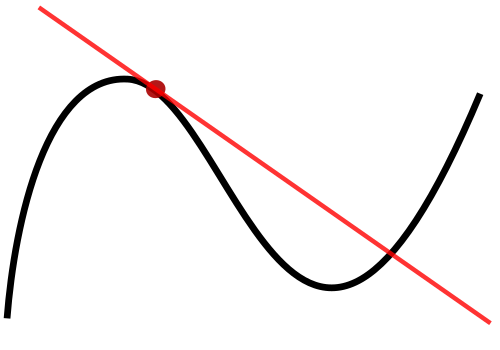
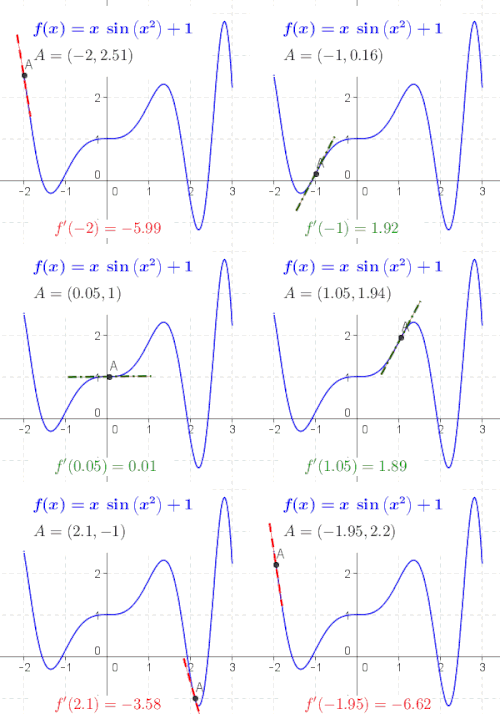
Let’s imagine a roller coaster! 🎢The path of the roller coaster is like a function. The derivative at a certain point tells us if the ride is going up, down, or flat. Up means faster climbing, down means it's falling fast, and flat means you’re taking a breather! The steepness of the coaster at that point is like the derivative. If the coaster is really steep, it has a big derivative; if it’s almost flat, the derivative is small! 🚀
Go deeper🤯 Higher-order Derivatives
Did you know we can take derivatives of derivatives? 🤯This is called higher-order derivatives! The first derivative tells us about the rate of change, but the second derivative shows us how that rate itself changes. It’s like going on a double roller coaster! The second derivative tells if the ride is speeding up (positive) or slowing down (negative)! 🌀Higher-order derivatives help in analyzing curves more deeply and grabbing all the exciting details! 🎢
Go deeper💰 Applications In Economics
In economics, derivatives help businesses understand costs and profits! 💰For example, if a company makes and sells toys, the derivative can tell them how much profit changes when they produce more toys. This is called marginal cost! 🧸If it costs more to make each extra toy, we can see how to adjust prices. Understanding these changes helps businesses make decisions to stay affordable and efficient! 📊
Go deeper⚡ Algebraic Rules Of Derivatives
In math, we have some cool rules to find derivatives quickly! One famous rule is the power rule. If you have x², the derivative is 2x (that’s doubling!). ⚡Another rule is the sum rule: if you have f(x) + g(x), the derivative is f'(x) + g'(x). And for a function multiplied by a number, like 3x, the derivative is simply 3! These rules help us solve problems faster and make math fun! 🎉
Go deeper🤖 Derivatives In Computer Science
In computer science, derivatives help in artificial intelligence and machine learning! 🤖Imagine teaching a computer to recognize pictures. When it makes a mistake, we want to change its understanding slightly, using derivatives to guide those changes. The derivative helps the computer learn faster and become smarter! 🖥️ This process also helps in creating video games and optimizing web pages so they work better! 🎮
Go deeper📱 Interactive Tools For Learning Derivatives
To learn about derivatives, you can use fun online tools! 📱Websites like Desmos allow you to graph and visualize how derivatives work in real time! 🖱️ You can adjust curves and see their derivatives instantly! There are also games and apps that help explain derivatives through colorful graphics, puzzles, and challenges! Learning can be both fun and exciting! 🎮So grab a calculator, go online, and explore the super cool world of derivatives! ✨
Go deeper