Cytoskeleton Facts For Kids
The cytoskeleton is a complex network of protein filaments that gives cells structure, helps them move, and supports various functions in all living organisms.
Select reading age

Cytoskeleton Facts For Kids
Videos & Quizzesincluded
About this topic
The cytoskeleton is like a super cool skeleton for tiny cells! 🦴Instead of being hard like our bones, the cytoskeleton is made of flexible protein filaments. It’s found in all cells, even those tiny ones called bacteria! 🌍It helps keep the cell's shape and supports it, just like how your skeleton helps keep you standing up straight. The cytoskeleton is always changing and moving, helping the cell do many jobs. Imagine a city with roads and buildings— that's how the cytoskeleton organizes everything inside the cell! 🚧
Explore with ChatDinoKey Points
Cell division is how cells make new cells!
Sometimes problems with the cytoskeleton can cause diseases!
The cytoskeleton is crucial for giving cells their shape!
The cytoskeleton helps cells move in many ways!
The cytoskeleton has many important jobs!
The cytoskeleton is made up of three main parts: microfilaments, intermediate filaments, and microtubules.
There are three main types of cytoskeletal filaments: microfilaments, intermediate filaments, and microtubules!
Cytoskeletal dynamics means how the cytoskeleton changes and moves!
Scientists use special techniques to study the cytoskeleton!
Photos of Cytoskeleton
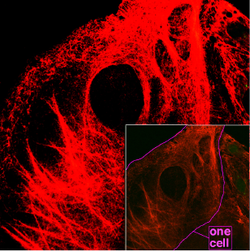
KeratinF9

Cytoskeleton — photo 2
![The cytoskeleton consists of (a) microtubules, (b) microfilaments, and (c) intermediate filaments.[1]](https://upload.wikimedia.org/wikipedia/commons/thumb/c/cb/0317_Cytoskeletal_Components.jpg/960px-0317_Cytoskeletal_Components.jpg)
The cytoskeleton consists of (a) microtubules, (b) microfilaments, and (c) intermediate filaments.[1]

eigen foto, gemaakt in het erasmusMC, Kleuring van microtubuli in een gefixeerde cel mbv anti-beta-tubuline antilichamen

Cross section diagram through the cilium, showing the "9 + 2" arrangement of microtubules
🚀 Role In Cell Division
Cell division is how cells make new cells! 🚀The cytoskeleton plays an essential role in this process. When a cell gets ready to divide, microtubules form a structure called the spindle, which helps pull the cell apart. 🌟This ensures each new cell gets the right number of chromosomes, which contain important genetic information. Without a well-functioning cytoskeleton, cells wouldn’t be able to divide correctly, which could lead to problems! So, the cytoskeleton acts like a helpful guide, making sure everything goes smoothly during cell division! 🧬
Go deeper😷 Cytoskeleton And Disease
Sometimes problems with the cytoskeleton can cause diseases! 😷For example, certain muscle diseases happen because the cytoskeleton can't support muscle cells properly, making them weak. Other times, changes in the cytoskeleton may allow cancer cells to spread easily in the body! 🦠Researchers study the cytoskeleton to understand how these diseases work and to find new treatments. By learning about the cytoskeleton, scientists hope to discover ways to help people stay healthy and strong! 🏥
Go deeper🏰 Cytoskeleton And Cell Shape
The cytoskeleton is crucial for giving cells their shape! 🏰Just like how a building needs a strong frame to stand tall, cells need the cytoskeleton to hold their form. It helps maintain different shapes, like round blood cells or square skin cells. 🩸Moreover, the cytoskeleton allows cells to change shape when needed—like when white blood cells squeeze through tiny spaces to fight germs! 🦠It keeps everything organized inside, so all the cell's parts know where to go, helping it perform its duties properly!
Go deeper🦠 Cytoskeleton In Cell Movement
The cytoskeleton helps cells move in many ways! 🦠For example, white blood cells can change shape and "crawl" to fight infections, thanks to microfilaments. Muscle cells contract and pull on the cytoskeleton, allowing us to run and dance! 💃Some cells even have tiny hair-like structures called cilia and flagella that help them swim. Think of sperm cells swimming towards an egg! 🏊♂️ The cytoskeleton is like a super cool motor that drives all this movement, making life possible for many living things!
Go deeper😊 Functions Of The Cytoskeleton
The cytoskeleton has many important jobs! 😊First, it gives the cell its shape—think of it as the building frame. It also helps cells move. For example, muscle cells have lots of special filaments that help us run, jump, and play! 🏃♂️ Additionally, the cytoskeleton helps move things inside the cell, like nutrients and waste products! 🍎Lastly, it’s involved in cell division, which is how cells make new cells. So, the cytoskeleton is like a hardworking construction team inside the cell!
Go deeper🤹♀️ Structure Of The Cytoskeleton
The cytoskeleton is made up of three main parts: microfilaments, intermediate filaments, and microtubules. 🤹♀️ Microfilaments are the thinnest and are like strands of spaghetti, helping with movement. Intermediate filaments are thicker and give the cell strength, like a sturdy piece of rope. 🪢Microtubules are the thickest and look like hollow tubes; they help transport things around in the cell. Think of them as highways for tiny delivery trucks! 🚚Each part of the cytoskeleton plays a special role in keeping the cell safe and strong.
Go deeper🌈 Types Of Cytoskeletal Filaments
There are three main types of cytoskeletal filaments: microfilaments, intermediate filaments, and microtubules! 🌈Microfilaments are made of a protein called actin and look like little cords. They’re important for movement! Intermediate filaments can be made of different proteins, helping cells resist stretching. 💪Lastly, microtubules are made from a protein called tubulin and can be quite long! They help organize the cell and transport materials within it. 🌐Each filament type works together to keep the cell healthy and working well!
Go deeper🌊 Cytoskeletal Dynamics And Regulation
Cytoskeletal dynamics means how the cytoskeleton changes and moves! 🌊It keeps adjusting itself to help the cell when it needs to grow, move, or divide. Special proteins help control this process, ensuring that the filaments can grow or shrink when necessary—like building blocks that can be stacked or taken apart! 🏗️ When a cell needs more support, the cytoskeleton can strengthen itself. When it’s time to move, it can become more flexible! These changes help the cell respond quickly to what is happening around it. 🕰️
Go deeper🔬 Research Techniques For Studying The Cytoskeleton
Scientists use special techniques to study the cytoskeleton! 🔬One important method is microscopy, which lets them see tiny cell parts up close. They can use fluorescent dyes to make the cytoskeleton glow, making it easier to see! 🌟Another way is to use genetic tools—scientists can change genes to see how it affects the cytoskeleton's function. This helps them learn how cells normally work and what goes wrong in diseases. 🧬By researching the cytoskeleton, scientists are discovering amazing secrets about life at the tiniest level!
Go deeper