Coriolis Effect Facts For Kids
The Coriolis effect is a phenomenon that causes moving objects on Earth to turn, veering to the right in the Northern Hemisphere and to the left in the Southern Hemisphere, due to the planet's rotation.
About this topic
Key Points
Photos of Coriolis Effect

Image from Cursus seu Mundus Mathematicus (1674) of C.F.M. Dechales, showing how a cannonball should deflect to the right of its target on a rotating Earth, because the rightward motion of the ball is faster than that of the tower.

Image from Cursus seu Mundus Mathematicus (1674) of C.F.M. Dechales, showing how a ball should fall from a tower on a rotating Earth. The ball is released from F. The top of the tower moves faster than its base, so while the ball falls, the base of the tower moves to I, but the ball, which has the eastward speed of the tower's top, outruns the tower's base and lands further to the east at L.

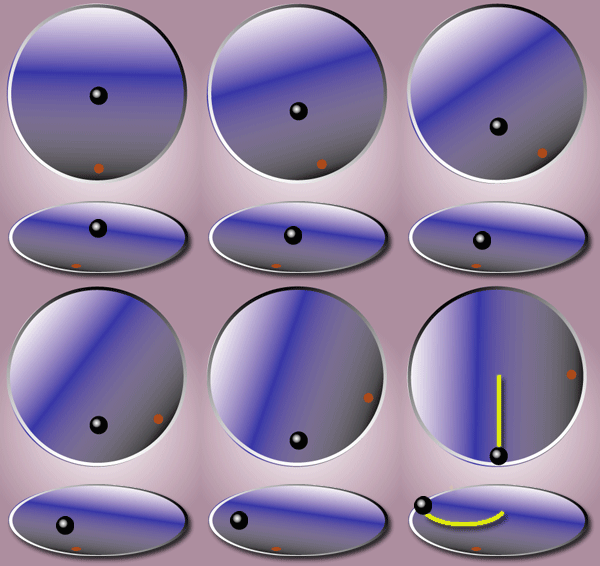
Left Figure: The trajectory of a ball thrown from the edge of a rotating disc, as seen by an external observer. Because of the rotation, the ball has both an initial tangential velocity and a radial velocity given by the thrower. These velocities bring it to the right of the center. Right Figure: The trajectory of a ball thrown from the edge of a rotating disc, as seen by the thrower, the rotating observer. It is deviating from the straight line.

Bird's-eye view of carousel. The carousel rotates clockwise. Two viewpoints are illustrated: that of the camera at the center of rotation rotating with the carousel (left panel) and that of the inertial (stationary) observer (right panel). Both observers agree at any given time just how far the ball is from the center of the carousel, but not on its orientation. Time intervals are 1/10 of time from launch to bounce.

Coordinate system at latitude φ with x-axis east, y-axis north, and z-axis upward (i.e. radially outward from center of sphere)

Due to the Coriolis force, low-pressure systems in the Northern Hemisphere, like Typhoon Nanmadol (left), rotate counterclockwise, and in the Southern Hemisphere, low-pressure systems like Cyclone Darian (right) rotate clockwise.

Schematic representation of flow around a low-pressure area in the Northern Hemisphere. The Rossby number is low, so the centrifugal force is virtually negligible. The pressure-gradient force is represented by blue arrows, the Coriolis acceleration (always perpendicular to the velocity) by red arrows

Schematic representation of inertial circles of air masses in the absence of other forces, calculated for a wind speed of approximately 50 to 70 m/s (110 to 160 mph).

Cloud formations in a famous image of Earth from Apollo 17, makes similar circulation directly visible
🌊 Real-world Examples
🌟 Historical Background
🌐 Scientific Explanation
✈️ Applications In Navigation
🌦️ Effects On Weather Patterns
📐 Mathematical Representation
F = 2 * m * v * ω * sin(θ)
In this formula:
- F is the Coriolis force,
- m is the mass of the object,
- v is the velocity (speed and direction of movement),
- ω represents the Earth's rotational speed, and
- θ is the latitude (how far north or south you are from the equator).
This equation helps predict how much an object will curve depending on where it is on Earth and how fast it's moving! 📐