Continental Drift Facts For Kids
Continental drift is a scientific theory that explains how Earth's continents move around on tectonic plates over long periods of time.


Do more with AI
Introduction
Continental drift is an amazing idea that explains how the continents we live on move 🌍! Picture the Earth as a giant puzzle. A long time ago, all the land was connected in one big piece called Pangaea. 🧩Over millions of years, this giant land split up and slowly drifted apart. Today, we have separate continents like North America, Africa, and Asia! This theory helps us understand earthquakes, volcanoes, and why certain animals live in specific places. Isn’t that cool? 🌋🌎 Knowing about continental drift helps scientists learn about our planet’s past and its future!
Images of Continental Drift
![Antonio Snider-Pellegrini's Illustration of the closed and opened Atlantic Ocean (1858)[12]](https://upload.wikimedia.org/wikipedia/commons/thumb/6/69/Antonio_Snider-Pellegrini_Opening_of_the_Atlantic.jpg/960px-Antonio_Snider-Pellegrini_Opening_of_the_Atlantic.jpg)
Antonio Snider-Pellegrini's Illustration of the closed and opened Atlantic Ocean (1858)[12]

Alfred Wegener

Mesosaurus skeleton, MacGregor, 1908
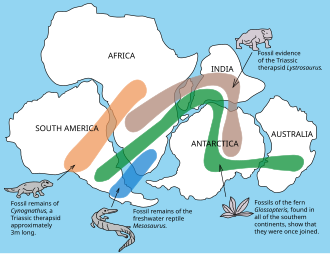
Fossil patterns across continents (Gondwanaland)
History Of Continental Drift
The idea of continental drift started in the early 20th century, around 1912. A German scientist named Alfred Wegener was the first to explain it. 🌟He believed that continents had once been joined together and later moved apart! Wegener looked at the shapes of the continents—like how South America and Africa fit together like a puzzle piece. 📅In 1915, he published a book called "The Origin of Continents and Oceans." Many scientists didn’t believe him at first! But later on, more evidence was found to support his ideas. 📚
Mechanisms Behind Continental Drift
But how do continents drift? The Earth’s outer layer, called the lithosphere, is broken into big pieces called tectonic plates. 🗺️ These plates float on a hot, semi-liquid layer below called the mantle. 🌡️ When the mantle moves because of heat from inside the Earth, it pushes and pulls the tectonic plates! This movement is super slow, only a few centimeters a year! 🌱Sometimes, the plates bump into each other or slide apart, causing earthquakes or making mountains grow. So, the dance of the continents is happening all the time, even if we don’t see it! 💃
Continental Drift In Popular Culture
Continental drift has made its way into movies, books, and even video games! 🎬One famous animated movie, "Ice Age," shows how animals move as the continents change. The characters go on wild adventures through ice and melting landscapes! ❄️ Other stories, like in "The Land Before Time," explore prehistoric creatures living in different environments before the continents split. 🌟Even games like "Minecraft" let players create and explore different continents! This makes learning about science fun and creative, showing kids how fascinating Earth really is! 🌈
Future Of Continental Drift Research
Scientists continue to study continental drift and tectonic plates today! 👩🔬 They use advanced technology like satellite measurements to see how fast plates move. 🚀By understanding these movements better, scientists can improve safety measures against earthquakes and tsunamis. 🌊There’s also a lot to discover about how continental drift connects to climate change and how our planet’s features will look in the future. 🌿The journey to learn more about Earth is exciting and ongoing, with new surprises waiting around every corner! 🧭
Evidence Supporting Continental Drift
Scientists have found many types of evidence that support continental drift! 🌍Fossils are one great clue. For example, the same fossils of the Mesosaurus, a freshwater reptile, were found in both South America and Africa, even though these continents are far apart today! 🌊They must have been together once. Scientists also noticed similar rocks and mountain ranges on different continents. ⛰️ For instance, the Appalachian Mountains in North America look similar to mountains in Scotland! 🏴☠️ These observations help scientists trust Wegener’s ideas about the drifting continents.
Plate Tectonics And Continental Drift
Plate tectonics is a big, important theory that explains how Earth’s plates move, making continental drift happen! 🌏Tectonic plates float on the mantle and are constantly shifting. There are three main types of plate boundaries: convergent, divergent, and transform. 🌀At convergent boundaries, plates push together, forming mountains or causing earthquakes. At divergent boundaries, plates pull apart, creating new ocean floor! 🌊And at transform boundaries, plates slide past each other, causing sudden shifts. These movements shape our planet and create amazing features like trenches and rift valleys! 😮
Key Scientists And Their Contributions
Many scientists helped to prove continental drift! Besides Alfred Wegener, there were others who played important roles. 🌟For example, Harry Hess, in the 1960s, explored the ocean floor and discovered seafloor spreading. 🌊This meant that new land could be formed, helping explain how continents move! Another important figure was J. Tuzo Wilson, who made the idea of plate tectonics better. He showed how the Earth's crust is made of large pieces, called plates, that float on the mantle below. These scientists shaped our understanding of Earth! 🎓
Modern Implications Of Continental Drift
Continental drift is not just a story from the past—it has modern implications too! 🌏It helps scientists understand natural disasters. For example, earthquakes often happen along plate boundaries where tectonic plates meet. ⚡️ This information is crucial for predicting earthquakes and keeping people safe. It also helps scientists find valuable resources like oil and minerals buried under the Earth’s surface, which are important for energy and technology. 🔋Plus, understanding how continents moved helps predict how climate and life might change in the future. Isn’t science exciting? 🔎
Impact On Earth’s Climate And Ecosystems
Continental drift has greatly affected Earth’s climate and ecosystems 🌱! Millions of years ago, when all the continents were joined, they all shared similar climates. 🌍But as the continents drifted apart, they experienced different weather patterns. For example, dinosaurs roamed in warm climates, but as continents separated, some areas turned cooler! 🦖This can change where plants and animals live, breaking connections between species. Over time, new ecosystems formed, and some species evolved into unique ones. Understanding these changes helps us learn how our planet has transformed over millions of years! 🌳
Continental Drift Quiz
Learn more about Continental Drift
