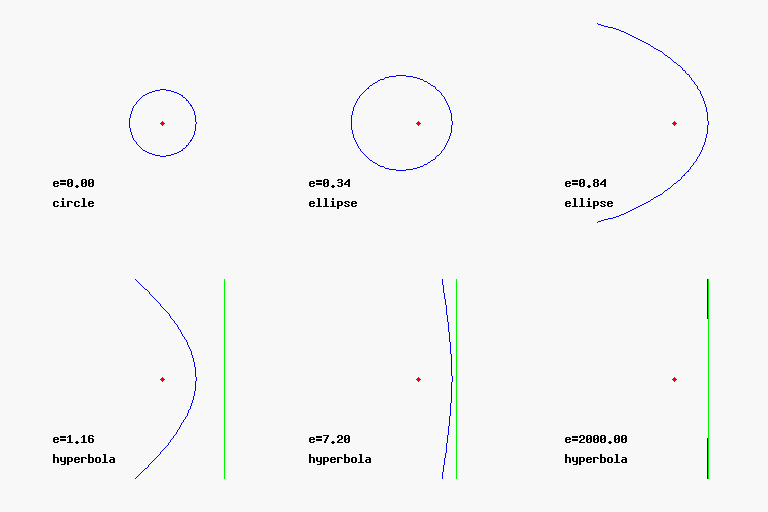
A conic section is a curve formed by the intersection of a cone and a plane, resulting in shapes like circles, ellipses, parabolas, and hyperbolas.
Set reading age
View for Kids
Easy to read and understand
View for Students
Clear, detailed explanations
View for Scholars
Deep dives and big ideas
Hi there, young explorers! 🌍Have you ever wondered what happens when you cut a cone with a flat surface? You get something super cool called a conic section! A conic section is a special kind of curve that comes in different shapes. These shapes can be circles, ellipses, parabolas, and hyperbolas. Each shape has its own unique features and can be found in nature and in our everyday lives! Isn't that amazing? Let’s dive into these wonderful shapes and learn more about them! 📐✨
Graphing conic sections can be tons of fun! 🎨You can use graph paper to draw circles, ellipses, parabolas, and hyperbolas easily. First, start by marking points that represent the shapes' properties. For a circle, use the center and draw all points at a distance (the radius) around it! For an ellipse, plot two foci to help shape it! With parabolas, find the vertex, and for hyperbolas, make sure to set the two curves apart! 📈Creating these graphs lets us visually understand their properties and connections to the world!
The story of conic sections goes way back, starting with ancient Greeks! 🎓Mathematician Conics learned from a scholar named Apollonius of Perga around 200 B.C. 📜He studied the curves made by slicing cones. Over the years, other brilliant minds like Galileo and Newton used conic sections to learn about space! They studied how planets move in ellipses and how projectiles fly in parabolas. This knowledge helped scientists discover how our universe works! Isn’t it neat to know math has such a rich history? 📚✨
There are four main types of conic sections, and they all have unique traits! 🎉First up is the circle, which you can find in wheels and cookies; it has no corners! Next is the ellipse, which looks like an oval and is seen in the orbits of planets. Then, we have the parabola, which is shaped like a U and shows up in the paths of thrown balls. Lastly, there's the hyperbola with its two separate curves! Each conic section has its own special properties and can be found in lots of places around us. 🚀🍪
Conic sections aren't just for math class; they’re all around us! 🌏For instance, the paths of planets are ellipses, and when you throw a ball, it follows a parabola. Engineers use parabolas to design satellite dishes, making sure signals come through! Circles help with wheels on bikes for smooth rides, while hyperbolas are used in GPS satellites to calculate positions. Knowing about conic sections helps us build and understand the world around us! 🚴♂️⚙️
Conic sections are important in physics, too! 🔬They help scientists describe how objects move. For example, when a rocket is launched into space, its path can be modeled as a conic section. The orbits of planets around the sun are ellipses, thanks to a law by physicist Johannes Kepler. 🍂Parabolic paths can explain the flight of baseballs or basketballs! Even light rays can bend and reflect off parabolic mirrors! Understanding conic sections helps scientists predict and explain things in nature based on the laws of physics! 🪐⚾
Conic sections can be described using special math equations! 📊For circles, the equation is (x-h)² + (y-k)² = r², where (h,k) is the center, and r is the radius. For ellipses, it looks like this: (x-h)²/a² + (y-k)²/b² = 1. In a parabola, we use y = ax² + bx + c, which describes the U shape. Lastly, hyperbolas follow the formula (x-h)²/a² - (y-k)²/b² = 1. These equations help us understand how to draw and analyze each shape! Sharing math can be fun! 🧮✨
So, what exactly are conic sections? 🤔Conic sections are the curves you see when a cone (like an ice cream cone) meets a flat plane. Depending on how you cut the cone, you can get different shapes! If you slice straight down, you get a circle. If you slice slanted but not too steep, it will be an ellipse (kind of like a stretched-out circle). If you make a sharp cut, you're looking at a parabola! Finally, if you slice through both halves of the cone, you'll find a hyperbola. Who knew cones could create so many fun shapes? 🍦🔍
Conic sections have some interesting properties! 🌟A circle has constant distance from the center, while an ellipse has two focal points where anything you add will add up to the same number! A parabola has a point called the focus, where rays meet, and it reflects perfectly! Hyperbolas have two focal points as well; if rays come from one point, they bounce off and go to the other. These properties help us understand how these shapes work in the world! Isn't it cool how math can explain nature? 🐦🌲
Math challenges can involve conic sections, too! 🤩A well-known problem is calculating the orbit of a planet, where you can use an ellipse to determine distance and time! You might also explore how to throw a ball and hit a target—using parabola equations can help with that! Mixing story problems with real-world scenarios helps kids see how conic sections are useful! Challenge your friends to find conic sections in playground designs or create art using their shapes! Let your imagination run wild with math! 🌈🎉


DIY is a creative community where kids draw, build, explore ideas, and share.
No credit card required