Compton Effect Facts For Kids
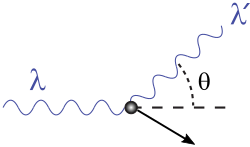
The Compton effect explains how high-energy photons scatter after colliding with electrons, resulting in a change in the wavelength of the light.
Select reading age
Compton Effect Facts For Kids
Videos & Quizzesincluded
About this topic
The Compton Effect is a cool science phenomenon discovered by Arthur H. Compton in 1923 🌠. It happens when high-energy light particles, called photons, bump into tiny charged particles called electrons. Imagine a ping-pong ball hitting a bowling ball! The light bounces off and changes color (or energy). This discovery helped scientists understand how light and matter interact, showing us that light can act like tiny balls of energy 🎳. This tells us a lot about the universe and helped lead to new discoveries in physics and astronomy! 🌌
Explore with ChatDinoKey Points
The Compton Wavelength is a special term in physics that helps us understand the size of a particle!
To understand the Compton Effect, scientists set up a special experiment 🔬.
The Compton Effect has had a huge impact on particle physics!
The Compton Effect happens through a fascinating interaction between photons and electrons.
The Compton Effect isn't just a fun experiment — it also helps scientists learn about stars and galaxies!
The Compton Effect is a key piece of the puzzle in understanding quantum mechanics!
Arthur H.
One of the coolest rules in physics is that energy and momentum must always be conserved!
In medicine, the Compton Effect is used in a special type of imaging called PET (Positron Emission Tomography) scans!
Photos of Compton Effect

A en:Feynman diagram of a s-channel en:Compton scattering process.

Fig. 3: Energies of a photon at 500 keV and an electron after Compton scattering.
![Plot of photon energies calculated for a given element (atomic number Z) at which the cross section value for the process on the right becomes larger than the cross section for the process on the left. For calcium (Z = 20), Compton scattering starts to dominate at hυ = 0.08 MeV and ceases at 12 MeV.[2]](https://upload.wikimedia.org/wikipedia/commons/thumb/7/72/Dominant_Photon-Matter_Interaction.svg/330px-Dominant_Photon-Matter_Interaction.svg.png)
Plot of photon energies calculated for a given element (atomic number Z) at which the cross section value for the process on the right becomes larger than the cross section for the process on the left. For calcium (Z = 20), Compton scattering starts to dominate at hυ = 0.08 MeV and ceases at 12 MeV.[2]
📏 Compton Wavelength
The Compton Wavelength is a special term in physics that helps us understand the size of a particle! 📏It is named after Arthur Compton. When scientists calculate it, they find out how light behaves when it meets a particle. The Compton Wavelength is important for understanding things like energy levels and how particles move. Each particle, like an electron, has its own unique Compton Wavelength. This information is super cool because it gives scientists clues about how particles act in different situations! 🔍
Go deeper🔬 Experimental Setup
To understand the Compton Effect, scientists set up a special experiment 🔬. They used a source of X-rays or gamma rays, which are high-energy light particles. The X-rays were directed at a thin metal target with many electrons, like a sheet of aluminum. When the X-rays hit the electrons in the metal, scientists measured how much energy was lost — like checking how much energy you have left after you throw a ball! 🎾By examining the scattered X-rays at different angles, scientists could see how energy was transferred and learn about the behavior of photons.
Go deeper🤯 Impact On Particle Physics
The Compton Effect has had a huge impact on particle physics! 🤯This field studies the tiniest particles in the universe, like electrons, protons, and neutrons. By understanding how photons interact with these particles, scientists can learn more about the building blocks of everything around us! 🏗️ The Compton Effect also plays a crucial role in experiments at big particle colliders, like the Large Hadron Collider in Europe. These experiments generate new discoveries about particles, allowing scientists to understand the universe better and answer big questions! 🌌
Go deeper⚡ Photon-electron Interaction
The Compton Effect happens through a fascinating interaction between photons and electrons. When a photon hits an electron, it transfers some of its energy, causing the electron to bounce away like a supercharged ball ⚡. The photon also changes direction and energy, often becoming less energetic, like a player who’s tired after a big run! This process shows that light is not just a wave but also behaves like a particle, illustrating the wave-particle duality of light. This important idea helps us unlock the mysteries of our universe! 🔍
Go deeper🌌 Applications In Astrophysics
The Compton Effect isn't just a fun experiment — it also helps scientists learn about stars and galaxies! 🌌For example, astronomers can observe high-energy photons from space, like gamma rays, and study how this light interacts with cosmic dust and gas. By understanding these interactions, they can gather clues about stars, black holes, and even the early universe! 🕳️ The Compton Effect allows us to explore the mysteries of space, helping us to unlock incredible secrets about our cosmos!
Go deeper🧩 Relation To Quantum Mechanics
The Compton Effect is a key piece of the puzzle in understanding quantum mechanics! 🧩Quantum mechanics is the science that studies the tiny particles in our universe, like photons and electrons. The Compton Effect shows how light behaves as both a wave and a particle, highlighting something special called wave-particle duality. This idea helps scientists understand the weird and wonderful world of quantum physics! 🎢It tells us that light and matter can interact in surprising ways, leading to exciting discoveries in science!
Go deeper🌡️ Discovery Of The Compton Effect
Arthur H. Compton, an American physicist, made his big discovery while studying X-rays in his lab 🌡️. He noticed that when X-rays hit electrons, the light changed. Compton found that the X-rays lost energy and the electrons gained energy, bouncing away as if they were playing a game of dodgeball! 🏐This important discovery supported the idea that light is not just a wave but also has particle-like qualities. For this work, Compton received the Nobel Prize in Physics in 1927! 🏆
Go deeper🔄 Energy And Momentum Conservation
One of the coolest rules in physics is that energy and momentum must always be conserved! 🔄When a photon hits an electron, both the energy and momentum (the “oomph” of moving objects) are shared between them. Imagine a game of tag where both players have to keep running with the same speed! In the Compton Effect, the photon gives some of its energy to the electron. By measuring how both changed, scientists can understand the interactions better and confirm that energy and momentum were never lost! This principle is super important for all types of physics! 💫
Go deeper🩺 Compton Scattering In Medical Imaging
In medicine, the Compton Effect is used in a special type of imaging called PET (Positron Emission Tomography) scans! 🩺When doctors want to see inside our bodies, they inject a small amount of a radioactive substance. This substance produces positrons, interacting with electrons to create gamma rays. By observing these rays using the Compton Effect, doctors can create detailed images of organs and tissues! 🖼️ This helps them find diseases like cancer and understand how our bodies work. Isn’t science amazing!
Go deeper