Cavitation Facts For Kids
Cavitation is the formation and collapse of vapor-filled cavities in a liquid, often leading to shock waves and potential damage to materials.
Select reading age

Cavitation Facts For Kids
Videos & Quizzesincluded
About this topic
Cavitation is a cool science topic that deals with bubbles! 🌊When liquids, like water, move very fast, they can create tiny bubbles. These bubbles form when pressure drops and disappear when pressure increases. It’s a bit like blowing bubbles in your drink with a straw! When the bubbles pop, they can cause sound and even little shockwaves that can be very strong! 🌟This is part of why cavitation is so interesting to scientists and engineers!
Explore with ChatDinoKey Points
There are different types of cavitation!
Cavitation happens in nature, too!
Cavitation was first studied by a scientist named Lord Rayleigh in the late 1800s!
Cavitation happens when the pressure in a liquid drops quickly.
Cavitation is a significant topic in engineering!
Cavitation can be used in many exciting ways!
Scientists and engineers are always learning more about cavitation!
Cavitation can be tricky because it can harm materials!
Photos of Cavitation

Cavitation damage on a valve plate for an axial piston hydraulic pump

Cavitation damage evident on the propeller of a personal watercraft

Cavitation damage to a Francis turbine
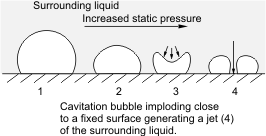
The implosion of a cavitation bubble causes a high-speed jet of fluid to impact a fixed surface
💧 Types Of Cavitation
There are different types of cavitation! One type is called "hydraulic cavitation," which is found in machines like pumps. 💧Another type is "venturi cavitation," which happens when water moves through a narrow space. 🌀There’s also "surface cavitation," which occurs on the surfaces of ships or propellers. 🚤Each type is caused by different conditions, but they all share that magical pop of bubbles! 🎉Scientists study these types to solve problems and invent better machines!
Go deeper🌎 Cavitation In Nature
Cavitation happens in nature, too! 🌎For example, when rivers flow fast over rocks or waterfalls, bubbles can form and pop. 🌪️ This is why you might hear a bubbly sound in fast-moving water! Some fish, like the arapaima, use cavitation to catch prey. 🎣They can create bubbles that help them snap their jaws quickly! The world around us is filled with cavitation wonders, making nature even more fascinating!
Go deeper🎩 History Of Cavitation
Cavitation was first studied by a scientist named Lord Rayleigh in the late 1800s! 🎩He looked at how bubbles form and pop in water. Later, in 1932, another scientist named Hermann von Helmholtz added to this knowledge. 🧑🔬 Since then, many other scientists have explored cavitation. They discovered how it could be used and what problems it could cause, especially in ships and engines. 🚢This history shows how understanding bubbles can help us improve technology!
Go deeper🧊 Mechanism Of Cavitation
Cavitation happens when the pressure in a liquid drops quickly. 🧊Imagine a water fountain! When water shoots up fast, the lower part of the water might have less pressure. This is where tiny bubbles form. 🎈When these bubbles move to a place with higher pressure, they collapse or pop! This creates little bursts of energy. 🔆The energy can sometimes be strong enough to cause noise or even damage materials nearby! This is how cavitation works, and it’s all about the dance between pressure and speed. 💨
Go deeper🏗️ Cavitation In Engineering
Cavitation is a significant topic in engineering! 🏗️ Engineers think about cavitation when designing products like ships, pumps, and turbines. 🚢They have to make sure that the machines won’t be harmed by cavitation. For example, they might choose special shapes and materials to reduce bubble formation. This helps machines work better and have a longer life. 🌟Studying cavitation makes our technology smarter and more efficient!
Go deeper🚀 Applications Of Cavitation
Cavitation can be used in many exciting ways! 🚀Did you know doctors use it? They have machines that create tiny bubbles to help break up kidney stones! 💎In industry, cavitation helps clean hard-to-remove dirt from surfaces. 👕It’s also used in making tasty foods like smoothies with blends of fruits, which uses cavitation to mix everything perfectly! 🍓These examples show that cavitation isn’t just for science – it helps us in everyday life!
Go deeper🔬 Future Research And Developments
Scientists and engineers are always learning more about cavitation! 🔬They are exploring new ways to use bubbles for energy and health. For instance, researchers are investigating using cavitation to create clean energy from water! ⚡Others study how to use bubbles for even better medical treatments. 💉The future is bright as we uncover more secrets about cavitation, helping us improve everyday life in amazing ways! 🌈
Go deeper😱 Effects Of Cavitation On Materials
Cavitation can be tricky because it can harm materials! 😱When bubbles collapse, they create strong forces that can hurt surfaces, like metal. This is a big issue for boats and machinery, as it may cause parts to break or weaken over time. ⚙️ Engineers and scientists study these effects to create stronger materials that can resist cavitation. This helps keep our machines safe and working longer! 💪
Go deeper