All Articles

Butterfly Effect

Butterfly Effect Facts For Kids

The Butterfly Effect illustrates how small changes in initial conditions in a chaotic system can lead to large and unpredictable outcomes.

🎨 Reading age for 6-8
Background blob
Butterfly Effect
Facts for Kids!
Image by Wrzlprmft, licensed under Creative Commons Attribution-Share Alike 4.0

Do more with AI

Introduction

The butterfly effect is a super cool idea in science! 🦋It says that a tiny change, like a butterfly flapping its wings, can lead to big differences later. Imagine if a butterfly flaps its wings in Brazil 🌳. This small action might lead to a big storm in Texas 🌪! It shows us how everything is connected. Just like how you smile at a friend, and they feel happy too. The butterfly effect helps scientists understand how small actions can change the world around us! 🌍Let's dive deeper into this wonderful concept!

Images of Butterfly Effect

A Battus polydamas butterfly in BrazilImage by Charles J. Sharp, licensed under Creative Commons Attribution-Share Alike 4.0

A Battus polydamas butterfly in Brazil

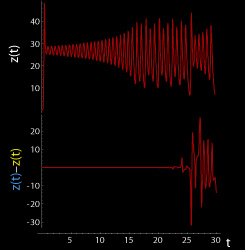
Created by XaosBits using Mathematica and POV-Ray. The blue image is one trajectory of the Lorenz system with ( σ , ρ , β ) = (10, 28, 8/3) started from the initial point (0, 0, 1). The yellow image is for the same parameters but a different initial condition, (0, 0, 1+ ε ) where ε = 10 -5 .Image by Hellisp (assumed), licensed under Creative Commons Attribution 2.5

Created by XaosBits using Mathematica and POV-Ray. The blue image is one trajectory of the Lorenz system with ( σ , ρ , β ) = (10, 28, 8/3) started from the initial point (0, 0, 1). The yellow image is for the same parameters but a different initial condition, (0, 0, 1+ ε ) where ε = 10 -5 .
LorenzCoordinatesSmall

LorenzCoordinatesSmall

A plot of Lorenz' strange attractor for values ρ=28, σ = 10, β = 8/3. The butterfly effect or sensitive dependence on initial conditions is the property of a dynamical system that, starting from any of various arbitrarily close alternative initial conditions on the attractor, the iterated points will become arbitrarily spread out from each other.Image by Wikimol , Dschwen, licensed under Creative Commons Attribution-Share Alike 3.0

A plot of Lorenz' strange attractor for values ρ=28, σ = 10, β = 8/3. The butterfly effect or sensitive dependence on initial conditions is the property of a dynamical system that, starting from any of various arbitrarily close alternative initial conditions on the attractor, the iterated points will become arbitrarily spread out from each other.

A Battus polydamas butterfly in BrazilImage by Charles J. Sharp, licensed under Creative Commons Attribution-Share Alike 4.0

A Battus polydamas butterfly in Brazil

Created by XaosBits using Mathematica and POV-Ray. The blue image is one trajectory of the Lorenz system with ( σ , ρ , β ) = (10, 28, 8/3) started from the initial point (0, 0, 1). The yellow image is for the same parameters but a different initial condition, (0, 0, 1+ ε ) where ε = 10 -5 .Image by Hellisp (assumed), licensed under Creative Commons Attribution 2.5

Created by XaosBits using Mathematica and POV-Ray. The blue image is one trajectory of the Lorenz system with ( σ , ρ , β ) = (10, 28, 8/3) started from the initial point (0, 0, 1). The yellow image is for the same parameters but a different initial condition, (0, 0, 1+ ε ) where ε = 10 -5 .

LorenzCoordinatesSmall

LorenzCoordinatesSmall

A plot of Lorenz' strange attractor for values ρ=28, σ = 10, β = 8/3. The butterfly effect or sensitive dependence on initial conditions is the property of a dynamical system that, starting from any of various arbitrarily close alternative initial conditions on the attractor, the iterated points will become arbitrarily spread out from each other.Image by Wikimol , Dschwen, licensed under Creative Commons Attribution-Share Alike 3.0

A plot of Lorenz' strange attractor for values ρ=28, σ = 10, β = 8/3. The butterfly effect or sensitive dependence on initial conditions is the property of a dynamical system that, starting from any of various arbitrarily close alternative initial conditions on the attractor, the iterated points will become arbitrarily spread out from each other.

Examples In Nature

Nature has many examples of the butterfly effect! 🌳Imagine a bee buzzing to one flower instead of another. This tiny choice helps spread pollen and causes new flowers to bloom in different places! 🌼Another example is a stone dropped in a pond. The ripples spread out, changing how fish swim and plants grow nearby! 🐟🌿 Each action connects to others, showing us how our choices can make a big difference over time. Every small thing matters in the wonderful web of life! 🕸️

Historical Background

The butterfly effect comes from chaos theory, which studies how tiny changes can lead to huge results. In 1961, an American mathematician named Edward Lorenz discovered this idea. He was working on weather predictions when he noticed that changing just one small number could change the forecast completely! 🌦️ Lorenz used a butterfly in his example, saying that if a butterfly flapped its wings in one place, it might cause a tornado elsewhere! 🌪️ This discovery changed how scientists think about weather and many other things in nature 🌱.

The Role Of Chaos Theory

Chaos theory is like a treasure map for discovering patterns in unpredictable systems! 🗺️ It helps scientists understand and predict how tiny changes affect the world. This theory doesn't mean everything is random; it just shows that small differences can have big consequences! 🌊For example, if a flock of birds takes a slightly different route one day, it can affect migration patterns for weeks! 🕊️ Chaos theory teaches us that while some things appear chaotic, they still have rules and patterns to discover! 🌈✨

Criticism And Limitations

While the butterfly effect is fascinating, it has some critics! 💬Some believe it oversimplifies how complex systems work. They think not every small change leads to huge results. 🌊For example, a butterfly flapping its wings may not always cause a storm! Knowing that, scientists work hard to improve their models and predictions. 🌐They use a mix of ideas to keep learning about the world. This way, we grow smarter about how our actions affect nature and each other! 🌱✨

Philosophical Implications

The butterfly effect raises interesting questions about life! 🤔Can a single choice change your entire future? Just like picking between two paths in a forest, that one decision can lead you to a different adventure! 🌲🍃 It makes us think about how important our choices are. It also teaches us to be responsible and aware of how our actions impact others. 👫So, even small acts of kindness can spread happiness! 🌞Understanding this helps us appreciate life’s ups and downs and the connections we share! ❤️

Butterfly Effect In Physics

In physics, the butterfly effect shows how systems can behave in surprising ways! Imagine this: if a tiny force pushes a ball at just the right angle, it can bounce differently and hit something far away! ⚽📐 In chaotic systems, tiny changes lead to unpredictable results. Chaos theory helps scientists understand weather, planets, and even atoms! 🌌Understanding this effect teaches us how the universe works and reminds us that everything is connected, so every little action counts! 🌌✨

Key Concepts And Definitions

Here are some key ideas about the butterfly effect! ✨"Chaos theory" studies how tiny changes make big surprises. "Initial conditions" are the starting points for any system. Think of them as a starting line in a race! 🏁When something small changes, it can create a completely different outcome, just like when you change your route to school and find a new friend along the way! 👦👧 These concepts help us understand why even small actions matter. It teaches us to be mindful of what we do! 😊

Cultural References And Media

The butterfly effect is popular in movies and books! 📚The 2004 film "The Butterfly Effect" explores how tiny choices can lead to big problems! 🎬Also, in the movie "Cloudy with a Chance of Meatballs," a small invention causes food to rain from the sky! 🍔🥫 These stories remind us of the power of little things. In video games, making small decisions can change the story and help characters grow! 🎮These fun examples connect to the butterfly effect in exciting ways! 🌟

Impacts On Weather Prediction

Weather prediction uses the butterfly effect to understand storms and sunshine! 🌦️ Scientists create complex computer models to predict the weather. When they change small details in the data, like temperature or wind speed, the outcome can be very different! 🌪️ This is why predicting weather can be so tricky! Sometimes, what seems like a small change can lead to rain instead of sunshine! ☀️ By studying these effects, meteorologists improve their predictions, helping everyone plan their days better! 🗓️

Applications In Social Sciences

The butterfly effect can teach us important lessons in social sciences! 🌍For example, if someone shares a kind message, it can inspire others to do the same and create a wave of kindness! 🌊In economics, small changes in prices can lead to large shifts in what people buy. New laws created by one person can change how many people live and work! Understanding these effects helps us realize that our choices and actions can create big changes in our communities and the world. 🌟

Butterfly Effect Quiz

Q1
Question 1 of 10

Learn more about Butterfly Effect

Ready to create?

Drop Files here
Make

To create a safe space for kid creators worldwide!

Create

Vibe Coding

Kids GPT

All Tools

Kibu

Resources

Worksheets

SafeTube

Blog

FAQ

Account

Pricing

Log-in

Sign-up

Data Deletion

Company

About

Community Guidelines

Privacy Policy

Terms of Service

2025, URSOR LIMITED. All rights reserved. DIY is in no way affiliated with Minecraft™, Mojang, Microsoft, Roblox™ or YouTube. LEGO® is a trademark of the LEGO® Group which does not sponsor, endorse or authorize this website or event. Made with love in San Francisco.