Barber Facts For Kids
A barber is someone who cuts and styles hair and beards so people look neat and feel confident, and barbershops are friendly meeting places.

Quick Facts
Key Points
Photos of Barber

A barber and his customer in Algeria, c. 1892

A traditional Hausa barber (Wanzami)

Boiotian Greek painted terracotta figure dating between c. 500 and c. 475 BCE, showing a barber cutting a man's hair, currently in the Boston's Museum of Fine Arts

Barber on the Hofämterspiel card game, 15th century

A barber getting ready to shave the face of a seated customer. Coloured etching by C. Bretherton, c. 1801, after H.W. Bunbury.

Barbershop in Bucharest, c. 1842. The barbershop also provides an opportunity for social contacts.

A red, white and blue striped pole

A barber chair in a recreation of J. N. Hooper's Barber Shop (Seattle, WA circa 1880s) at the Museum of History and Industry
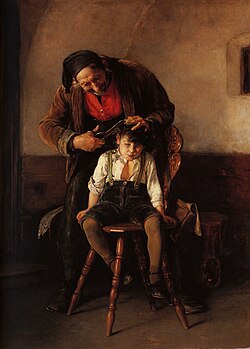
Barber — photo 9
📘 History
Starting in the Middle Ages, many barbers also did basic medical work like pulling teeth or treating wounds; these barber-surgeons formed guilds to learn and protect their trade. By the 1800s and 1900s, barbershops grew into small businesses and neighborhood meeting places, and they keep changing with new tools and ideas.
🔎 Introduction
A barbershop is more than a place for haircuts. For many centuries these shops have been places where people meet, talk about news, and share ideas. Long ago, barbers also did some medical jobs, and in the 1900s cosmetology split off so barbers could focus mostly on men's hair.
🧭 Barber Schools
You also study some body basics like the skin and scalp, simple germs, and how certain products affect hair. Schools teach facial shaving, scalp massage, and how to run a shop—things like money, rules, and treating customers well. Programs must meet state rules: training can be from about 800 to 2,000 hours, many finish in 15 months or less, and tuition often ranges around $6,500 to $10,000. Will you try a fun haircut in a class someday?
💡 Services And Skills
Barbers learn special skills like designing beard shapes or custom shave lines. Long ago barbers did more medical work, but now they focus on hair and grooming. Which haircut or beard style would you like a barber to make?
🌟 Names And Regulation
Rules about barbers vary. U.S. states make different laws about what barbers and cosmetologists may do, like whether they can use a straight razor. In some places, one license covers both jobs; in others they are separate. These rules help keep customers safe and explain what services each worker can offer.
🧩 Equipment And Symbols
Inside a barbershop you find special things: a heavy, comfy chair that spins and leans back, clippers, scissors, capes, mirrors, and small comforts like magazines or a TV. Some towns even have very tall poles as a local fun fact.
🗺️ Barbershops And Culture
Today, shops still bring people together. Many have special chairs, magazines or TV, and music. Some barbershops host projects like reading programs or health checks, because people trust the barber and the shop as a place to learn and care for the community.
Frequently asked questions
What does a barber do?
A barber cuts, styles, grooms, dresses, and sometimes shaves hair and beards using combs, scissors, clippers, and sometimes razors to help someone look neat or try a new haircut.
What is a barbershop like?
A barbershop is a place for haircuts and also a meeting spot where people talk and share ideas; many shops have special chairs, magazines or TV, music, and sometimes host projects like reading programs or health checks.
Why does a barber pole have red, white, and blue stripes?
Long ago the red and white reminded people of simple medical care barbers once helped with, the blue stripe was added later in the United States, and when the pole spins the stripes make an optical trick that looks like they are moving up or down.
Did barbers do medical work long ago?
Yes — starting in the Middle Ages many barbers also pulled teeth, treated wounds, and formed barber-surgeon guilds to learn and protect their trade.
What do students learn in barber school and how long does it take?
In barber school you learn how to cut, color, and style hair, care for the scalp, shave, keep tools and the shop clean, and run a shop; programs usually require about 800 to 2,000 hours of training and many finish in 15 months or less, with tuition often around $6,500 to $10,000.
Why are there rules about barbers?
Rules about barbers vary by place and say what barbers and cosmetologists may do, such as whether they can use a straight razor, and these rules help keep customers safe and explain what services each worker can offer.