All Articles

Angular Momentum

Angular Momentum Facts For Kids

Angular momentum is the measure of an object's rotational motion, depending on its mass, speed of rotation, and distance from the center of rotation.
🎨 Reading age for 6-8
Background blob
Angular Momentum
Facts for Kids!

Do more with AI

Introduction

Angular momentum is a special idea in physics that helps us understand how things spin! 🌪️ Just like how a moving car has momentum due to its speed and mass, spinning objects also have momentum based on their rotation. Imagine a merry-go-round! If you give it a push, it spins faster and has more angular momentum. 🌀Angular momentum depends on how quickly something spins and how far the mass is from the center. It’s important for everything that spins, from planets to toys. Understanding angular momentum helps scientists learn about our universe! 🌍✨

Images of Angular Momentum

Velocity of the particle m with respect to the origin O can be resolved into components parallel to (v∥) and perpendicular to (v⊥) the radius vector r. The angular momentum of m is proportional to the perpendicular component v⊥ of the velocity, or equivalently, to the perpendicular distance r⊥ from the origin.Image by Tfr000, licensed under Creative Commons Attribution-Share Alike 3.0

Velocity of the particle m with respect to the origin O can be resolved into components parallel to (v∥) and perpendicular to (v⊥) the radius vector r. The angular momentum of m is proportional to the perpendicular component v⊥ of the velocity, or equivalently, to the perpendicular distance r⊥ from the origin.
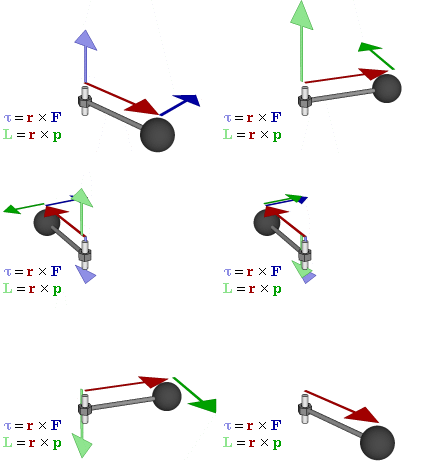
Relationship between force (F), torque (τ), momentum (p), and angular momentum (L) vectors in a rotating system. r is the position vector.

Relationship between force (F), torque (τ), momentum (p), and angular momentum (L) vectors in a rotating system. r is the position vector.

Moment of inertia (shown here), and therefore angular momentum, is different for each shown configuration of mass and axis of rotation.

Moment of inertia (shown here), and therefore angular momentum, is different for each shown configuration of mass and axis of rotation.

A figure skater in a spin uses conservation of angular momentum – decreasing her moment of inertia by drawing in her arms and legs increases her rotational speed.
A figure skater in a spin uses conservation of angular momentum – decreasing her moment of inertia by drawing in her arms and legs increases her rotational speed.

The torque caused by the two opposing forces Fg and −Fg causes a change in the angular momentum L in the direction of that torque (since torque is the time derivative of angular momentum). This causes the top to precess.Image by Xavier Snelgrove, licensed under Creative Commons Attribution-Share Alike 2.5

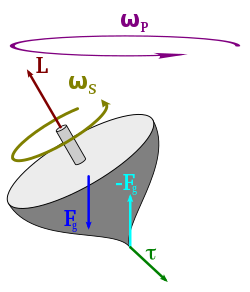
The torque caused by the two opposing forces Fg and −Fg causes a change in the angular momentum L in the direction of that torque (since torque is the time derivative of angular momentum). This causes the top to precess.

The angular momentum of the particles i is the sum of the cross products R × MV + Σri × mivi.Image by Tfr000, licensed under Creative Commons Attribution-Share Alike 3.0

The angular momentum of the particles i is the sum of the cross products R × MV + Σri × mivi.

The 3-angular momentum as a bivector (plane element) and axial vector, of a particle of mass m with instantaneous 3-position x and 3-momentum p.

The 3-angular momentum as a bivector (plane element) and axial vector, of a particle of mass m with instantaneous 3-position x and 3-momentum p.

Angular momenta of a classical object.Left: "spin" angular momentum S is really orbital angular momentum of the object at every point.Right: extrinsic orbital angular momentum L about an axis.Top: the moment of inertia tensor I and angular velocity ω (L is not always parallel to ω).[36]Bottom: momentum p and its radial position r from the axis. The total angular momentum (spin plus orbital) is J. For a quantum particle the interpretations are different; particle spin does not have the above interpretation.

Angular momenta of a classical object.Left: "spin" angular momentum S is really orbital angular momentum of the object at every point.Right: extrinsic orbital angular momentum L about an axis.Top: the moment of inertia tensor I and angular velocity ω (L is not always parallel to ω).[36]Bottom: momentum p and its radial position r from the axis. The total angular momentum (spin plus orbital) is J. For a quantum particle the interpretations are different; particle spin does not have the above interpretation.

In this standing wave on a circular string, the circle is broken into exactly 8 wavelengths. A standing wave like this can have 0, 1, 2, or any integer number of wavelengths around the circle, but it cannot have a non-integer number of wavelengths like 8.3. In quantum mechanics, angular momentum is quantized for a similar reason.Image by Yuta Aoki, licensed under Creative Commons Attribution-Share Alike 3.0

In this standing wave on a circular string, the circle is broken into exactly 8 wavelengths. A standing wave like this can have 0, 1, 2, or any integer number of wavelengths around the circle, but it cannot have a non-integer number of wavelengths like 8.3. In quantum mechanics, angular momentum is quantized for a similar reason.

Velocity of the particle m with respect to the origin O can be resolved into components parallel to (v∥) and perpendicular to (v⊥) the radius vector r. The angular momentum of m is proportional to the perpendicular component v⊥ of the velocity, or equivalently, to the perpendicular distance r⊥ from the origin.Image by Tfr000, licensed under Creative Commons Attribution-Share Alike 3.0

Velocity of the particle m with respect to the origin O can be resolved into components parallel to (v∥) and perpendicular to (v⊥) the radius vector r. The angular momentum of m is proportional to the perpendicular component v⊥ of the velocity, or equivalently, to the perpendicular distance r⊥ from the origin.

Relationship between force (F), torque (τ), momentum (p), and angular momentum (L) vectors in a rotating system. r is the position vector.

Relationship between force (F), torque (τ), momentum (p), and angular momentum (L) vectors in a rotating system. r is the position vector.

Moment of inertia (shown here), and therefore angular momentum, is different for each shown configuration of mass and axis of rotation.

Moment of inertia (shown here), and therefore angular momentum, is different for each shown configuration of mass and axis of rotation.

A figure skater in a spin uses conservation of angular momentum – decreasing her moment of inertia by drawing in her arms and legs increases her rotational speed.

A figure skater in a spin uses conservation of angular momentum – decreasing her moment of inertia by drawing in her arms and legs increases her rotational speed.

The torque caused by the two opposing forces Fg and −Fg causes a change in the angular momentum L in the direction of that torque (since torque is the time derivative of angular momentum). This causes the top to precess.Image by Xavier Snelgrove, licensed under Creative Commons Attribution-Share Alike 2.5

The torque caused by the two opposing forces Fg and −Fg causes a change in the angular momentum L in the direction of that torque (since torque is the time derivative of angular momentum). This causes the top to precess.

The angular momentum of the particles i is the sum of the cross products R × MV + Σri × mivi.Image by Tfr000, licensed under Creative Commons Attribution-Share Alike 3.0

The angular momentum of the particles i is the sum of the cross products R × MV + Σri × mivi.

The 3-angular momentum as a bivector (plane element) and axial vector, of a particle of mass m with instantaneous 3-position x and 3-momentum p.

The 3-angular momentum as a bivector (plane element) and axial vector, of a particle of mass m with instantaneous 3-position x and 3-momentum p.

Angular momenta of a classical object.Left: "spin" angular momentum S is really orbital angular momentum of the object at every point.Right: extrinsic orbital angular momentum L about an axis.Top: the moment of inertia tensor I and angular velocity ω (L is not always parallel to ω).[36]Bottom: momentum p and its radial position r from the axis. The total angular momentum (spin plus orbital) is J. For a quantum particle the interpretations are different; particle spin does not have the above interpretation.

Angular momenta of a classical object.Left: "spin" angular momentum S is really orbital angular momentum of the object at every point.Right: extrinsic orbital angular momentum L about an axis.Top: the moment of inertia tensor I and angular velocity ω (L is not always parallel to ω).[36]Bottom: momentum p and its radial position r from the axis. The total angular momentum (spin plus orbital) is J. For a quantum particle the interpretations are different; particle spin does not have the above interpretation.

In this standing wave on a circular string, the circle is broken into exactly 8 wavelengths. A standing wave like this can have 0, 1, 2, or any integer number of wavelengths around the circle, but it cannot have a non-integer number of wavelengths like 8.3. In quantum mechanics, angular momentum is quantized for a similar reason.Image by Yuta Aoki, licensed under Creative Commons Attribution-Share Alike 3.0

In this standing wave on a circular string, the circle is broken into exactly 8 wavelengths. A standing wave like this can have 0, 1, 2, or any integer number of wavelengths around the circle, but it cannot have a non-integer number of wavelengths like 8.3. In quantum mechanics, angular momentum is quantized for a similar reason.

Common Misconceptions

Many kids think angular momentum is just about spinning fast, but that’s not the whole story! 🌀It’s really about how mass is spread out and how fast something spins. Another misconception is that we can't see angular momentum—actually, we can see it in everyday actions like riding a bike or watching a spinning top! ⛷️ Also, some believe it only applies to big objects like planets, but it works for tiny particles, too! So, angular momentum is everywhere, just hidden in plain sight! 👀

Mathematical Formulation

The formula for angular momentum (L) is pretty cool! It can be written as L = I × ω. 📏Here, "I" stands for the moment of inertia, which tells us how much mass is distributed in relation to the axis of rotation, while "ω" (omega) represents angular velocity, the speed of the spin. For example, if a spinning top has a lot of mass far from the center, it has a higher moment of inertia and therefore a higher angular momentum. 🎩With this formula, physicists can calculate the spinning motion of various objects!

Examples In Everyday Life

We see angular momentum all around us! 🚴‍♀️ When you ride a bicycle and turn, the wheels are spinning and have angular momentum. The world’s oceans have tides that create angular momentum as the Earth spins! 🌊Even spinning ice skaters and Ferris wheels show us this concept in action. If you’ve ever seen a basketball player spin the ball on one finger, that’s angular momentum, too! 🏀Every time you spin around, you are experiencing angular momentum firsthand. Isn’t that amazing?

Angular Momentum In Physics

In physics, angular momentum is super important! 🔭It helps scientists explain how things move and spin in space. For planets, stars, and galaxies, angular momentum plays a key role in their formation and movement. 🌌It tells us how fast celestial bodies orbit each other and how they stay in balance. Physicists study angular momentum to understand everything from the tiny particles in atoms to the large forces that govern the entire universe. Angular momentum connects the spinning world to the greater cosmos! 🌠

Applications In Engineering

Engineers use angular momentum in many cool ways! 🏗️ For example, when designing roller coasters, they calculate the angular momentum to make sure riders are safe while spinning. ⚡️ In robotics, engineers ensure robots can spin and turn correctly by considering angular momentum. Even in cars, understanding this concept helps improve handling during turns! 🚗Angular momentum is vital for creating fun toys like spinning tops and gyroscopes, which rely on this physical principle to demonstrate fascinating rotational motion. 🚀

Definition Of Angular Momentum

Angular momentum is the measure of how much motion an object has while it is spinning. 🛞It tells us both the speed of the spin and how far the mass is from the center of that spin. The further away the mass is, the more angular momentum there is! For example, when you spin in place, your arms out wide make you spin slower than when they are close to your body. 🤸‍♂️ Just like a whirlpool, the water spins fast in the center! So, angular momentum helps keep things spinning in the right way.

Conservation Of Angular Momentum

The conservation of angular momentum is an exciting principle! 🌟It means that if no forces act on a spinning object, its angular momentum will stay the same. Picture a figure skater spinning—when they pull their arms in, they spin faster! 🩰That's because they conserve their angular momentum. This principle helps explain why planets keep orbiting stars and why spinning toys keep turning until they run out of energy. It shows how nature loves to keep things balanced and stable! ⚖️

Relation To Rotational Kinematics

Rotational kinematics and angular momentum go hand in hand! 🔄Rotational kinematics describes how objects move while spinning, just like regular kinematics describes straight motion. Angular momentum is the result of this motion! 🌀While rotating, we can measure things like how fast an object spins (angular velocity) and how far it moves in circular paths. Being able to calculate angular momentum based on these factors helps scientists and engineers understand everything that spins—from toys to galaxies! ✨

Angular Momentum In Quantum Mechanics

Did you know that angular momentum is important in quantum mechanics? 🧬In the tiny world of atoms, particles like electrons also have angular momentum! This is called "quantum angular momentum" and it helps determine how particles behave. 🌌Electrons spin around the nucleus of an atom, and their angular momentum affects how they interact with each other. Scientists study this to understand the very fabric of nature! Quantum mechanics shows us that even the smallest particles follow the same rules of angular momentum! 🌟

Experiments Demonstrating Angular Momentum

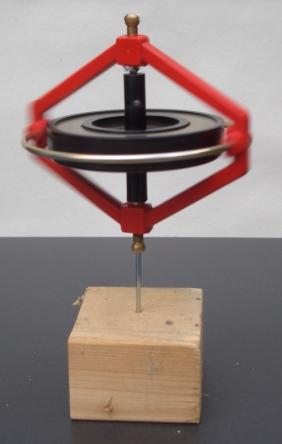
You can explore angular momentum with fun experiments! 🌠For example, try spinning a basketball on your finger. Notice how it keeps spinning because of angular momentum! 🏀You can also take a bicycle wheel, hold it by the axle, and spin it. Feel how it resists when you try to change its direction! 🚴‍♂️ Even a simple toy top can be a great demonstration—give it a spin and watch it balance! These hands-on activities show how angular momentum is all around us and how it keeps our world spinning! ✨

Angular Momentum Quiz

Q1
Question 1 of 10

Learn more about Angular Momentum

Ready to create?

Make

To create a safe space for kid creators worldwide!

Create

Vibe Coding

Kids GPT

All Tools

Kibu

Resources

Worksheets

SafeTube

Blog

FAQ

Account

Pricing

Log-in

Sign-up

Data Deletion

Company

About

Community Guidelines

Privacy Policy

Terms of Service

2025, URSOR LIMITED. All rights reserved. DIY is in no way affiliated with Minecraft™, Mojang, Microsoft, Roblox™ or YouTube. LEGO® is a trademark of the LEGO® Group which does not sponsor, endorse or authorize this website or event. Made with love in San Francisco.