Anemometer Facts For Kids
An anemometer is a device that measures wind speed and direction, crucial for weather forecasting and various applications in meteorology.
Select reading age

Anemometer Facts For Kids
Videos & Quizzesincluded
About this topic
An anemometer is a fun tool that measures how fast the wind is blowing! 🌬️ It helps scientists and weather reporters understand the weather better. Anemometers have been around for a long time and have different shapes. They are important for activities like sailing, flying kites, or even just knowing if it’s a windy day to play outside! With the help of an anemometer, we can figure out wind speeds in miles per hour (mph) or kilometers per hour (km/h). Learning about wind can even help us understand storms and keep us safe! 🌪️
Explore with ChatDinoKey Points
Anemometers work by detecting how fast the wind moves!
There are several types of anemometers, each doing its job in a cool way!
To make sure an anemometer gives the right wind speed, it needs to be calibrated!
The first anemometer was invented a long time ago in 1450 by a smart man named Giovanni Battista Benedetti in Italy!
Anemometers have many cool uses everywhere!
When scientists go outside to measure wind with an anemometer, they use field measurement techniques!
Today, anemometers are getting even more advanced!
Different types of anemometers have their own strengths!
Anemometers are also used in environmental impact assessments!
Anemometers play a key role in weather forecasting!
Photos of Anemometer

A reconstruction of an anemometer by Leonardo da Vinci
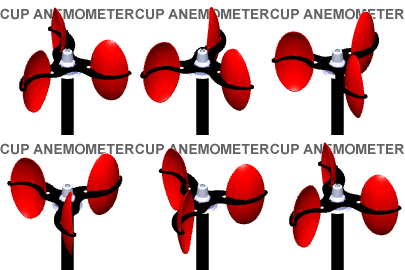
Cup anemometer animation

Anemometer — photo 3

Anemometer — photo 4
Anemometer — photo 5

Anemometer — photo 6


Drawing of a laser anemometer. The laser light is emitted (1) through the front lens (6) of the anemometer and is backscattered off the air molecules (7). The backscattered radiation (dots) re-enters the device and is reflected and directed into a detector (12).

Fixed mounted 2D ultrasonic anemometer with 3 paths. Central spike keeps birds away.
🌬️ How Anemometers Work
Anemometers work by detecting how fast the wind moves! 🌬️ For example, in a cup anemometer, when the wind blows, it pushes the cups, causing them to spin. The faster they spin, the stronger the wind is! Each full spin counts as a measurement. Similarly, vane anemometers use a small fan; the wind spinning the fan tells us how fast the wind is going. 🌀These instruments often have little gears or electronic parts to change spins into meaningful numbers that we can read, making them super useful for weather experts!
Go deeper🌪️ Types Of Anemometers
There are several types of anemometers, each doing its job in a cool way! One of the most common types is the cup anemometer, which has three or four cups that spin in the wind. 🌪️ Another type is the vane anemometer, which has a fan and spins when the wind blows. There are also digital anemometers that show the wind speed on a screen! 📱Some scientists use hot-wire anemometers, where a thin wire gets hot and measures how fast wind cools it down! All these types help us measure wind effectively!
Go deeper📏 Anemometer Calibration
To make sure an anemometer gives the right wind speed, it needs to be calibrated! This means checking and adjusting it so it works perfectly. 📏Scientists often use a known wind speed to set the anemometer. They blow air at it with controlled speed and see if the reading matches! If not, they make adjustments. Calibration helps ensure that all measurements are accurate for everyone who needs them, from meteorologists at weather stations to sailors on the sea. Regular checks are important to keep everyone safe and informed! ✅
Go deeper🌍 History Of Anemometers
The first anemometer was invented a long time ago in 1450 by a smart man named Giovanni Battista Benedetti in Italy! 🇮🇹 Over the years, many scientists improved anemometers, including the famous Benjamin Franklin in the 1700s. He actually helped connect wind measurements to weather! In the 19th century, an even better design called the cup anemometer was made, which looks like a tiny windmill with cups. Today, anemometers are used all over the world, from measuring breezes in gardens to studying storms in meteorology centers! 🌍
Go deeper🏞️ Applications Of Anemometers
Anemometers have many cool uses everywhere! 🏞️ Sailors use them to decide the best time to set sail or adjust their sails for a nice ride. In aviation, pilots check wind speed to ensure safe takeoffs and landings. 🛩️ They're also used at weather stations to report wind conditions, helping to issue warnings for storms or floods. In construction, workers use anemometers to check if it’s safe to work on tall buildings or cranes. Anemometers really help keep people safe and inform them about wind conditions wherever they are!
Go deeper🌳 Field Measurement Techniques
When scientists go outside to measure wind with an anemometer, they use field measurement techniques! 🌳They often pick a high spot, like a hill or a tower, to get cleaner wind data without blockages from trees or buildings. They also take measurements for a set time to make sure they have enough data. 📊Sometimes, they’ll move the anemometer around to find how wind speed changes in different spots. These careful methods allow scientists to gather information that helps everyone understand more about the weather!
Go deeper🚀 Modern Technological Advances
Today, anemometers are getting even more advanced! 🚀We have digital sensors and wireless devices that can send wind data right to our phones or computers. New technology allows us to measure wind speed and direction in real time over great distances. 🌐Some scientists even use satellite data to study wind patterns in the atmosphere! Also, smart weather stations use automatic anemometers that can measure changes without anyone needing to be there. These improvements help us understand big weather systems and can warn us about storms sooner than before!
Go deeper💪 Comparison Of Anemometer Types
Different types of anemometers have their own strengths! 💪For example, cup anemometers are simple and effective for general use, while vane anemometers can give precise readings in small areas thanks to their fans. Fans may struggle with high winds but are perfect for low wind conditions! Digital anemometers display data conveniently and can often log wind information over time. 📅Hot-wire anemometers are super sensitive and excellent for research, though they can be tricky to use. Each type is unique, making it easier for scientists to choose the best one for their needs!
Go deeper🌱 Environmental Impact Assessments
Anemometers are also used in environmental impact assessments! 🌱Scientists check wind patterns to understand how wind can affect air quality, pollution spread, and even plant growth! They can see how wind can help or harm local animals and plants in different weather conditions, like when storms roll in or if green energy like wind turbines is being used. 🌬️ By measuring wind speeds, we get a better understanding of how to take care of our planet and ensure a healthy environment for everyone.
Go deeper⛅ Importance In Weather Forecasting
Anemometers play a key role in weather forecasting! ⛅By measuring wind speed and direction, meteorologists can predict how storms might move and change. Strong winds can mean trouble, like hurricanes or tornadoes! 🌀Scientists collect data from many anemometers to create accurate weather reports that help us prepare for different conditions. This means we can know when to stay inside during shows or when the wind is perfect for a kite-flying day! 🏖️ Anemometers help everyone understand and respect the power of nature!
Go deeper