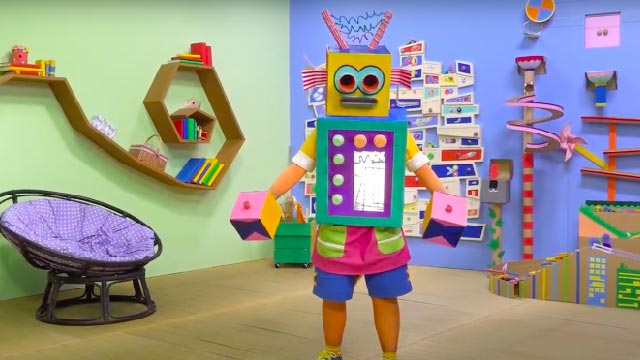
The Robot Costume Challenge!
Design and build a wearable robot costume using cardboard, foil, paint, and safe LED circuits; learn measuring, decorating, and problem solving skills.
About this activity
Design and build a wearable robot costume using cardboard, foil, paint, and safe LED circuits; learn measuring, decorating, and problem solving skills.
What you need
Step by step
- 1
Step 1
Measure the child from shoulders to waist and mark the top and bottom lines on the cardboard with a pencil and ruler.
- 2
Step 2
Cut off the top flaps of the box so the top is open and you can make a head hole.
- 3
Step 3
Cut a round or square head hole in the center of the top where you marked it.
- 4
Step 4
Mark shoulder points on each side and cut armholes at those marks.
- 5
Step 5
Tape all cut edges and seams on the inside and outside to make the costume strong and smooth.
- 6
Step 6
Paint the outside of the box with a base colour you like.
- 7
Step 7
Let the paint dry completely before you touch the costume again.
- 8
Step 8
Smooth pieces of aluminum foil onto areas you want shiny and glue or tape them down to make metal panels.
- 9
Step 9
Decide where your lights should go and mark small dots for each LED with your pencil.
- 10
Step 10
Connect the batteries to the pre-wired LED lights and turn the lights on to test they work.
- 11
Step 11
Attach each LED to its marked spot using tape or glue so the light faces outward.
- 12
Step 12
Fasten the LED wires to the inside of the costume using electrical tape so they do not pull loose.
- 13
Step 13
Tape the battery pack to the inside of the costume where the switch is easy to reach.
- 14
Step 14
Put the costume on and move your arms to check the fit and that the lights light up safely.
- 15
Step 15
Share your finished robot costume on DIY.org
Fun facts
How do I build a wearable robot costume for the Robot Costume Challenge?
Start by sketching a simple robot design and measuring the child's head, shoulders, and length for fit. Cut cardboard pieces for the torso, headbox, and arm tubes; have an adult do any utility-knife work. Cover panels with foil for a metallic look, then paint details. Attach battery-powered LED strips or prewired LED kits to chosen spots with tape or glue, insulating connections. Use elastic straps or Velcro for wearability, test mobility, and add decorations. Supervise all cutting and wiring.
What materials do I need to make a robot costume?
You’ll need cardboard boxes, aluminum foil, acrylic paints, paintbrushes, permanent markers, a ruler or measuring tape, masking tape, strong tape or hot glue (adult use), scissors and a utility knife (adult), elastic straps or Velcro, and battery-powered LED lights or a child-safe LED kit. Optional extras: craft foam, stickers, pipe cleaners, and small decorations. Keep LED power sources low-voltage and choose non-toxic paints for safety.
What ages is the Robot Costume Challenge suitable for?
This activity suits children age 5 to 12 with varying supervision. Ages 5–7 enjoy decorating, measuring, and fitting while adults handle cutting and wiring. Ages 8–10 can cut simple shapes, attach pieces, and place LED lights with supervision. Ages 11–12 can plan more complex builds and safely assemble low-voltage circuits with guidance. Tailor tools, instructions, and safety rules to each child's ability.
What safety tips should I follow when making a wearable robot costume?
Safety first: always supervise cutting, hot-glue, and any wiring. Use child-safe scissors and have adults use box cutters or soldering tools. Choose low-voltage, battery-powered LED kits and insulate connections with electrical tape or heat-shrink tubing. Secure batteries in a sealed pocket away from elbows and edges. Ensure clear vision and breathing—cut face openings and avoid full masks. Use non-toxic paints and ventilate while painting. Test the costume for balance, sharp edges, and freedom
Watch & Learn
Need help?
What can we use if pre-wired LED lights or batteries are hard to find?
Use battery-powered fairy lights or glow sticks taped where you mark LED dots and tape or secure their battery bundle where the instructions say to tape the battery pack so the switch is easy to reach.
My LEDs won't light — what should I check?
Check that the batteries are connected correctly to the pre-wired LED lights, that the battery pack switch is on, and that the LED wires are fastened to the inside with electrical tape so they don't pull loose.
How can I adapt this activity for different ages?
For younger kids have an adult measure and cut the head and armholes and use washable paint and tape-on foil panels, while older children can mark the LED dots, connect the pre-wired LED lights themselves, and add detailed painted designs and aluminum foil panels.
How can we make the costume more impressive or personalized?
Add cardboard antennae taped to the head hole, create accordion-folded jointed arms with duct tape at the armholes, glue extra aluminum foil panels for more shine, and tuck a phone or small speaker near the taped battery pack to play robot sounds before sharing on DIY.org.