Perform the T-Perm Algorithm on Your Cube
Learn and perform the T-perm algorithm on a 3x3 Rubik's Cube, practicing hand motions, pattern recognition, and tracking piece positions.


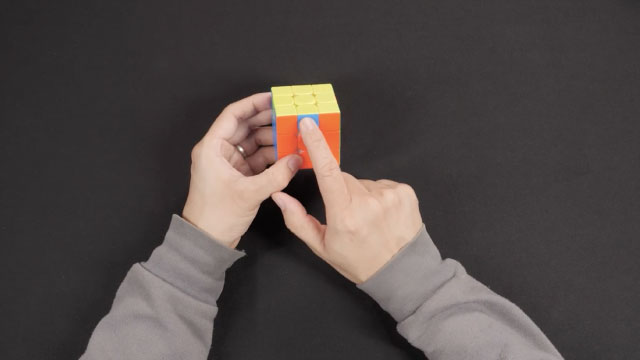
Step-by-step guide to perform the T-Perm algorithm on your cube
Step 1
Place your solved 3x3 Rubik's Cube on the flat surface with the white face on top and the green face facing you.
Step 2
Pick two stickers to watch during the moves: one on the top-front-right corner and one on the front-center edge.
Step 3
Turn the right face clockwise once (R) to practice the R move.
Step 4
Turn the right face counterclockwise once (R') to practice the R' move.
Step 5
Turn the top face clockwise once (U) to practice the U move.
Step 6
Turn the top face counterclockwise once (U') to practice the U' move.
Step 7
Turn the front face clockwise once (F) to practice the F move.
Step 8
Turn the front face counterclockwise once (F') to practice the F' move.
Step 9
Turn the right face 180 degrees once (R2) to practice the R2 move.
Step 10
Slowly perform the full T-perm algorithm exactly as written: R U R' U' R' F R2 U' R' U' R U R' F'.
Step 11
Look at the two stickers you picked and say out loud where each sticker moved after the algorithm.
Step 12
Repeat the full T-perm algorithm two more times at a steady slow speed to build finger-memory while watching the same stickers.
Step 13
Share your finished T-perm practice and what you learned on DIY.org.
Help!?
I don't have a solved 3x3 Rubik's Cube — what can I use instead?
If you don't have a solved 3x3 Rubik's Cube, use any 3x3 cube or a reliable online cube simulator and set it with white on top and green facing you before practicing the R, U, and F moves.
I keep losing track of the two stickers while doing the T-perm — how can I avoid that?
Put small removable dot stickers or mark the top-front-right corner sticker and the front-center edge, then slow down or pause between moves while you run the full algorithm (R U R' U' R' F R2 U' R' U' R U R' F') to watch their movement.
How can I change this activity for younger or older kids?
For younger kids, simplify by practicing single moves (R, R', U, U', F, F') and a short 4–6 move sequence with a larger cube, and for older kids, time three full T-perm repetitions, practice from different orientations, or progress to other PLL algorithms after sharing results on DIY.org.
Any fun ways to extend or personalize the T-perm practice?
Personalize by marking your two watched stickers with different colors, video the three steady slow repetitions to track improvement in finger-memory and accuracy, and then share your finished T-perm practice and what you learned on DIY.org.
Watch videos on how to perform the T-Perm algorithm on your cube
HOW TO DO T PERM
3 Videos
HOW TO DO T PERM
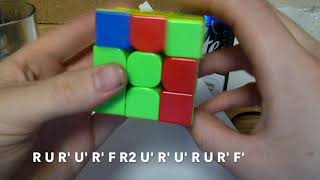
How to Solve the Rubik's Cube: T-Perm
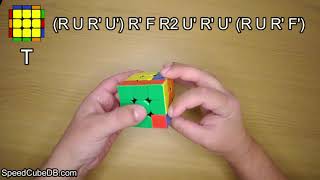
PLL Algorithms - T Perm
Facts about Rubik's Cube algorithms
🧩 The Rubik's Cube has about 43 quintillion possible positions (43,252,003,274,489,856,000) — that's a huge puzzle playground!
🔁 The T-perm is a PLL algorithm that swaps two adjacent corners and two adjacent edges to complete the cube's last layer.
📚 T-perm is one of the 21 PLL cases that many cubers learn in the CFOP method to solve the last layer quickly and reliably.
⌛ Skilled speedcubers practice finger tricks so they can execute T-perm in a fraction of a second during super-fast solves.
👐 Singmaster notation (R, U, F, etc.) is the common language cubers use to write and share algorithms like T-perm.
How do I perform the T-perm algorithm on a 3x3 Rubik's Cube?
What materials do I need to learn and practice the T-perm on a 3x3 cube?
What ages is learning the T-perm suitable for?
What are the benefits of practicing the T-perm algorithm with my child?
