Draw Your Dungeons & Dragons Character
Draw and design your Dungeons and Dragons character, including appearance, outfit, weapon, and background story, then color and share your finished artwork.


Drawing Apps
Step-by-step guide to draw your Dungeons & Dragons character
Draw Your DnD World!!
Step 1
Choose a race and class for your Dungeons & Dragons character like human wizard or elven rogue.
Step 2
Write a one-sentence backstory at the top or side of your paper telling where your character came from.
Step 3
Lightly sketch the character’s pose and basic body shapes with your pencil.
Step 4
Draw the character’s face and hairstyle to show their personality.
Step 5
Design the outfit or armor by drawing clothes and any special details.
Step 6
Draw the character’s weapon and any gear they carry.
Step 7
Add a simple background that shows where your character lives or goes on adventures.
Step 8
Trace all your pencil outlines with a black pen or thin marker to make them bold.
Step 9
Let the ink dry completely so it does not smudge.
Step 10
Gently erase the pencil guide lines so only the inked drawing remains.
Step 11
Color your character and background using your coloring materials.
Step 12
Add finishing touches like highlights patterns or small symbols to make your character unique.
Step 13
Share your finished creation on DIY.org
Help!?
What can we use if we don’t have a black pen or thin marker, or if we’re missing special coloring materials?
If you don't have a black pen or thin marker to 'Trace all your pencil outlines,' use a fine-tip ballpoint or dark colored pencil for inking, and substitute crayons, watercolor pans, or markers for the listed coloring materials when you 'Color your character and background.'
My ink smudged when I tried to erase—how can I prevent or fix that?
To avoid smudging, follow the instruction to 'Let the ink dry completely so it does not smudge,' or use a fast-drying pen, gently blot with scrap paper, then 'Gently erase the pencil guide lines' with a kneaded eraser.
How can I change the project for different ages or skill levels?
For younger kids, simplify by providing pre-drawn poses to 'Lightly sketch the character’s pose' and sticker details for outfits, while older kids can add detailed anatomy, intricate armor patterns, and digital coloring after they 'Trace all your pencil outlines with a black pen.'
What are easy ways to make the character more unique or to extend the activity?
In addition to 'Add finishing touches like highlights patterns or small symbols,' personalize by expanding the 'one-sentence backstory' into a page, creating a mini character sheet, making paper props for the weapon, or sharing the final piece on DIY.org.
Watch videos on how to draw your Dungeons & Dragons character
How to Design and Draw and D&D Dungeon Map!
4 Videos
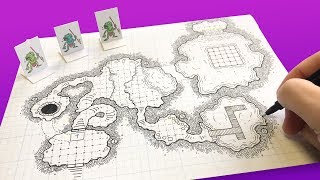
How to Design and Draw and D&D Dungeon Map!
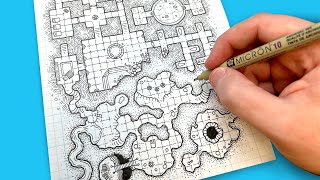
How to Draw A Detailed Dungeon Map (It's not hard!)
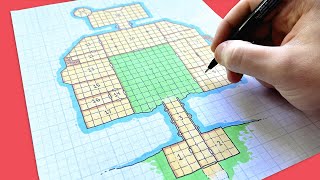
How to Create Your Own D&D Dungeon!
11 Tips for Creating D&D Encounters Your Players Will Love (and avoiding tedious combats)
Facts about drawing and character design for kids
🐉 Dungeons & Dragons was first published in 1974 by Gary Gygax and Dave Arneson.
🎲 The 20-sided die (d20) is central to modern D&D for attack rolls, saving throws, and skill checks.
🧠 D&D characters usually have six ability scores: Strength, Dexterity, Constitution, Intelligence, Wisdom, and Charisma.
🎨 Fantasy art and character portraits help players visualize outfits, weapons, and heroic poses.
✍️ A character's background story adds personality and can inspire adventures—some editions even give background features.
How do I draw my Dungeons & Dragons character step-by-step?
What materials do I need to draw and design a Dungeons & Dragons character?
What ages is drawing a Dungeons & Dragons character suitable for?
What are the benefits of drawing Dungeons & Dragons characters for kids?
