Do an easy light refraction experiment
Do a simple refraction experiment by placing a pencil in a glass of water to observe its apparent bend; try different angles and record observations.


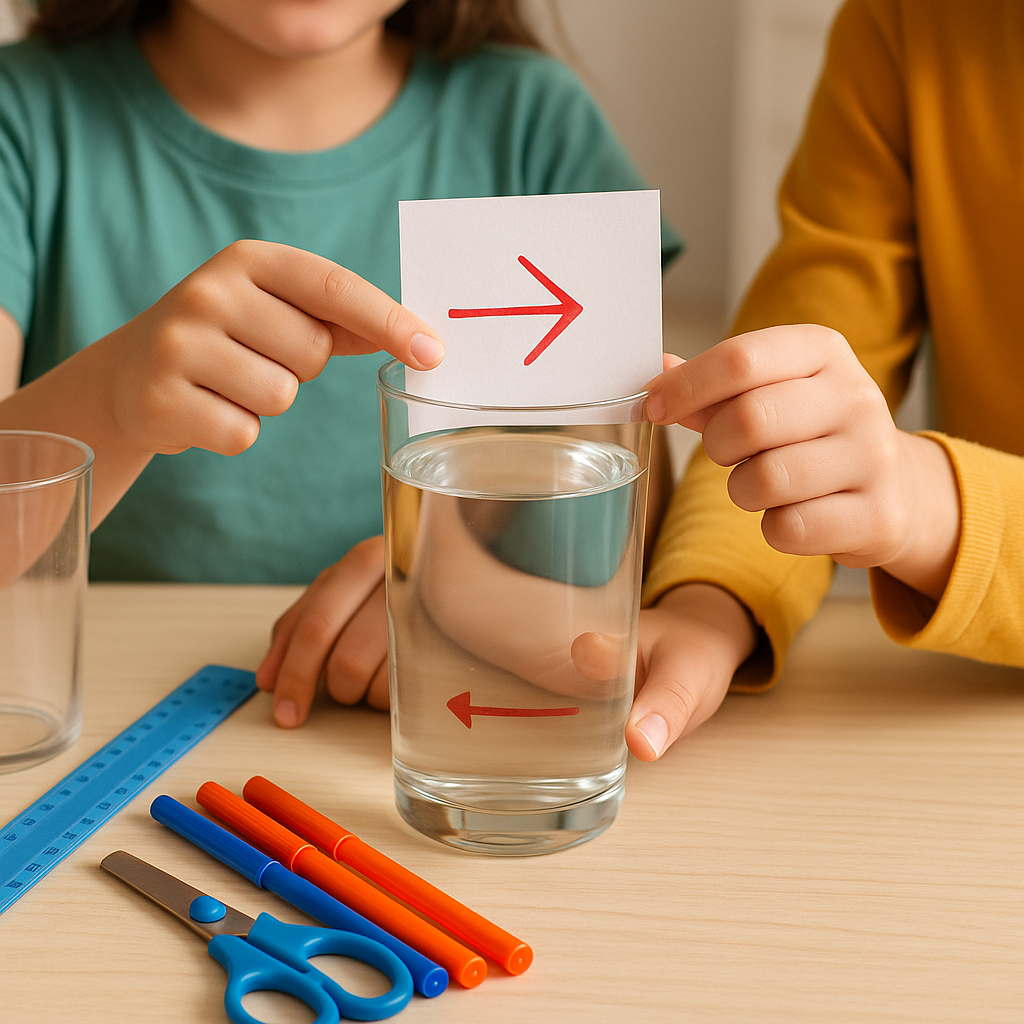
Step-by-step guide to a simple light refraction experiment using a pencil and a glass of water
Refraction Of Light In Water | Science Experiments for Kids | Sema's Lab
Step 1
Gather all the materials on a flat table or countertop.
Step 2
Fill the clear glass about three-quarters full with water.
Step 3
Place the white paper standing behind the glass so you can see the pencil against the paper.
Step 4
Put the pencil into the glass so one end is in the water and one end sticks out.
Step 5
Stand so your eye is level with the middle of the glass.
Step 6
Look at the pencil from that side-eye position.
Step 7
Draw on the paper how the pencil looks to you right now.
Step 8
Gently tilt the pencil to a new angle and hold it steady.
Step 9
Look again from the same eye level at the tilted pencil.
Step 10
Draw the new view on the paper and write one short sentence about what changed.
Step 11
Share your finished drawings and notes on DIY.org.
Help!?
What can we use if we don't have a clear glass or white paper?
If you don't have a clear glass use a clear plastic cup or clean jar and if you don't have white paper place plain notebook paper or white cardboard behind the cup so you can still see the pencil against it.
Why can't I see the pencil bending and how can I fix it?
If the pencil doesn't look bent, make sure the glass is filled about three-quarters with water, the white paper is directly behind the glass for contrast, and your eye is exactly level with the middle of the glass while you view from the side.
How can I adapt this experiment for younger or older kids?
For younger children let an adult steady the glass and have them use a chunky crayon to draw a simple 'bent' shape, and for older kids have them tilt the pencil to precise angles and measure and record the angle changes on the paper.
How can we extend or personalize the activity after finishing the two drawings?
To extend the experiment, try the same steps with different clear liquids (like oil or saltwater) or different pencils, photograph each drawing and write a short note about differences before sharing the results on DIY.org.
Watch videos on how to perform a pencil-in-water light refraction experiment
Easy simple science experiments for school students| DIY | Light refraction #scienceproject
4 Videos
Easy simple science experiments for school students| DIY | Light refraction #scienceproject
Cool Light Refraction Science Experiment
Light Refraction experiment | DIY magic trick
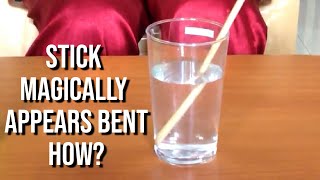
Science Experiment on Bending of light | Refraction | How to make Stick magically appear bent
Facts about basic optics for kids
🔍 Light slows down when it enters water from air, and that speed change makes objects look shifted or bent.
✏️ A pencil looks broken in a glass of water because light rays change direction at the water's surface.
🌈 Refraction separates white light into colors — that's how rainbows form when sunlight passes through raindrops.
🔬 Snell's law is the rule scientists use to calculate exactly how much a light beam will bend between two materials.
📏 Different materials have different refractive indices: water ≈ 1.33 and many glass types ≈ 1.5, which tells how much light bends.
How do I do a simple light refraction experiment with a pencil and a glass of water?
What materials do I need for a pencil-in-water refraction experiment?
What ages is this light refraction experiment suitable for?
What are the benefits, safety tips, and variations for this refraction experiment?
