Clap out the strumming pattern!
Clap and count common strumming patterns, practicing steady beats, rests, and accents with a metronome or hand percussion to build rhythm skills.




Step-by-step guide to clap out the strumming pattern
Step 1
Turn on your metronome or metronome app and set it to 60 beats per minute.
Step 2
Sit or stand where you can move your hands freely.
Step 3
Clap once on every metronome click for eight counts to feel a steady pulse.
Step 4
Clap only on beats 1 and 3 for eight counts to practice leaving rests on beats 2 and 4.
Step 5
For eight counts clap louder on the first beat and softer on the other beats to practice accents.
Step 6
Write the pattern D D U U D U on your paper and write the counts 1 & 2 & 3 & 4 & underneath.
Step 7
Slowly clap the pattern D D U U D U while saying the counts "1 & 2 & 3 & 4 &" out loud for four measures, using louder claps for D and lighter claps for U.
Step 8
Raise the metronome to 80 beats per minute to play the pattern a bit faster.
Step 9
Clap the full pattern in time with the faster metronome for eight measures and try to stay steady without missing a beat.
Step 10
Share your finished rhythm practice on DIY.org
Help!?
What can we use instead of a metronome or metronome app if we don't have one?
If you don't have a metronome or metronome app, set a phone timer to a steady 60 BPM pulse or have a parent tap a steady click at 60 while you follow step 1.
I'm missing beats when I try the D D U U D U pattern at 80 BPM—how do I fix that?
If you miss beats, go back to the earlier instruction to slowly clap the pattern D D U U D U while saying the counts 1 & 2 & 3 & 4 & out loud and practice two-measure chunks at 60 BPM, using louder claps for D and lighter claps for U before raising the metronome again.
How can I adapt this activity for younger or older children?
For younger kids, start with 'Clap once on every metronome click' and 'Clap only on beats 1 and 3' at 60 BPM, while older children can treat the 80 BPM step as a minimum and add actual down/up strumming motions matching louder D and softer U.
How can we extend or personalize the rhythm practice after finishing the steps?
After you master eight measures at 80 BPM, write your own four-count pattern on paper like the D D U U D U step, practice it with the same counting and accents, record a short clip, and share your finished rhythm practice on DIY.org.
Watch videos on how to clap out the strumming pattern
Everything You Need To Know About Strumming Patterns (Beginner's Masterclass)
4 Videos
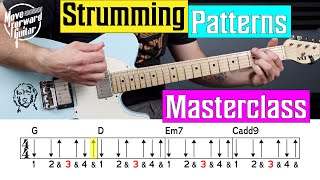
Everything You Need To Know About Strumming Patterns (Beginner's Masterclass)

Every Possible Strumming Pattern Explained in 8 Minutes

Beginner Strum Patterns - 6 Essential Strums for Beginners

6. How to strum any pattern to any song, naturally and easily!
Facts about rhythm training and strumming patterns
🕰️ The modern metronome was popularized in the early 1800s by Johann Nepomuk Maelzel.
👏 Clapping a rhythm before strumming helps musicians lock in timing and often reduces playing mistakes.
🎸 The "backbeat" on beats 2 and 4 is a signature feel in rock and pop that makes songs feel driving and danceable.
🥁 Percussionists count rests and accents carefully—rests are as important as hits for creating clear patterns.
⏱️ Many pop songs sit around 100–130 beats per minute, a comfy tempo range for clapping and practicing strumming.
How do you do the "Clap out the strumming pattern" activity?
What materials do I need for "Clap out the strumming pattern"?
What ages is "Clap out the strumming pattern" suitable for?
What are the benefits of doing "Clap out the strumming pattern" with kids?
