Clap in a rhythm to any music
Practice clapping steady rhythms to different songs, learn to keep time by counting beats, and create simple hand rhythms to any music.


Step-by-step guide to clap steady rhythms to music
Step 1
Stand or sit comfortably with your hands free and a little room to move.
Step 2
Shake your hands and wrists gently for five seconds to warm up.
Step 3
Pick one song you love to clap along to.
Step 4
Tap your foot steadily to the song to find the steady beat.
Step 5
Count the beats out loud as "1 2 3 4" for eight beats to lock the pulse.
Step 6
Clap once on each beat for eight beats to match the steady pulse.
Step 7
Choose a faster or slower song and clap once on each beat for eight beats to practice different tempos.
Step 8
Clap two even claps for every beat for eight beats to practice subdividing the beat.
Step 9
Make a simple 4-beat rhythm pattern in your head using claps and rests (for example clap clap rest clap).
Step 10
Write that 4-beat pattern on your paper using short words or symbols.
Step 11
Practice performing your written pattern along with the song for eight measures until it feels steady.
Step 12
Share your finished clapping rhythm on DIY.org
Help!?
What can we use instead of paper, a pen, or DIY.org if those are not available?
If you don't have paper or a pen, write your 4-beat pattern from the 'Write that 4-beat pattern on your paper' step in a phone notes app or on a whiteboard, and if you can't post to DIY.org show your finished clapping rhythm to a family member instead of uploading it.
What should we do if the child keeps losing the steady beat while tapping their foot or clapping once on each beat?
If they lose the steady pulse during 'Tap your foot steadily' or 'Clap once on each beat,' slow the song or pause and count the beats out loud as '1 2 3 4' for eight beats again, then practice tapping the foot alone before adding claps.
How can we adapt the activity for very young children or older kids who want more challenge?
For very young children shorten the practice to one or two measures, use a slow, familiar song and offer hand-over-hand help during 'Clap once on each beat,' while older kids can extend the task by creating longer written patterns and practicing 'Clap two even claps for every beat' at faster tempos.
How can we make the clapping rhythm activity more creative or advanced?
To enhance the activity, add body percussion like stomps and snaps into your written 4-beat pattern, experiment with switching between faster and slower songs from the 'Choose a faster or slower song' step, and record your performance to share as your finished clapping rhythm on DIY.org.
Watch videos on how to clap steady rhythms to music
Rhythm Clap Along: Two-Bar Phrases - Level 1 to 3 (for Beginners/Kids) 👏
4 Videos
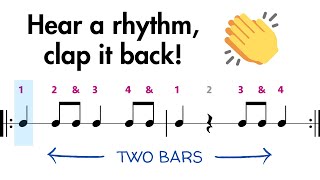
Rhythm Clap Along: Two-Bar Phrases - Level 1 to 3 (for Beginners/Kids) 👏
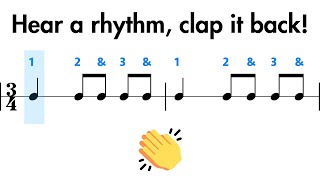
Rhythm Clap Along - 3/4 Time | Level 1 to 3 | For Beginners/Kids 🎵👏
Rhythm & The Beat (with 27 Clap-Along examples)
Pop Rhythm Clap Along - 3 Levels Of Rhythm Practice For Beginners and Students
Facts about rhythm and music education for kids
🥁 4/4 is the most common time signature — it's the steady 'one-two-three-four' pulse in lots of pop and dance songs.
👏 Clapping is a global form of body percussion: people use hand rhythms to keep time, cheer, and add musical patterns.
⏱️ Tempo is measured in beats per minute (BPM); clapping once per second equals 60 BPM.
🧠 Studies show practicing rhythms can improve timing, coordination, and even skills linked to language and reading.
🎵 Many people naturally prefer tempos around 100–120 BPM — similar to average walking speed and many pop hits.
How do I practice clapping steady rhythms to different songs with my child?
What materials do I need to practice clapping rhythms with my child?
What ages is clapping rhythm practice suitable for?
What are the benefits of practicing clapping rhythms with my child?
