Chop, dice, and mince
Practice chopping, dicing, and mincing vegetables to prepare a simple salad or salsa, using child-safe knives and adult supervision for safe kitchen practice.


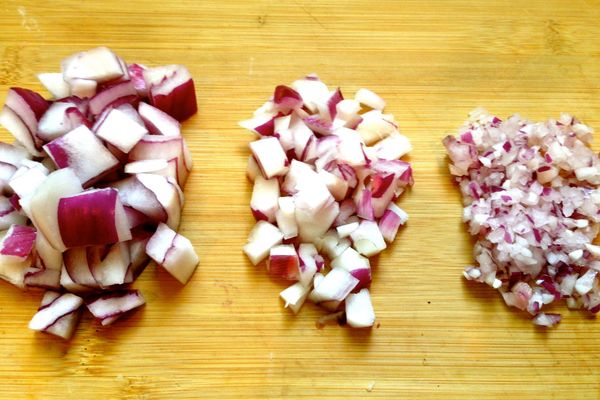

Step-by-step guide to chop, dice, and mince vegetables
Chop Vs. Dice Vs. Mince: What's the Difference?
Step 1
Wash your hands with soap and water for 20 seconds and dry them with the towel.
Step 2
Lay the towel flat on the table where you will work.
Step 3
Put the cutting board on top of the towel so it won’t slide.
Step 4
Set the plate for scraps and the small mixing bowl next to the cutting board.
Step 5
Rinse each vegetable under cool running water to clean them.
Step 6
Pat the vegetables dry with the towel.
Step 7
Pick up the child-safe knife and hold the handle with your dominant hand.
Step 8
Make a claw with your other hand by curling your fingertips inward.
Step 9
Use the claw hand to hold a vegetable steady on the cutting board.
Step 10
Slice the bell pepper into wide strips to practice chopping.
Step 11
Turn one strip and cut across it into small cubes to practice dicing.
Step 12
Peel the small onion or garlic clove to remove the skin.
Step 13
Mince the peeled onion or garlic by rocking the knife tip and chopping until the pieces are tiny.
Step 14
Put all chopped diced and minced pieces into the mixing bowl and stir gently with the spoon to combine.
Step 15
Share your finished salad or salsa on DIY.org.
Help!?
What can we use if we don't have the towel, child-safe knife, or small mixing bowl?
Use a damp non-slip placemat under the cutting board instead of the towel, a plastic or butter knife with close adult supervision in place of the child-safe knife for slicing the bell pepper and dicing strips, and a large cup or plate instead of the small mixing bowl to collect the chopped pieces.
My cutting board keeps sliding or my child can't hold the claw safely—how do we fix those problems?
If the cutting board slides, wet the towel or put a damp paper towel underneath for extra grip, and if making a claw is hard use a finger guard or have an adult steady the vegetable while the child practices holding the knife handle and slicing wide strips.
How can we change the steps to suit different ages?
For toddlers skip knife use and let them rinse, pat vegetables, and stir in the mixing bowl while an adult does the cutting, for preschool/early school-age let them practice holding a child-safe knife, making the claw, and slicing the bell pepper into strips, and for older kids add dicing, mincing the onion or garlic, and more independent stirring and plating.
What are simple ways to extend or personalize the salad or salsa before sharing it on DIY.org?
Let kids pick colorful vegetables, add chopped herbs or citrus for extra flavor, arrange diced colors into a pattern on the plate, taste-test seasonings, photograph the finished salad or salsa, and write a short note about the steps to post on DIY.org.
Watch videos on how to chop, dice, and mince vegetables
How to Slice, Dice and Mince Onions Like a Pro | Food Network
3 Videos
How to Slice, Dice and Mince Onions Like a Pro | Food Network
How to Peel, Slice, Dice and Chop Shallots - How to Mince Shallots - Ciseler Technique
Basic knife skills | Learning different cuts | Julienne | Batonnet | dice...
Facts about knife skills and kitchen safety for kids
🔪 A typical chef's (kitchen) knife is about 8–12 inches (20–30 cm) — an 8-inch knife is the classic all-purpose tool for chopping and dicing.
🥗 The word "salad" comes from the Latin sal, meaning salt, because ancient salads were often seasoned with salty dressings.
🌶 "Salsa" simply means "sauce" in Spanish; many beloved salsas are fresh, uncooked mixes of chopped tomatoes, onions, and peppers.
🧒 Child-safe knives (blunt tips or serrated safety blades) help kids learn cutting skills while reducing the risk of common kitchen injuries under supervision.
⏱️ Cutting vegetables into uniform pieces (dicing) helps them cook evenly and can make recipes finish faster by increasing surface area.
How do I teach my child to chop, dice, and mince vegetables safely to make a salad or salsa?
What materials and tools do I need for a child to practice chopping, dicing, and mincing vegetables?
What ages is chopping, dicing, and mincing vegetables suitable for?
What safety tips and fun variations can I use when teaching chopping, dicing, and mincing?
