Build a model of dna
Build a DNA model using colored pipe cleaners, beads, and paper labels to explore base pairing, the double helix, and molecular structure.


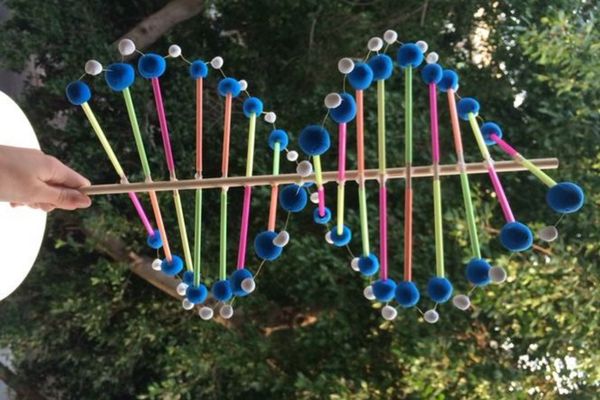
Step-by-step guide to build a model of DNA
DIY DNA Working Model | EASY Science Project | 3D DNA Structure
Step 1
Gather all your materials and clear a small workspace so you have room to build.
Step 2
Pick two different colored pipe cleaners to be the two DNA backbone strands.
Step 3
Cut both backbone pipe cleaners to the same length using scissors.
Step 4
Twist one end of the two backbone pipe cleaners together to join them at one end.
Step 5
Choose which bead colors will represent A T C and G so each base has a matching partner.
Step 6
Write the letters A T C and G on small paper labels using the marker and match each label to a bead color.
Step 7
Make several base-pair pieces by threading two beads of paired colors onto short pipe cleaner pieces and twisting the ends to hold the beads.
Step 8
Attach each base-pair piece between the two backbone strands by wrapping the short ends of the base piece around each backbone.
Step 9
Space the base pairs evenly along the backbone so they look like ladder rungs.
Step 10
Gently twist the two backbone strands along their length so the ladder turns into a spiral double helix.
Step 11
Count how many base pairs you attached to your model.
Step 12
Write that number on a paper label and stick it onto your model with tape or glue.
Step 13
Share a photo and a short description of your finished DNA model on DIY.org
Help!?
What can we use if pipe cleaners or small beads are hard to find?
If you can't find pipe cleaners, use two different-colored shoelaces or flexible craft wire for the backbones and substitute large pasta beads or punched colored paper circles for the small beads when making base-pair pieces.
My beads keep sliding off or the base pairs fall apart—how can I fix this?
After threading beads onto the short pipe cleaner pieces, fold each short end back over the bead and twist firmly or put a small drop of glue on the twist so the beads stay put and then wrap those twisted ends tightly around each backbone strand.
How can I adapt this DNA model activity for younger or older children?
For younger kids have an adult pre-cut pipe cleaners and pre-make base-pair pieces with larger beads and help with twisting, while older kids can increase the number of base pairs, calculate percentages of A/T versus C/G from their count, or make a longer helix per the 'count how many base pairs' step.
How can we extend or personalize the finished DNA model before sharing it on DIY.org?
Label each backbone and base with the paper labels you made, add a taped tag showing the counted base-pair number and a short typed description or a pattern that spells a name with bead colors, and decorate the model before photographing for DIY.org.
Watch videos on how to build a model of DNA
How to Make Easy DNA Model for School | Easy Styrofoam 3D Double Helix DIY Tutorial
4 Videos
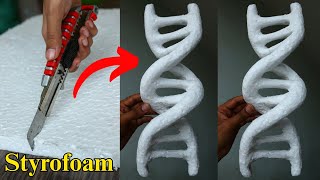
How to Make Easy DNA Model for School | Easy Styrofoam 3D Double Helix DIY Tutorial
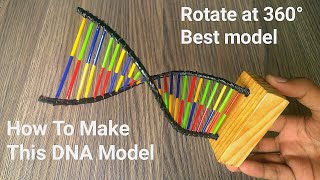
How to make DNA model very easy at home | 3d rotate DNA model ideas for science project DIY
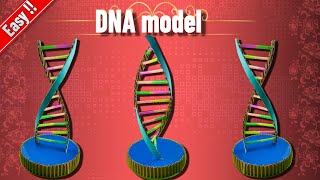
How to Craft a Stunning Cardboard DNA Model | Ultimate DIY Science Project Guide!
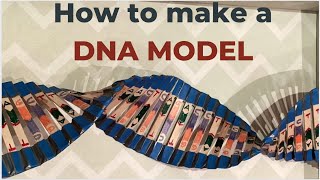
Easy! How to make a DNA Model from ice cream sticks (science project)
Facts about DNA and genetics
🧬 The human genome contains about 3 billion base pairs — that’s enough DNA to stretch about 2 meters if unraveled from a single cell!
🧪 DNA is built from just four bases (A, T, C, G) — like a four-letter code that makes every living thing unique.
🔗 Adenine (A) pairs with Thymine (T) using two hydrogen bonds, while Cytosine (C) pairs with Guanine (G) using three — that helps the helix stay stable!
📏 If you lined up all the DNA in your body, it would reach to the Sun and back over 300 times — tiny strands, HUGE reach!
🔬 The double helix shape was revealed in 1953 by Watson and Crick with crucial X-ray clues from Rosalind Franklin.
How do I build a DNA model using colored pipe cleaners, beads, and paper labels?
What materials do I need to build a pipe cleaner DNA model?
What ages is this DNA pipe cleaner model activity suitable for?
What are the benefits of building a DNA model and what safety tips should I follow?
