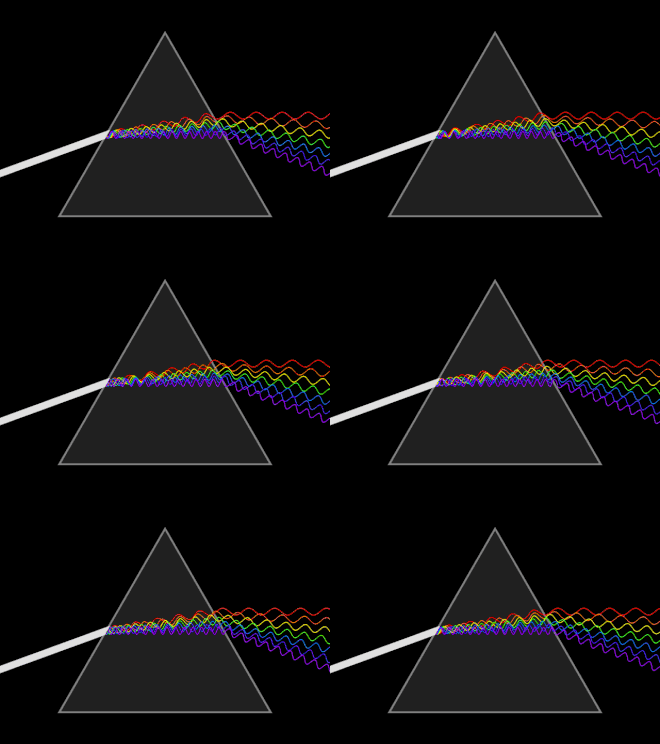
Wavelength is the distance over which a wave's shape repeats, represented by λ (lambda), and is fundamental to understanding the behavior of waves in various contexts.
Set reading age
View for Kids
Easy to read and understand
View for Students
Clear, detailed explanations
View for Scholars
Deep dives and big ideas
Wavelength is an important concept in physics that helps us understand waves😄. Imagine you’re at a beach watching the ocean waves. The distance between one wave crest (the top) and the next is the wavelength. Waves can be found in water, sound, light, and other places! 🏄♂️ Wavelength tells us how long the wave is. When scientists study waves, they often look for different wavelengths to learn more about them. Longer wavelengths can carry smaller energy, while shorter ones carry more energy⚡️. Tomorrow, when you’re playing outside, think about all the waves around you! 🌊🎵
Light behaves as both a wave and a particle. ☀️ Light waves have different wavelengths that create the colorful rainbow we see! 🌈Red light has longer wavelengths, while violet has much shorter ones. This is why red light doesn’t scatter much, making sunsets look red and yellow! Scientists use a tool called a spectrometer to measure these wavelengths and explore light's many colors and properties. Without understanding light wavelengths, we wouldn’t have technologies like cameras and color screens! 📷💻 So next time you see a rainbow, remember: it’s all about wavelengths! 🌈
Wavelength is measured in units called meters (m) or nanometers (nm)🏷️. One nanometer is one-billionth of a meter! For example, visible light has wavelengths between 400 and 700 nm. The blue light has a wavelength of about 475 nm, while red light is approximately 650 nm🔴💙. For sound waves, wavelengths can be much larger, sometimes in meters! So when you hear a low rumble from thunder, its wavelength might be several meters long! 🌩️ Knowing these units helps us understand various wave types!
Wavelength is the distance between two matching points on a wave, like from one crest to another🌟. It is usually represented by the Greek letter λ (lambda). For example, if you could measure the distance from the top of one wave in the ocean to the top of another, you would find the wavelength! In some ways, wavelength helps define different types of waves. Longer wavelengths mean the waves are more spread out, while shorter wavelengths are closer together. This concept shows how waves can look and behave differently! 🌈
Wavelength has many exciting applications! 🎉In telecommunications, different wavelengths are used for transmitting data, like on the internet or during phone calls📞. For example, different radio stations broadcast at different wavelengths to avoid interference. In medicine, wavelengths are used in imaging techniques like X-rays and MRIs to create pictures of our insides📸. Artists even use wavelengths of light to create beautiful colors in their paintings! Each application shows how important understanding wavelength is for technology, health, and art! 🎨
Sound waves travel through the air and have wavelengths too! 🎶When you speak or play music, those sounds are made up of waves. Low-pitched sounds, like a drum, have longer wavelengths, while high-pitched sounds, like a whistle, have shorter wavelengths. This is why you might hear a deep bass from a distance, but a whistle sounds sharper! If you’ve ever wondered why some sounds travel further than others, it’s because of their wavelengths! 🌪️ Musicians and sound engineers always consider wavelengths when creating and mixing music! 🎤🎵
Mathematically, wavelength (λ) can be represented with a simple formula: λ = v/f. 🎉Here, "v" stands for the wave's speed, and "f" is the frequency, or how many wave crests pass by in one second🐢. The higher the frequency, the shorter the wavelength! For example, if a sound wave travels at 340 m/s and has a frequency of 170 Hz, you can calculate its wavelength by substituting values into the formula. Knowing how to use this equation helps scientists predict wave behaviors and study their properties 📈!
Wavelength and frequency are closely linked like best friends👫! The frequency tells us how many waves pass a point in a second. When wavelength is long, the frequency is low, meaning fewer waves pass by💨. In contrast, a short wavelength has a high frequency, resulting in many waves passing through in one second! This relationship is crucial in many areas, such as music. The higher the frequency, the higher the note sounds, like a tiny bell ringing🔔. Understanding this relationship helps us learn why different sounds and colors exist in our world! 🌍
Wavelength appears in various contexts, like water waves, sound, and light! 🌌📯 Ocean waves might have longer wavelengths, while sound waves we hear have medium wavelengths, and light waves have the shortest wavelengths. These differences affect how we experience them. For instance, the sound of a bass guitar has longer wavelengths that feel deep and heavy, while a whistle has shorter wavelengths that sound high and sharp! 🎸🎼 Each type of wave has its unique features based on its wavelength, which is essential for how we perceive the world!
You can try fun experiments to see wavelength in action! 🌟One way is to create waves in water. Fill a shallow tray with water and gently tap one end. Watch the waves travel across the water. Measure the distance between the crests to find the wavelength! 🌊You can also use a guitar or a piano to explore sound waves. Plucking a string creates soundwaves with different wavelengths. The tuning of the string affects the sound, so changing the string length lets you hear different pitches! 🎸🔊 Explore and have fun with this hands-on learning! 🧪
The study of wavelength goes way back in time! 🌍In the 18th century, famous scientist Thomas Young conducted experiments showing how light behaves like a wave. He discovered the principle of interference, which helped explain wavelengths of light! 🔍Later, scientists like James Clerk Maxwell used formulas❗️ to describe how light travels through space. In the 20th century, quantum physics introduced new ideas about waves and particles. These discoveries have shaped our understanding of the universe and opened doors for amazing technologies we use today! 🚀


DIY is a creative community where kids draw, build, explore ideas, and share.
No credit card required